
Embracing Paradox

I’ve been appreciating Brené Brown’s newest book (Strong Ground). She names some of the paradoxes that wise and courageous leaders learn to embrace.

I immediately resonated with the chapter on the importance of “negative capability.” It’s a concept she found in a letter from the poet John Keats (1795-1821). Keats praises this capacity that he perceives in great men like Shakespeare – “when a man is capable of being in uncertainties, mysteries, doubts, without any irritable reaching after fact and reason.”

There are moments when abiding in love and truth is particularly painful. These are the moments of the in-between, when we have only partial insights or unsatisfactory options. We feel the pressure to make something happen and get away from the tension as soon as possible. It becomes almost unbearable to abide and wait for fuller truth and goodness and beauty to emerge.

To be human in a fallen world is to live in this tension. We are stretched by two seemingly incompatible truths. On one side is the harsh reality of impermanence. As much as we attempt to deny it, our earthly existence is fleeting. Nothing gold can stay. On the other side is the nonstop human tendency for meaning-making. We insatiably interpret what is happening and why – a task that our brains engage both consciously and unconsciously, even while we sleep! We don’t like waiting to receive the fuller truth. We both desire and need to belong securely and trustingly to something solid.

To put the paradox differently, our human hearts were not created for endings, and everything good in this world comes to an end. What can we do?

As Brené Brown puts it, “Negative capability is a difficult muscle to build.  We’re wired to resolve tension and seek certainty.  This capability requires the ability to reach inward toward stillness rather than out toward counterfeit facts and reason.”

“Be still, and know that I am God” (Psalm 46:10).

Even in turning to God, we are likely – in our urge to escape the pain of this paradox – to engage in yet another form of irritable grasping or controlling in the face of eternal mysteries that are never for sale, and will repel any attempts as seizing or sieging.

I’ve been reading the comments of a few thousand participants in the listening sessions I facilitated for my diocese this fall. You can feel attempts at grasping among many of our longtime parishioners who (in a world where everything has changed so much and so rapidly) expect their parish church to be the one place where nothing changes – only it already has, many times over. You can feel the grasping in the comments of hundreds of others who expect everyone else to adopt their political or liturgical ideology. If only we all thought this way, or all did things this way, our pain and suffering would go away. They forget the flaming sword that will not permit us to return to Eden (Genesis 3:24).

I empathize with their fear and restlessness because I know those movements in my own heart! I have my own versions of grasping or striving or hiding when the tension feels unbearable.

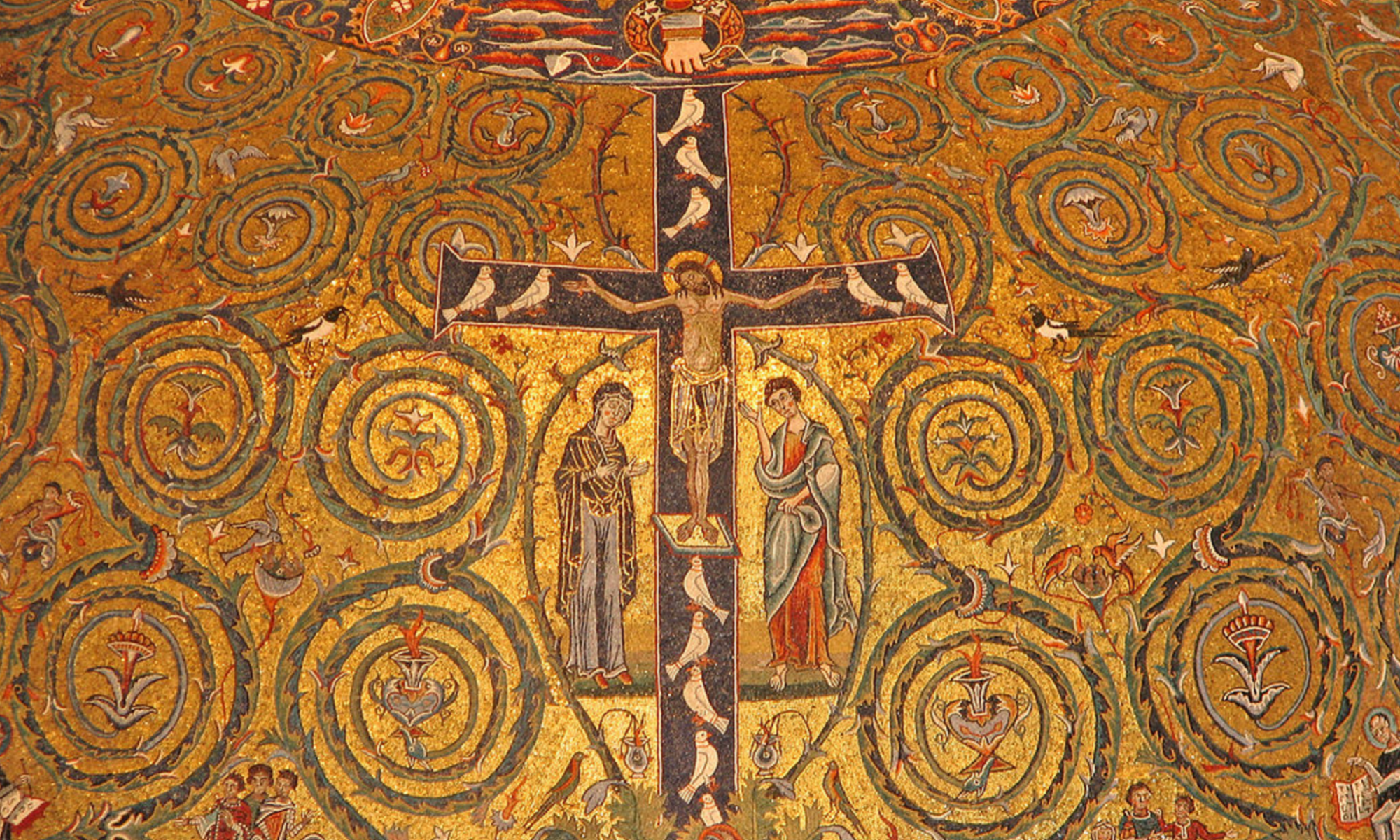
The real invitation is go deeper into the paradox without trying to escape it, nor to escape the tension found therein. This is exactly what Jesus and Mary do on Good Friday and Holy Saturday.

Jesus, true God and true man, does not erase or eliminate the dreadful consequences of our human freedom. Rather, he brings eternal love into the depths of our humanity, loves us to the end, and invites us back into relationship – with his Father and with each other.

His mother Mary does not do what so many churchgoers do when feeling the powerlessness of this paradox. She offers no fixing, no advice, no comparisons with others who have it worse, no backing away from his Cross. She stands with and witnesses.

Her with-ness and witness continue on Holy Saturday, a day of Sabbath – a day of stillness and rest. “Be still, and know that I am God” – these words sound so pleasant and peaceful in other settings. Not so much on a day of Sabbath rest in which your Son is buried in the tomb, and you are utterly powerless. Even then, rather than grasping or escaping, Mary embraces the promises of Jesus and waits in Hope amidst the paradox, not knowing how he will fulfill these promises until it actually happens.

Even after the Resurrection and Ascension, when so many questions remain unanswered, when the disciples are still downcast and doubtful, she abides with them and prays with them for nine days (Acts 1:10-14). They learn from her the capacity for passion and compassion that she exhibited so beautifully at each earlier moment of her discipleship, a capacity which grew and deepened as each mystery unfolded.

Yes, prayer and liturgy and Church are all part of our human response to this painful paradox – not so much being the answer itself, but the context in which The Answer can be encountered, again and again, stretching our capacity to receive – which also means stretching our capacity to suffer! The suffering of the Saints does not diminish as they grow closer to God. The greater their longing, the greater the gap feels between them and the living God. The greater their willingness to stay connected to others, the greater their capacity to suffer with. Show me even a few such saints, and I’ll show you a church community that is thriving on mission!

I find Brené Brown’s words both comforting and emboldening: “Resist the urge to reach for certainty where it does not exist. The longer we can hold that paradox, the greater our capacity to see and honor one another in our fullness AND in our contradictions.”

Faith and Christian community are essential, not as an escape from the tension of this world, but as a shared receptivity of the eternal, and of the mystery of each human person. It is in abiding relationship and receptivity that we can glimpse and taste the goodness of the Kingdom of God, and can persevere in our sojourning until this world definitively passes away, when Jesus comes again with full righteousness, wiping every tear away and abolishing death forever.

A Mood Change

What is life like when we change our mood from “imperative” or “subjunctive” and learn to live in the indicative?

If that question makes no sense to you, don’t worry – I’ll explain along the way.

I love language. I love learning new languages. I love the experience of connection with someone else’s insights, beautifully expressed – all the more so when the words bridge a gap of time and culture. In another life, I could have been a philologist, like Tolkien or Lewis.

I even love grammar. I’m grateful to my high school teachers, who placed such great emphasis upon it. It served me well later in life when I was wrestling with Latin or Greek or German. With my own writing, being grounded in grammar is not unlike the months of training that Daniel underwent with Mr. Miyagi in Karate Kid. Good grammar doesn’t make good writing, but it lays a sturdy foundation, without which creative expression will stagger and stumble.

During my many years of study, I had nine semesters of Latin and five of Greek. I answered hundreds of questions about declension and case, gender and number, tense and mood. My Latin Composition class in 1998 was at times a torture. Dr. Petruccione relentlessly and manically drove us through Bradley’s Arnold, always sporting a bowtie. Twice every week, we submitted our elaborate sentences, translated from English into Latin. If you missed one time, you dropped a letter grade. If you missed a single class, you dropped a letter grade. Late every Friday afternoon, I would wistfully watch my friends go to goof off, while I plodded off to class. The professor could tell that my mind was wandering, but could never catch me!

“And what mood is that, Mister Sakowski?” At the sound of my name, my distracted brain jolted to attention, frantically poring over the last 10 seconds. Somehow, I always come up with the answer. “Subjunctive!” He screwed up his face with a look of “I’ll get you next time!!” But he never did. What can I say? My body pays attention even when it’s not paying attention. I guess hypervigilance has its advantages.

What kind of overachieving college student enrolls in a challenging elective class on late Friday afternoons? The same kind, I suppose, as the high school student who spends four weeks of her high school summer vacation learning Latin, along with seven of her peers. In 1999 and 2000, home for the summer, I taught Latin upon the request of students at my alma mater. We had a blast.

Most of the students were highly competitive overachievers, but one struggled significantly. Honestly, he only passed because I found creative ways to give him points on his tests. It wasn’t hard, because he made up for his lack of Latin prowess with a wicked sense of humor. One section asked them to parse different words. I had to give him bonus points as I howled at his answers:

  Person?  Magister   [“Teacher” – the name the students called me]

  Tense? Very

  Voice? Sometimes mumbles

  Mood? Depends on the day…

As some of you know, verbs can have different “moods” – indicative, imperative, subjunctive, etc. The indicative mood describes or asks about matters of truth (what actually is, was, or will be the case). The imperative mood gives commands. The subjunctive mood expresses the “woulds” and “coulds” and “shoulds.”

When it comes to discipleship and morality, moods also matter! I’ve come to appreciate living in the indicative mood, rather than the imperative or the subjunctive. Eagerly pursuing the good is much more possible when we can tell the truth with kindness, when we can name particularly what actually is without judging it or pressuring it to be a different way. I wrote recently about this calm noticing and accepting of what is as a prerequisite for virtue.

I remember my early years as a pastor. I was overwhelmed and putting all kinds of pressure on myself. I had just returned from Rome, where I had been researching and learning in seven different languages in the writing of my doctoral thesis. Now I was shared as a pastor of two previously separate parishes, and ministering to the Latino community in the region. I had 5-6 Masses each weekend and felt impossibly pulled in three directions. I lived daily with a fear of failure and a felt trapped in powerlessness. No matter how many “shoulds” I checked of my list, it was never good enough – not for many of the people I was trying to serve and not for my harsh inner critic.

Those first several years, I wrote out my Spanish homilies. One memory that is clearer amidst the blur is my struggle to find effective ways in Spanish to translate “should.” That should say something about the content of my preaching at the time – both to others and to myself!

It was only a matter of time before present pressures and past unhealed wounds converged in an unbearable torrent. When I finally reached out for help, I found myself swept away on a journey of transformation that continues nine years later.

I definitely experienced a “mood change” along the way. I’ve been learning and re-learning the joy of living and relating in the indicative mood – accepting what is and engaging it with curiosity and kindness. Then deciding what to do.

Advice is overrated. It is exceedingly rare for me to tell people what to do. I’ve learned to be with, to notice, to point things out, or to pursue by asking curious questions – all in the indicative mood. When I show up that way, the others can tell that there is no judgment, no pressuring them to be a different way than they are now. They feel my genuine curiosity, wanting to get to know them, and delighting in them as they are now.

To those driven by moral imperatives or living in a “should” fortress, this approach seems madness. In their view, you have to get people to do the right thing, or you’re not being a good Christian. Can you feel the fear there?

How  can we discern what is truly good if we don’t slow down, be with, and perceive what truly is? And how can we see what truly is when shame and fear are in the driver’s seat? They literally and figuratively narrow our field of vision.

I’ve learned to pay attention to what shame is up to. Where there’s contempt, there’s shame. When I notice self-contempt or other-contempt coming up, I get curious. I acknowledge the shame (if I don’t, the shame will power up even more!). But I ask if it’s ok to look at what actually is, setting aside judgment for the moment. Can I just be with you in what’s coming up now?

One would think that all the shaming and pressuring to do what you “should” would be a place of greater truth-telling, but it actually isn’t. When shame is talking, we utter strong-sounding and vague statements like “totally messed up” or “wacko” or “off the rails.” We speak in language of always or never, all or nothing, good guys and bad guys, us versus them. If we calm down and slow down, we can look more honestly at what is really happening – often surprised in the discoveries we make! Pretending like certain emotions aren’t there (or wishing they weren’t there) is not truth telling. Pretending like we can live reaction-less lives is not truth-telling. It’s dehumanizing.

Calming down and slowing down, wondering about what really is (even if it seems unglamourous or “bad”), also allows room for desire to breathe and grow.

Desire can take us places that shame never will. Some of you have seen Monsters, Inc. – the Pixar film about monsters fueling their power plant by capturing the fear of children. Then they make a revolutionary discovery – that laughter is far more powerful than fear. Similarly, desire for goodness is far more powerful than any amount of fear-mongering or “shoulding.” When Christians feel threatened, it seems like only fear and shame will get results. It is much messier to get down in the dirt and look up at what’s really going on. But that’s exactly what humility does.

When we humbly, calmly, curiously, kindly, and truthfully look at what is, we begin to see a much more truthful narrative. We start to see the ways in which deeper desire has been shamed, silenced, belittled, dismissed, or hemmed in. I find that shame is the loudest when desire feels vulnerable and exposed. Rather than allow desire (yet again) to be abandoned, betrayed, dismissed, or disappointed, shame will take over the controls. Setting down shame feels risky! But only then can desire be untethered to seek and find the good, and in finding it to desire it all the more.

What mood are you in today? Do you put pressure on yourself to be a certain way. Is your life one of “I should…” / “I just have to…”/ “I really need to…”? What would it cost you to dial down that pressure for a while, to be with a safe person, and to look at what is? You just might discover your deeper desires, and how your good Father is inviting you to soar.