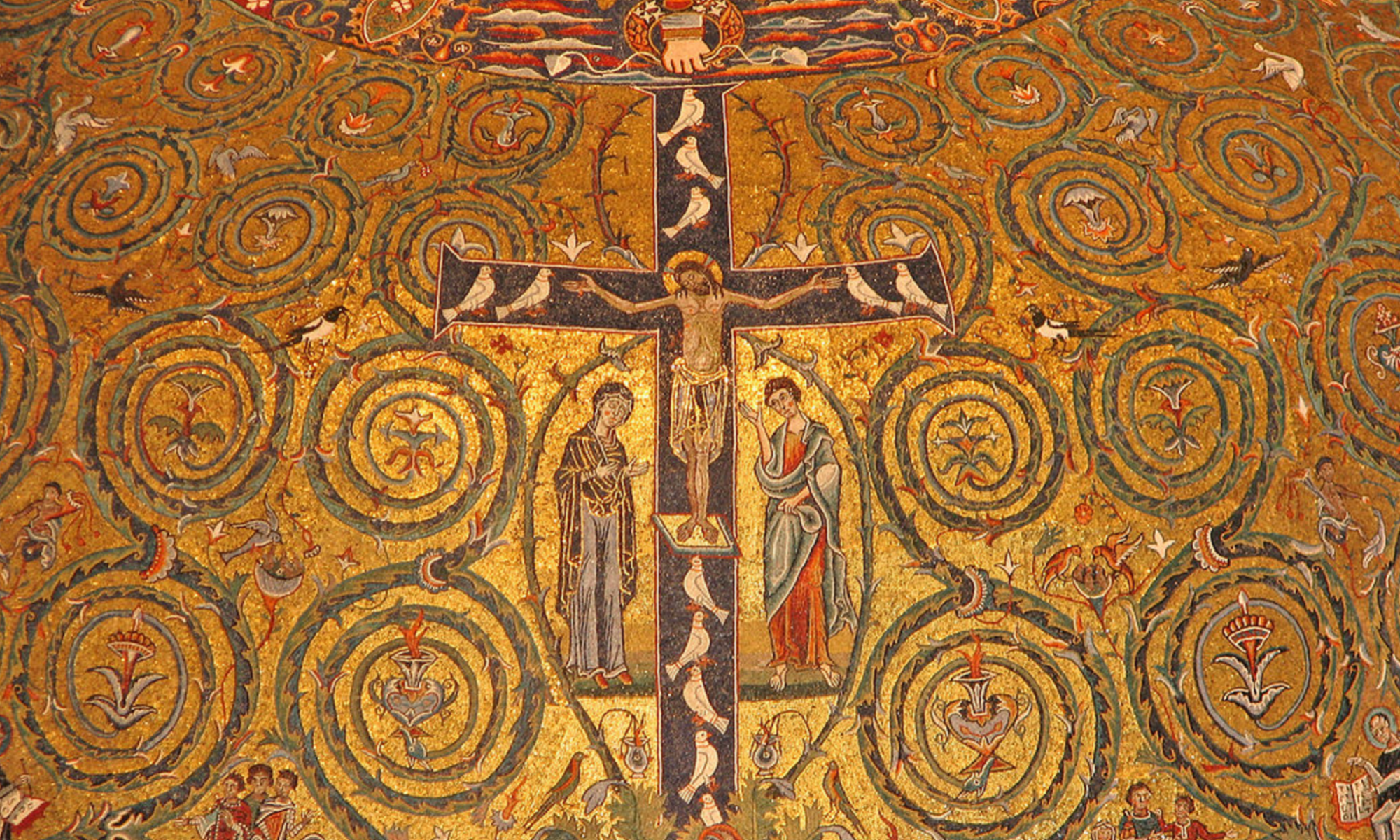
Behold Your Mother!

As Jesus died on the Cross, he uttered his final words. In any great story, the last words of the hero are loaded with significance. The dying and rising of Jesus is the greatest story ever told.

On the Cross, Jesus speaks to his mother Mary and to his beloved disciple (John 19:25-29). He tells her, “Behold your son!” He tells him, “Behold your mother!”

Why does Jesus make a point of introducing this relationship? Why does John, inspired by the Holy Spirit, make a point of recording it for all posterity to read?

Jesus is not a procrastinator who suddenly realizes he has not made arrangements for his mother. He is not worried about who will take care of her. He is inviting you and me into a relationship with his mother. He is introducing her as a mother that we all need!

Each one of us is a beloved disciple of Jesus. Each one of us is invited into the new and eternal covenant, sealed with his blood on the Cross. And each one of us needs a heavenly mother.

At the Last Supper, two chapters earlier (John 17), Jesus prays his priestly prayer to his Father. He delights in the intimate relationship he has with his Father. He prays for the disciples he has chosen. He also prays for you and me –for those who one day will believe and become his beloved disciples (John 17:20). He desires and prays that all that is his will be ours. That includes his intimate relationship with his Father. It also includes having his mother as our mother.

This weekend we celebrate another Mother’s Day. As we show honor and delight to our earthly mothers, or give thanks in their memory, we can also ponder Jesus’ invitation from the Cross. He offers us Mary as an icon of motherhood, but also as a real human being (now sharing in his glory in heaven) who is capable of being intimately present as a heavenly mother to each and all of us in the ways we most need.

As children, we all needed tender nurturing, fierce protection, and wise guidance. These needs are hardwired into us in the biological bond between mother and child.

Those needs may shift in adulthood, but they do not go away. In fact, for the last couple of centuries, it is mothers themselves who have been most deprived of those needs! The very genesis of the Mother’s Day holiday is a feeble acknowledgement that we live in a culture that devalues and degrades women while expecting the impossible of them.

Most mothers that I know feel like they are failing most of the time. They continue to struggle with their own ache for nurture, protection, and mentoring, and are somehow supposed to provide those things to each child – AND be a strong and capable worker, AND have the right body shape and allure, AND engage in prayer and self-care, AND…   You get the point. Holding a commercialized holiday in mid-May does not dispense us from the duty of conducting a thorough inspection of the toxic waters we expect mothers to swim in.

Some think it has always been so. I do not agree. Yes, throughout history, women are subject to exploitation by men seeking privilege and power. But it shows up differently in different times and places. What many consider to be “traditional” gender roles are much more modern than they realize! The burden placed upon women in the West in the modern industrial era is uniquely ugly.

If you study the Saints of the Middle Ages, you will find many tender-hearted men and many fierce women. Literacy was not widespread anywhere prior to the printing press, but there were many literate women who became strong leaders. One of the unintended side effects of the Protestant splintering was the abolition of religious life. No more alternative paths for women. Be a wife and mother.

A second major shift happened with the Industrial Revolution. The division into specialized labor led to massive migration, pulled extended families apart, and pushed men who used to work at home or close to home into factories. The nuclear family replaced extended families as the norm, and women were left alone at home – except at wartime, when they were also supposed to provide the needed labor in the workforce. In all these shifts, women were largely abandoned in their God-given task of mothering – without tribe or village supporting them. It is impossible to mother alone! That conviction seems to be what fueled Anna Marie Jarvis in the original observance of this holiday.

Both the culture and our churches tend to perpetuate false and impossible expectations on women. The “perfect family” idealized over the decades in ads or TV shows or church culture does not actually exist! Some glamorize the “good old days” of the mid-20th Century – ignoring the ugly realities of domestic violence, sexual abuse, and objectification. Meanwhile, the ideal woman is supposed to check an impossible list of boxes regarding appearance and performance, while still finding a way to nurture, protect, and guide her kids.

How can mothers give what they have not themselves received? And how do our institutions and structures back up mothers to ensure they can thrive during the critical years of mothering? For multiple generations now, motherhood has been in survival mode. That cycle means that even the best of mothering experiences will leave the children aching for more when they enter adulthood.

The Catechism of the Catholic Church (n. 2779) warns us that our notions of fatherhood and motherhood are often wordly, distorted, and toxic. They need to be purified by looking to how Jesus has revealed God’s Fatherhood (and Mary’s motherhood) to us. We have much to reflect on!

In the meantime, each of us needs Mary’s mothering. Each of us has an ongoing ache for the tender nurture and fierce protection that she can provide. Each of us can turn to her as the wisest of mothers.

To be continued…

Emmaus and the Eucharist

Of all the resurrection stories, perhaps my favorite is the Road to Emmaus (Luke 24:13-35). Two downcast disciples are wandering away from Jerusalem, away from all their hope, when Jesus walks up and joins them. He playfully pretends not to know what is going on. He wants them to acknowledge their loss so that his Holy Spirit can enter their hearts and rekindle their hope. He breaks open the Scriptures for them, helping them to make sense of the Messiah’s story and their own story. Their hearts expand in a yearning to stay connected with him. He breaks bread with them, at which point they recognize his presence. They hasten to Jerusalem and become witnesses of the resurrection.

But there is more. Luke wrote his Gospel for the sake of early Christian communities who were already gathering Sunday after Sunday to listen to the Scriptures and to “do this in memory of me” by celebrating the Eucharist (Luke 22:19). It is not merely a story about a one-time appearance of Jesus to some guy named Cleopas and some other unnamed guy. It is a story about how every Sunday Eucharist is a life-transforming encounter with the risen Jesus. That which happened to those two disciples on a Sunday is intended for each of us.

Our Sunday worship bears a twofold structure: Liturgy of the Word and Liturgy of the Eucharist. We listen receptively to the Scriptures and ponder how they connect with our present-day life. We allow our hearts to be set ablaze as we realize how Jesus’ story gives meaning and purpose to our own story. Then we get fed with his very flesh and blood following a ritual reenactment of the once-for-all offering of Jesus. We remember those saving events in a way that allows us to participate in them here and now.

Bishop Robert Barron, in his insightful and inspiring fashion, has drawn many other connections. We begin each Mass by calling on the Lord for mercy: kyrie eleison. Like Cleopas and his friend, we are downcast. Many of the early Church fathers described the fallen human condition as incurvatus. Like the crippled woman in Luke 13, we are bowed down. We are wounded by sin – by the way others’ sins have harmed us and by our own sins. We remain God’s beloved children, inherently good. But we are bent, weighed down, and turned in on ourselves. Without divine mercy, we are like a younger Peter, fluctuating between an “I’ve got this!” grandiosity and an “I’m so horrible!” discouragement.

So, we begin the Mass by acknowledging our sins and inviting the mercy God freely offers us in Christ. We trust that his victory allows us to stand upright – not through our own merits but by his free gift.

Then we listen to the Scriptures and allow them to be broken open for us. In every Sunday Mass, there is a connection between the First Reading and the Gospel. The Catechism of the Catholic Church cites an adage from the early Church: “The New Testament lies hidden in the Old, and the Old Testament is unveiled in the New” (n. 129). There is also a connection between the stories of Scripture and our own personal story – some of which we know with clarity and some of which is a mystery to us. Without the story of Jesus, our own story will remain fragmented and disorienting.

Those of us who are ordained ministers are commissioned by God to proclaim the Gospel with authority. That does not mean that every homily we preach will be brilliant and breathtaking. It does not even mean that we will preach the truth. It does mean that we are called to stand in as Christ, allowing him to speak in and through us. I think every priest or deacon has had the experience of what we thought to be a rather flat performance becoming the divinely chosen moment for one person’s heart to be permanently changed.

The first half of Mass centers around the ambo – the podium at which the Word is proclaimed. We then shift to the altar, which is also a banquet table. All of Scripture and all of the Mass revolve around the paschal mystery of Jesus. “Paschal” is another word for “Passover.” Jesus shows the disciples at Emmaus how the Passover events in Egypt were a prefiguration of his once-for-all Passover offering – which begins at sundown on Holy Thursday. Jesus freely offers himself as the Paschal Lamb – feeding his disciples at table, praying prostrate in the Garden of Gethsemane, suffering and dying on the Cross, proclaiming the Gospel in the realm of the dead, rising in glory, and now robed in human flesh as our great high priest, interceding for us at the right hand of the Father. He is both the priest who offers and the victim who is offered. The Mass participates in that one eternal sacrifice. But why? So that we can all join together with him at the banquet table, celebrating his nuptial union with his bride. Every Mass is a taste and glimpse of the wedding feast of heaven. The Eucharist, Christ’s own risen flesh and blood, is both our food for the journey and our medicine. It nourishes, heals, and strengthens us.

Mass ends by sending us forth. “Mass” comes from missa (“sent”). Like the disciples on the road to Emmaus, we can go forth truly changed – having passed over from old to new, no longer downcast but erect, eager to live as witnesses of Jesus’ story that has given so much meaning to our own story. Renewed and sustained by this steady gift, we now have the capacity to live in a way that attracts others to be curious about Jesus.

Until Jesus comes again, the Eucharist is the beating heart of the Church. We fulfill Jesus’ command to “keep on doing this in memory of me.” We remember where we have come from and where we are going. We become again and gain what we one day will be.

Self-Denial vs. Deprivation

“It is just as much a sin to deprive the body without discernment of what it really needs as it is to indulge in gluttony.”

These were wise words of Francis of Assisi to his band of brothers in the 1220’s. This is the Francis of Assisi who embraced radical poverty, including fasting and prayer vigils that most today would consider austere. He often meditated on the sufferings of Christ, and desired to be one with Jesus on the Cross. But Francis was known above all else for his radiant joy – a heart bursting with praise and gratitude. He surrounded himself with beauty and delight, but never grasped at it. He freely gave it all back to God.

The daily invitation of Jesus was imprinted in Francis’ heart: to deny ourselves, take up our cross each day, and follow him (Luke 9:23). How, then, can we make sense of his caution about not depriving ourselves of what we really need?

Francis of Assisi, with his marvelous grasp of the human heart, understood intuitively what contemporary research proves consistently: there is a connection between unmet human needs and unwanted behavior. Whenever we human beings are chronically deprived of play, rest, connection, community, understanding, safety, nurture, or meaningful purpose in life, it is only a matter of time before we start acting out with entitled behaviors.

Deprivation feeds entitlement. Entitlement then seizes. Our grasping attitude may not be that far from that of Sméogol in Lord of the Rings: “We wants it, we needs it! Must have the precious! They stole it from us!” If you are not a Tolkien fan, then I imagine you can resonate with the words of the apostle Paul, “The good I desire I do not do, but I do the evil I do not want” (Romans 7:19).

The immediate instinct in these cases is to assume that it is a problem of laziness or lack of discipline – often with no small amount of self-contempt and shame. We then punish ourselves by deprivation, telling ourselves we are doing penance and following Jesus. But in many cases, these penances embraced without discernment also begin to cut us off from what we truly need – from the things our hearts (and limbic brains) were looking for in the first place.

As a priest, I’ve worked with hundreds of people over the years who struggle repeatedly with the same patterns of behavior. Any time I have curiously explored, I have always found a significant deprivation of one or more authentic needs. Deprivation is not the primary reason why people get stuck in unwanted behaviors, but it is almost always there as a driving force!

I’ve learned much from contemporary Christian authors like Mark Laaser or Jay Stringer. Mark (now deceased) helped thousands to find freedom from their addiction to pornography or worse, not to mention helping to restore many marriages. Jay conducted research with 3,800 men and women struggling with unwanted sexual behaviors. His book (entitled Unwanted) explores the causes and contributing factors that need to be addressed if a struggling individual desires to live differently. Both make a convincing case for the importance of paying attention to our human needs, whatever our unwanted behaviors might be. Mark and his wife Debbie (in the book Seven Desires) describe how every human needs to be heard and understood, affirmed, blessed, safe, touched in a meaningful way, chosen, and included. Jay discusses the importance of delight, rest, play, creativity, meaning, and purpose. If we have a serious lack in any of these areas, we are likely to find ourselves unfree in our decision making.

Today’s authors give more precise language to these needs, they are by no means the first to notice them! I think of the Rule of Saint Benedict (he lived from 480-547). Most of us today would find their monastic lifestyle quite penitential. But it is moderate compared with the desert monks that Benedict had learned from. His Rule seeks balance and adaptability. He frequently acknowledges the importance of a wise abbot offering accommodations to monks regarding their prayer or eating or sleep, based on what is truly best for them and the community.

And then there is the quotation from Francis. Here is the fuller story from his companion and biographer, Thomas of Celano:

“One night while all were sleeping, one of his followers cried out, ‘Brothers! I’m dying! I’m dying of hunger!’ At once [Francis] got up and hurried to treat the sick lamb with the right medicine. He ordered them to set the table … Francis started eating first. Then he invited the brothers to do the same, for charity’s sake, so their brother would not be embarrassed.”

Francis concludes with the important lesson: it is just as much a sin to deprive the body without discernment of what it really needs as it is to indulge in gluttony. And then he reminds them of the supreme rule of charity (Christ-like love of God and neighbor). Our freedom in receiving and giving love is the ultimate test in discerning the wisdom of any self-denial.

Finally, let us not forget the example of Jesus himself. His human needs mattered. As a human being, he definitely received understanding, safety, nurture, delight, care, connection, rest, and play – not all the time or from everyone, but in ways that left a lasting impact. Throughout his childhood, he received from Mary and Joseph, not to mention his heavenly Father. He spent less than 10% of his life giving in public ministry – and even then he received care from friends like Lazarus or Mary or Martha. Even in Holy Week, Jesus rested in Bethany with those friends – receiving hospitality and love. Even in the Garden of Gethsemane, as he entered his Passion, Jesus reached out to his other friends (Peter, James, and John), asking them for connection and care.

Sometimes we don’t get what we need. Sometimes God even asks us to sacrifice things that we truly need – but usually he doesn’t. Over time, as deprivation of authentic human needs intensifies, our freedom tends to diminish, and with it our ability to receive and give freely in love. Our “sacrifice” will become joyless; our resentment will increase – and with it a Gollum-like grasping of entitled behaviors.

Discernment is the key. Jesus tells us to test a tree by its fruits. If self-denial is leading to growth in freedom, growth in faith, growth in hope, and growth in love, then we know it is being led by the Holy Spirit.

Yes, our greatest calling is to make a total gift of self and become the grain of wheat that dies so as to bear abundant fruit. That self-gift is only possible if (like Jesus) we humbly allow ourselves to receive, again and again, all that we need. Francis of Assisi and many other Saints understood. Their humble acknowledgement of their depth of human need allowed them to receive. Their receptivity opened them to the amazing joy of self-gift. May we learn from their example!

A Horn of Salvation

He has raised up for us a horn of salvation, in the house of his servant David (Luke 1:69).

These are the words proclaimed by Zechariah, the father of John the Baptist, after nine long months of silence. Nine months to ponder the promises of God given through the angel Gabriel.

At the very moment of proclaiming that his newborn son will be named “John,” Zechariah was flooded with the Holy Spirit and burst into praise – in words that many of us proclaim each morning in the Liturgy of the Hours. Unfortunately, our English version loses something in translation, saying “He has raised up for us a mighty savior…”

By contrast, the original text speaks of a “horn of salvation.”  Why?

If the name John (“God is gracious”) was significant and willed by God, so much more the holy name of Jesus, at which every creature must bow – those in heaven, those on earth, and even those in the infernal regions (Philippians 2:10-11).

The name “Jesus” in Hebrew is Yeshua – the very same name as “Joshua” in the Old Testament. The name means “savior.” Joshua was a figure of salvation – giving us a foretaste of Jesus, the true savior of the world.

Joshua led the Israelites in the battle of Jericho (see Joshua 5 and 6). But more truthfully, it was God himself, through his mighty messenger, who won the battle. As Joshua approaches Jericho, he sees a fierce warrior, drawn sword in hand, and asks him, “Are you one of us, or one of our enemies?” And the warrior replies, “Neither. I am the commander of the army of the Lord: now I have come” (Joshua 5:13-14).

We could debate whether this messenger was Michael the Archangel, or the Word of God himself (not yet in the flesh, not yet named “Jesus”). Either way, the instructions come directly from the Lord: Joshua and his soldiers are to circle the city for six consecutive days. Then on the seventh day they are to circle the city seven times. Seven priests are then to blow their seven horns, followed by a jubilant shout.

In light of that story, the seventeenth-century theologian Jacques-Bénigne Bossuet interpreted Zechariah’s choice of words: “The word horn is one of magnificence and terror that in Scripture signified at once glory and an incomparable power for defeating our enemies.”

But who are these enemies from which we need to be delivered? Bossuet reminds us, “They are, in the first place, the invisible enemies who hold us captive by our sins.”

The apostle Paul says the same: “Our struggle is not with flesh and blood but with the principalities, with the powers, with the world rulers of this present darkness, with the evil spirits in the heavens” (Ephesians 6:12).

What important reminders for us today! If we spend mere minutes on social media, we will encounter animosity and enmity – one group of humans pitted against another group of humans, their accusations dripping with contempt. The devil is a master strategist, and “divide and conquer” is one of his choice strategies!

But – you might object – some human beings are perpetrating atrocities against other human beings, or threatening to force us to change our beliefs, or else. Doesn’t that make them “enemies”?

Yes and no. Human beings are only ever “enemies” in a secondary sense. They are, first and foremost, created in God’s image and likeness. He wills their and our salvation (1 Timothy 2:4). Jesus commands us, “Love your enemies and pray for those who persecute you” (Matthew 5:44). Paul gets even more specific: “If your enemy is hungry, feed him; if he is thirsty, give him something to drink; for by so doing you will heap burning coals upon his head. Overcome evil by doing good” (Romans 12:19-20).

This is not a command to become objects for others to use or oppress. Rather, it is a command to be on fire with the love of Jesus and to trust God the Father. Jesus was never a powerless victim to others’ manipulations and schemes; yet he truly loved his enemies. Bossuet suggests that this manner of heaping coals upon their head is “to warm up and melt their icy and hardened hearts.” Not all with hardened hearts will welcome this melting. God desires that all be saved, but fully honors our freedom.

Jesus came among us as a true savior from our real enemies. He allowed God’s own breath, the Holy Spirit, to blow through him according to the Father’s will. He knocked down the wall of hostility that had divided us, opening up true reconciliation with the Father and with each other (Ephesians 2:14-16).

For us on earth, the battle is still playing itself out. We are still in the middle of the story. It is so normal for us to feel terrified. It is so tempting for us to look for scapegoats – to depict one human or group of humans as “the enemy.” We need not let the evil spirits play upon our fear and our shame. We need not allow them to seduce us into hatred, division, or contempt. We need not succumb to the lie that secular human efforts will save and deliver us.

Imagine how hard it must have been for Joshua and his soldiers to surrender with trust to God and his promises! Were they really to believe that seven priests blowing on their horns would win the battle, rather than military might or human cunning? But at God’s command, so it happened.

And what a powerful reminder that God does not belong to any sides in our human factions! For him, there is never an “us versus them.” He is fully in charge, and all human beings are called to be restored as his beloved children.

Rather than seeing other human beings as enemies to be fought, rather than looking to secular means of deliverance, will we trust the living God? Will we give our fears over to him, and seek the deliverance that only Jesus can bring?

Abiding in the Still Point

And suddenly there was a multitude of the heavenly host with the angel, praising God and singing: “Glory to God in the highest and on earth peace to those on whom his favor rests!” (Luke 2:13).

What was it like for those shepherds to hear the song of the heavenly angels in Bethlehem at midnight on that first Christmas?

There are joyful moments or peaceful moments in which time almost loses its relevance. There are moments of stillness, moments of rest, moments in which we feel held by the embrace of eternity.

And then time presses on. The moment passes. The great poet T.S. Eliot reflects on those moments in which “we had the experience but missed the meaning.” It was almost within our reach! We can try to go back to it, try to recreate the moment, but it will never be the same.

I love reading the poetry of T.S. Eliot. Every Good Friday I recite aloud his Four Quartets. Almost every December, I re-read his play Murder in the Cathedral, which tells the tale of Thomas Becket’s martyrdom. At many moments in both works, Eliot ponders these mysteries of time, eternity, human freedom, and redemption.

In both works, Eliot ponders “the still point.”

In Burnt Nornton (the first of his Four Quartets) he speaks of a moment in which all is “reconciled among the stars.” I have little doubt that he is speaking of the Incarnation, and of that Christmas mystery in which the stars themselves paid homage to the newborn King of the Universe.

Eliot puts it this way:

At the still point of the turning world. Neither flesh nor fleshless;
Neither from nor towards; at the still point; there the dance is,
But neither arrest nor movement. And do not call it fixity,
Where past and future are gathered. Neither movement from nor towards,
Neither ascent nor decline. Except for the point, the still point,
There would be no dance, and there is only the dance.
I can only say, there we have been: but I cannot say where.
And I cannot say, how long, for that is to place it in time.

Likewise in Murder in the Cathedral, Eliot offers the image of time as a turning wheel. The wheel ever turns. Some of us want to take control of it, but we cannot. In the play, Becket faces four tempters. To the first he flatly says, “Only the fool, fixed in his folly, may think he can turn the wheel on which he turns.”

Are we then helpless victims, whipped around by the wheel of time? Do we just passively accept things as they come? No, freedom is neither seizing control nor passively abdicating. It is something else:

You know and do not know, what it is to act or suffer.
You know and do not know, that acting is suffering
And suffering action. Neither does the actor suffer
Nor the patient act. But both are fixed
In an eternal action, an eternal patience
To which all must consent that it may be willed
And which all must suffer that they may will it,
That the pattern may subsist, that the wheel may turn and still
Be forever still.

These are actually the words of the fourth tempter to Thomas Becket – quoting Becket’s own words and mocking him. He has easily dismissed the other temptations, but this one sickens him – to do the right deed (martyrdom) but for the wrong reason. Finally, he finds freedom in total surrender, abiding in the still point:

I shall no longer act or suffer, to the sword’s end.
Now my good Angel, whom God appoints
To be my guardian, hover over the swords’ points.

Becket discovers the very freedom of Mary’s fiat – “Let it be done to me according to your Word.” In one sense, Mary is incredibly active, asking the angel how this can be and pondering these Christmas mysteries in her heart. In another sense, she is totally passive – totally receptive of God’s Word, so much so that he becomes flesh in her. She adds nothing, subtracts nothing, and alters nothing. Eliot appeals to Mary’s fiat in Dry Salvages, the third of the Four Quartets. It is “the hardly, barely prayable prayer of the one Annunciation.”

I loved merry-go-rounds as a child. I loved having a strong uncle whip us around as fast as he could – even though I knew I would start feeling sick. I curiously moved to the middle of the merry-go round – a much different experience. At the outside, I had to clutch at the rails with all my six-year-old strength. At the center, I could stand unaided – though I still might grow dizzy. Were I somehow smaller, I could truly stand at the still point, noticing the movement without being swept away by it.

It is humility that makes us small enough to stand at the still point. Humility is neither an achievement nor a product of old age. There can be young saints and old fools. T.S. Eliot reminds us:

Do not let me hear
Of the wisdom of old men, but rather of their folly,
Their fear of fear and frenzy, their fear of possession,
Of belonging to another, or to others, or to God.
The only wisdom we can hope to acquire
Is the wisdom of humility: humility is endless.

The Father knowns our fear, and he knows our frenzy. We get all spun up, and resist receptivity and rest. We get stuck in the past, trying to recapture a moment that is gone, and missing the moment of the present. Yet always the invitation is there – the invitation of the angel Gabriel at Nazareth, the invitation of the angel to the Shepherds at Bethlehem, and the invitation of our own guardian angel right here and now.

May we echo Mary’s fiat, again and again. We will likely drift from the still point. Then we will feel whipped around by truly challenging times. We may try to take control, pushing Jesus from the center.

The stillness of Christmas night is an invitation into the stillness of God’s eternity. Granted, we are not fully ready for it. The very time that imprisons us is the time in which we will be redeemed. But when we notice we are drifting, we can surrender again and again, until at last we find our true home in the still point of God’s eternal rest.

Merry Christmas!

HopeSick

Advent is a season of Hope. We allow our hearts to long for the coming of Jesus. We dare to desire more.

The Church’s liturgy invites us to listen attentively to the prophets, who burned with an eagerness for the coming of the Messiah. Isaiah imagines what things will be like: swords turned into plowshares, a definitive end to war; the desert blooming with flowers; the blind restored to sight, the deaf restored to hearing, the lame leaping with joy; the lion and the lamb living in harmony; the stump of Jesse blossoming and bearing fruit.

In one sense, the longed-for Messiah has come. Jesus was born in Bethlehem. Humans and angels alike who participated in the events of that night were bursting with joy and praise.

In another sense, nothing has changed. There seems to be just as much greed, devouring, exploitation, hatred, contempt, abuse, and violence as in Jesus’ day.

In one sense, Jesus has definitively won the victory. When we get to Holy Week, we will remember his words on the Cross: “It is finished.” At Easter we will celebrate him as the lamb once slain who lives, never to die again.

In another painfully real sense, as you and I embrace everyday life in these challenging times, that victory feels anything but assured.

Many aspects of life went “back to normal” nine months ago. But no amount of socializing or traveling, getting or spending has restored joy or peace. Many of us feel depleted, burnt out, or discouraged. We struggle to remember how long ago things happened, and feel a great uncertainty and dis-ease about where things are headed. Even when we keep returning to our holy desires, we can sometimes feel stuck.

I have a word for this dis-ease: being HopeSick. I’m sure I’m not the first one to think it up. I sometimes feel sick amidst my hoping. And yes, like the prophet Jeremiah, sometimes I cry out to the Lord because I am feeling sick of hoping.

I was expressing this felt heartache to a wise mentor, who suggested the metaphor of sickness – not as a moral failing (any more than Covid or the flu is a character flaw) but as a point of powerlessness. We all know those moments of a disease in which we feel utterly overwhelmed. We can’t change anything; we can’t alleviate anything. Even if we know it will eventually pass, we have no way of knowing how long, and we notice no signs of relenting.

There are also aches or illnesses that will never go away in this life. It doesn’t always get better. Many of you live with debilitating pain day after day. You alternate days of surrender, serenity, and joy with days of discouragement. Darkness is only an absence of light, but it can feel very, very real.

Advent is a time of Hope amidst the darkness. As the warmth and light of the sun flee us, we still dare to Hope. In a time of sickness and powerlessness, we endure in Hope.

Advent is a time of “already but not yet.” The Kingdom of God has indeed broken into this world, in the person of Jesus Christ. He promises to come again with the fullness of justice – and he will. Meanwhile, we watch and wait. And wait. And wait.

If our hearts are anything like the hearts of the prophets (or like the souls of the just in the Book of Revelation), we eventually cry out in agony, HOW LONG??

What joy to be like Simeon or Anna in the temple, keeping prayerful watch for decades and finally, at long last, beholding the object of their desire, embracing and delighting in the newborn Jesus. Simeon was totally ready to die amidst his overflowing satisfaction and joy.

Luke narrates that exhilarating moment of fulfillment. He only hints at the many moments of heartache that preceded. I wonder – how often, through all those decades of waiting, did Simeon or Anna feel HopeSick?

We know that Jeremiah and Job felt HopeSick, as did Abraham and Moses. They often cried out to God in exasperation, feeling as though they couldn’t possibly go on. God met them in their longing, and they went on.

Hope can be precarious because it so often includes a felt powerlessness, and even moments of darkness. For many of us, there have been many such moments – even from a young age. The prince of darkness loves to draw near in those moments, whispering his lies about who we are, who others are, and who God is. See, this is what always happens… Nothing will ever change… What’s the point?… You can’t count on others; just take care of yourself…

Those of us who have known intense moments of trauma experienced an intense powerless in those moments. Whether the “moment” was 15 minutes or 15 years, it didn’t matter. We lost our sense of time.

And our bodies remember. Present day moments of timeless trauma, of feeling stuck in HopeSickness, can bring back old feelings and old lies – and with them old behaviors! And then we can really feel stuck. Or we can begin shaming ourselves or feeling shamed by the well-intended advice of others.

Jesus did not shame the blind, the deaf, or the mute. Nor did he shame those who were sick in their sins. He bore our infirmities and connected with us amidst our anguish.

Most of the advice given to the HopeSick, even when it is totally true, is a way of spiritually bypassing the agony of Hope. But to lose our longing is to settle for less than God is promising! The prophets are those who refuse to let go of their longing – even when they feel sick or stuck.

It is, however, vitally important to stay connected with Jesus as we abide in Hope. It may be necessary to call on Jesus and tell the evil spirits where they can go. We can renounce their lies and proclaim our trust in the promises of Jesus. AND we can cry out to God, asking him “How Long?”. He always answers, though often not in the ways we imagine or expect. Sometimes silence is the best answer. It doesn’t mean he’s ignoring us. When we are in the throes of an illness, we need presence more than words. We need to not be abandoned.

Advent is a season of presence. Advent is a season of renewed Hope.