As Advent comes to a close and we welcome the Messiah, I offer some reflections from the prophet Isaiah. He’s been a close companion of mine these past four months.
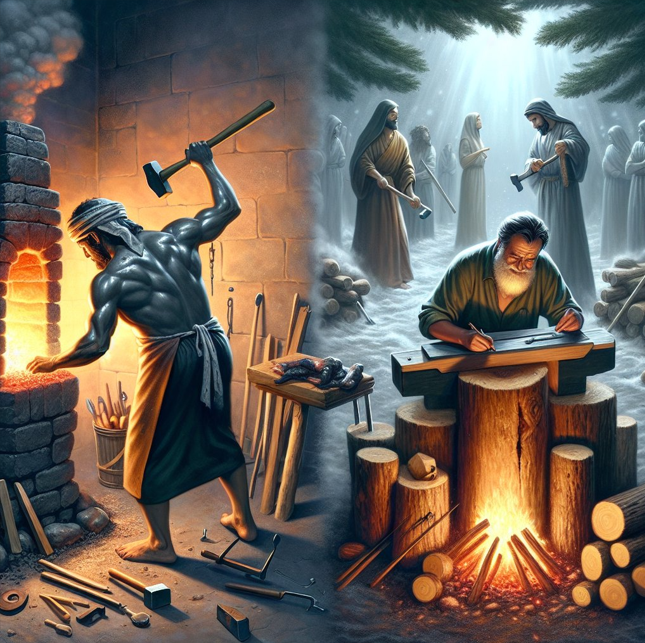
Isaiah invites Israel to repent of its idolatry, and return to the living God (see Isaiah 44). On the one hand, he names idol worship as empty and fruitless, ultimately leading both idol-crafter and idolater to be put to shame. Yet his lengthy descriptions of the crafting and worship of idols have a certain warmth and tenderness to them. There is a felt beauty and hopefulness in the process that leads, ultimately, to so much emptiness, enslavement, and misery.
Idols are not always ugly. They’re often appealing and alluring. They bring beauty and soothing and comfort. They promise security and protection. There is a certain satisfaction in idols because they are the work of our own hands. We can see them and touch them. They offer a transactional relationship. We know what we are dealing with.
And idols ruin us. They leave us miserably alone and exhausted, languishing in increasing fruitlessness. The work of our hands can never save us. Idols ultimately enslave and torment us.
I have some obvious idols in my life – addictive pleasure that leave me unhealthy, exhausted, depleted, and ashamed. But much more frequently, I feel the pressure to produce or perform, the relentless “I have to, or else…” I can be pulled back-and-forth between those two poles in an endless tug-of-war – only to feel more powerless and ashamed.
As I prepared this summer for the public launch of the Rebuild My Church Initiative in our diocese, I was amped up with anxiety and fear and pressure, which sometimes became paralyzing. In truth, the challenging situations our churches are facing (as well as the amazing opportunities that are in front of us) are beyond any merely human stratagem. The deeper invitation is for me and for all of us to be renewed in our secure relationship with the Father and with each other. Mission is a way of being.
If I’ve learned anything in my personal recovery journey, it’s that most of us have far more shame and fear and insecurity than we care to recognize. Shame and fear, when unnoticed and untended, become a hotbed for the weeds of idolatry to take root and take over.
During many moments of overwhelm this past spring and summer, I felt a gentle invitation from Jesus to keep embracing the interior integration he is inviting me to. Any “successful” institutional renewal only flow from my interior renewal.
So, at the end of the summer, I began journaling and reflecting on forgiveness, slowly making my way through Robert Enright’s new book on that topic. I shared back in October how that reflection unexpectedly brought me to Robert Frost’s poem “Nothing Gold Can Stay.”
The Lord had more to show me that day. I suddenly remembered the words of Isaiah – “All flesh is grass.” And I found my way to Isaiah 40.
“A voice says, ‘Cry out!’ And I said, ‘What shall I cry out?’”
“All flesh is grass, and all its beauty is like the flower of the field … The grass withers, the flower fades, but the word of our God will stand for ever” (Isaiah 40:6-8)
And I kept reading. Chapter after chapter, the words pierced my heart. I felt encouraged and emboldened by the invitation to be a herald, about to cry out to thousands during the fall listening sessions. It’s easy for me to see the ways that our Catholic parishes are clinging to a familiar institutional culture that offers a false security and comfort while choking off new life. The Lord was showing me the same struggle in my own day-to-day discipleship. How can I invite institutions to repent of their idols if I don’t look at my own?
The Lord also spoke promises and assurances (Isaiah 41:8-10). They seeped into a deeper layer in my heart than ever before:
Friend
I have chosen you
I am with you
I am your God
I will strengthen you
I will help you
I will uphold you with my victorious right hand
For many days, I kept returning to these words in prayer. Meanwhile, I was finishing reading a book about families raising securely attached kids. I was stunned when the author discussed the prospect of grooming and sexual abuse of one’s own children. After many valuable practical instructions on crucial conversations, she calmly and matter-of-factly named the truth that parents cannot stop bad things from happening. Security comes not from the prevention of tragedy, but from knowing that there is an abundance of secure love and connection before, during, and after any bad things that happen.
Here God was answering some painful cries of my heart in the preceding months. Occasionally, I write my own psalms of lament to God (not easy to do, but worth it!). More than once I have written, “How can I trust you?” – along with a list of complaints to God of the ways he did not stop bad things from happening in my life. Where’s the “protection” in that?
Can you see the appeal of idols here? They twist the promises of God in Isaiah 41:
The LORD – “I am your God”
Idols – “Craft your own god”
The LORD – “I will strengthen you”
Idols – “You can be strong on your own”
The LORD – I will help you”
Idols – “you won’t need to depend”
The LORD – “I will uphold you”
Idols – “You can uphold yourself”
The LORD – “my victorious right hand”
Idols – “Bad things happen in this world. You need to protect yourself!”
Idols seduce us by appealing to our fear and shame, and distracting us away from our deeper longings of Faith, Hope, and Love. Idols promise protection against those desires getting betrayed, crushed, rejected, abandoned, or disappointed.
Desire is a dangerous thing. It feels dangerous to us. But it is first dangerous to the devil and his kingdom of darkness. He is a liar and a murderer from the beginning, envying what God placed in us and the lofty destiny he has for us. So he assaults and disrupts our secure relationships with God and with each other. He invites us to turn away from our desires, and instead to live controlled, curated, and comfortable lives. He seduces us individually, but especially loves it when entire church institutions can begin living this way. That way, even when some individuals (like the prophet Isaiah) have abundant desire and lively imagination for more, there is an inertia in place to resist institutional change. Prophets tend to be persecuted.
In a fallen world, in which bad things happen (and all flesh is grass that will wither), it is not an easy thing to abide in Faith, Hope, and Love. Holding desire and imagination for abundance means weeping over what is no longer and waiting for the not-yet. It means trusting in the promises of a God who is truly good.
God actually does NOT promise us that no bad thing will ever happen to us. As human beings, we find ourselves in the middle of a story in which terrible tragedy has already struck. Things are not as they should be, and more bad things will happen. Through the prophet Isaiah, the LORD promises to be our friend, to be with us, to be our God, to help us, and to uphold us as He works out the victory that is already assured.
The birth of Jesus at Christmas brings the assurance of Emmanuel, God-with-us. He enters our world, enemy-occupied territory, on a stealth rescue mission. Precious few people realized that the God-man was in their midst – certainly not the rich or the powerful of this world. They only felt threatened and attempted to murder him. Baby Jesus barely escapes.
I love imagining that flight into Egypt. Baby Jesus, even in his frail humanity, felt calm and secure, not because Joseph and Mary were preventing bad things from happening, but because they were connecting again and again to God, to each other, and to him. They had no idea how this all was going to be okay, except that they were being assured by God’s promises.
Jesus brings true salvation and security. Genuine security is not found in managing or controlling. It’s not found in five-year strategic planning or by setting measurable goals and objectives (even when there is a time and place for those). Genuine security doesn’t even mean that you and I won’t experience fear or failure. We will, and often.
The true security that Jesus brings is the one-flesh union of the heavenly wedding feast, already anticipated on the Holy Night that we are about to celebrate. The gap between heaven and earth is now bridged. Humanity and divinity are now one, in the tiny body of the babe of Bethlehem. What God has joined together, no human being can separate.
Come, let us adore Him.
