Capture the Flag

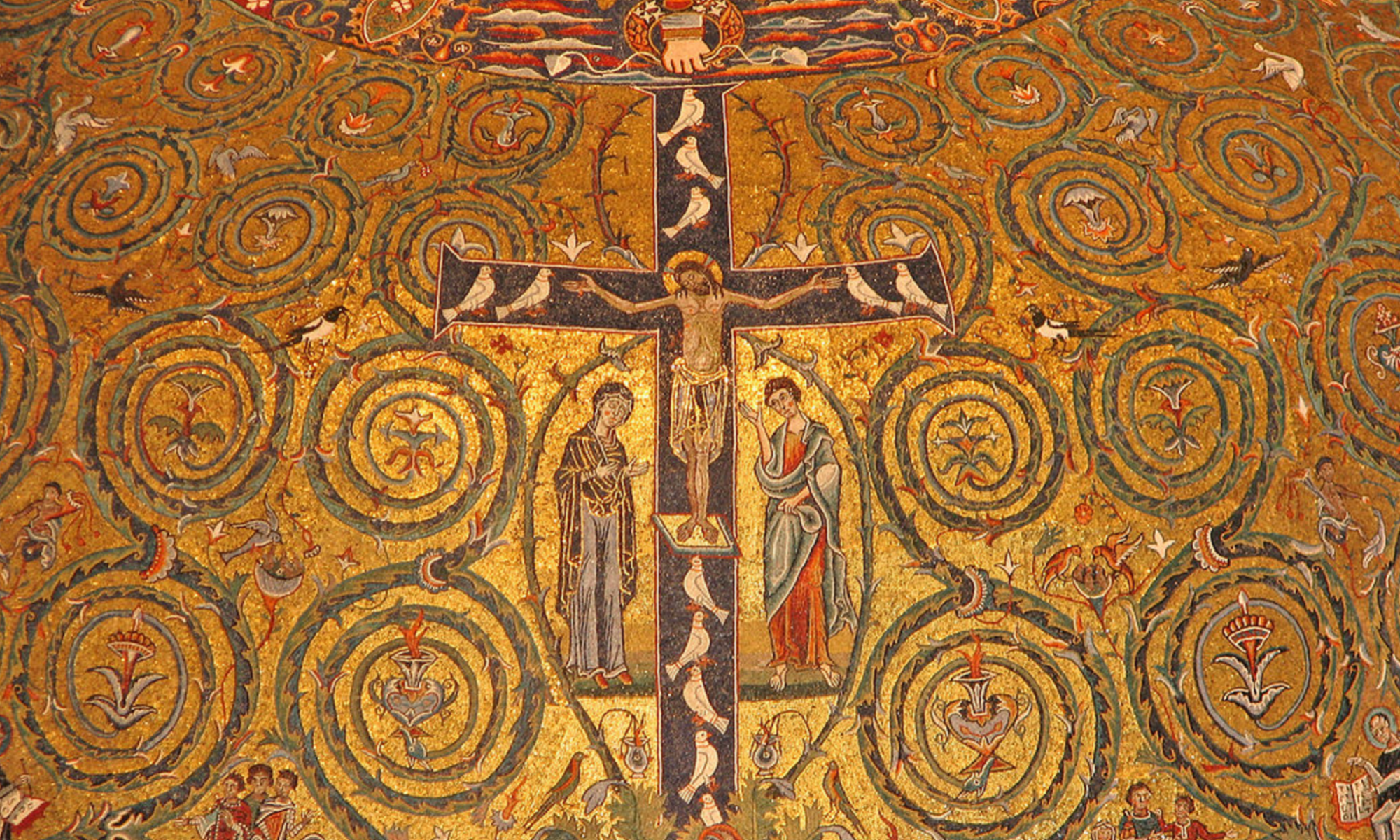
Jesus Christ is the Lamb of God who takes away the sin of the world. That’s no ordinary Lamb! He is the conquering Lamb, the victorious Lamb, the Lamb who overturns the devil’s kingdom of death and sin. The meekest of creatures becomes the mighty champion. He who willingly allowed himself to endure the humiliation of the Cross now bears the banner of victory, and makes a mockery of the devil. Jesus is victorious in a decisive and definitive game of “capture the flag.” We have been rescued from the kingdom of darkness. Our ancient foe has been defeated and despoiled.

Yet the fervor of our response tends to be more like the animations in Monty Python and the Holy Grail. “And there was much rejoicing… yay.”

We’ve all seen the Easter images of the lamb and the flag. In Christian circles, these depictions are so quaint that they carry little meaning or force. There is always a danger of our symbols and practices becoming so familiar that we lose any sense of the newness and the power of the Gospel. In this case, we are also hindered by the paradox of the Cross, and the utterly unexpected way that Jesus took the fight to the devil. His weapons are rather unconventional.

It is in John’s Gospel that we hear Jesus proclaimed as the Lamb of God (John 1:29). It is also in John’s Gospel that Jesus willingly embraces his “hour.” He knowingly and freely enters suffering and humiliation (John 10:18), not as an optionless victim but as one very much in charge. He confidently declares, “Now is the judgment of this world; now will the ruler of this world be cast out” (John 12:31). Jesus’ meek and humble death, his becoming sin for our sake, becomes the permanent undoing of death and the definitive removal of sin.

Lambs don’t exactly instill terror. I’ve yet to hear someone shriek, “It’s a lamb! Run for your lives!!” It’s imaginable only in the world of Monty Python (if I can dare taunt you with that film a second time).  Consider the famous scene with the Killer Rabbit of Caerbannog. It’s so hilarious because it’s so incongruous. The thought of a fluffy bunny turning into a ferocious fighter is laughable. Some of Arthur’s hapless knights discover their mistake only too late.

So does the devil.

The devil’s seeming moment of triumph was actually the moment of his undoing. We can easily miss the brilliance of Jesus’ stratagem. Gentler than the gentlest dove and more cunning than the ancient serpent, Jesus brings unimaginable weapons to the fight and secures the victory over the ruler of this world, a victory that can never be undone.

We speak of the “glory” of the Resurrection, and rightly so. But in John’s Gospel, the glory of Jesus is especially revealed on the Cross. It is there that he casts out the ruler of this world. It is there that he wins the permanent and irrevocable victory. And the devil knows it.

The Cross is the victory. The Resurrection is the beginning of the victory parade. The artistic images of the lamb and flag don’t typically do it justice. We might be better served imagining the victory parades at the end of World War II, which are often depicted in film. We see the faces lining the streets and cheering – recently released prisoners, liberated townspeople, or relieved citizens who never thought this day would come.

But there is more. The Paschal victory parade is a mockery of the devil. That’s exactly how the apostle Paul describes it in Colossians 2:15. Jesus disarms the rulers and authorities (the evil spirits) and makes a public spectacle of them.

You have perhaps seen Roman victory arches, such as the ancient one near the Roman Forum or the more modern Arc de Triomphe in Paris. The ancient practice was for the victorious general to parade through the arch, openly showing off the prizes of victory taken from the enemy, and putting the losing generals on display.

In Jesus’ case, it is the ultimate reversal. In his Passion and Cross, he willingly embraced humiliation and shame – all the things done to him in the moment as well as all the shame ever experienced by you or me or any other human. What sadistic delight that must have brought to the demons! But their aroused revelry becomes their utter undoing, and the beginning of their eternal humiliation.

It’s common to find devotional reflections on Jesus’ physical sufferings in the Passion. Such reflections are not wrong, but they miss the deeper point. A clever critic could point to other forms of torture that would have been far longer lasting and more intensely painful. The Romans themselves had such methods. But Jesus was crucified. Crucifixion included plenty of torture and torment, but the core of crucifixion was utter humiliation. It was a form of execution that invited and encouraged mockery and degradation.

What is fallen human nature like when soldiers or prison guards are given a free pass to mock and degrade a captive? What kinds of dark behaviors emerge (particularly when the captive is stripped naked as part of the mocking)? We don’t even like to think about it. We sanitize and pretend that such atrocities don’t happen. Scripture mentions only a few particulars in Jesus’ case. There may have been more. Either way, the Gospel writers focus far more on the mocking and humiliation than on the physical torment. The evil one and the humans who were seduced by him went to no end to shame Jesus as much as possible.

I have written often about shame. I have studied it in depth – sometimes in books and podcasts, but mostly by studying myself, by exploring my own story, or by accompanying others into those places in their story. I find that toxic shame is perhaps the most unbearable of all human torments. I’ve met many people who tolerate an enormous amount of physical pain in their daily lives. I’ve met far fewer who are willing to linger in places of intense shame. It is in those places that we are most easily bound up by the powers of sin and death.

Jesus went fully and completely into the shame-bound places of the human heart that we can barely tolerate, even with the best of support. He plants the flag of his Cross and declares victory. He pulls down the devil’s banner. He manifests in his risen flesh that death and sin do not get the final word.

I described his methods as “utterly unexpected,” but that’s not entirely true. It’s exactly what God promised, even in the first moment of shame in the garden. There would come “the woman” who would be a total enemy of the devil, and her offspring would crush the head of the serpent (Genesis 3:15). Jesus is that offspring. He is the long-awaited Messiah. He is the glorious “Son of Man” described in Daniel and in other writings (like the Book of Enoch) that are not properly part of the Scriptures – but which were quite familiar to both Jesus and his followers. In that same Book of Enoch there is a prophecy of a conquering lamb, who will grow strong horns and bring the fight to God’s enemies, who have scattered his people like sheep. Jesus is that conquering Lamb.

Even his weapons were foretold, elsewhere, when Isaiah describes the Suffering Servant. But that vulnerable means of fighting was so unthinkable, so scandalous, so foolish that no one besides God made all these connections. Jesus helped his disciples connect the dots after the Resurrection, seeing how all these prophecies and commandments find their fulfillment in him (see Luke 24:27).

His mercy endures forever! God’s mercy, his kindness, his covenantal love (hesed in Hebrew) combines the meekness of the Lamb of God with the ferocity of the Lion of Judah. And let’s not forget that lions are predators. On the Cross, Jesus meekly and innocently suffers. On the Cross, Jesus cleverly lays a snare in a manner far more cunning than the most cunning predators. And the devil takes the bait.

In the Catholic world, we celebrate the Easter Octave – eight festive days of rejoicing in this victory. We begin with the Sunday of the Resurrection and conclude with the Sunday of Divine Mercy. Jesus overturns the ancient powers of death and sin – “powers” here in the biblical sense of evil sprits who pretend like they get to hold us captive and torment us in our powerlessness.

Left to ourselves, we are indeed powerless to overcome these unstoppable forces. They seduced Adam and Eve and us, and we gave our authority over to them. They won’t willingly release it. God knows that, and willingly sends his own Son to upend the powers of this fallen world in a way they could not imagine.

Like those at a victory parade, we can feel the liberation and the joy of the rescue that has just happened. We can be confident in the victorious Lamb who has torn down the enemy’s banner, and who puts the enemy and his impotent claim to power on public display. He has no such power over us. Not anymore. With the apostle Paul, we can boldly proclaim:

O death, where is your victory? O death, where is your sting? The sting of death is sin, and the power of sin is the law – but thanks be to God who has given us the victory through our Lord Jesus Christ! (1 Corinthians 15:55-57)

Who shall separate us from the love of Christ? Shall tribulation, or distress, or persecution, or famine, or nakedness, or danger, or sword? As it is written, “For your sake we are being killed all the day long; we are regarded as sheep to be slaughtered.” No! in all these things we are more than conquerors through him who loved us. For I am sure that neither death nor life, nor angels nor rulers, nor things present nor things to come, nor powers, nor height nor depth, nor anything else in all creation, will be able to separate us from the love of God in Christ Jesus our Lord (Romans 8:35-39).

And there was much rejoicing!

Emmaus and the Eucharist

Of all the resurrection stories, perhaps my favorite is the Road to Emmaus (Luke 24:13-35). Two downcast disciples are wandering away from Jerusalem, away from all their hope, when Jesus walks up and joins them. He playfully pretends not to know what is going on. He wants them to acknowledge their loss so that his Holy Spirit can enter their hearts and rekindle their hope. He breaks open the Scriptures for them, helping them to make sense of the Messiah’s story and their own story. Their hearts expand in a yearning to stay connected with him. He breaks bread with them, at which point they recognize his presence. They hasten to Jerusalem and become witnesses of the resurrection.

But there is more. Luke wrote his Gospel for the sake of early Christian communities who were already gathering Sunday after Sunday to listen to the Scriptures and to “do this in memory of me” by celebrating the Eucharist (Luke 22:19). It is not merely a story about a one-time appearance of Jesus to some guy named Cleopas and some other unnamed guy. It is a story about how every Sunday Eucharist is a life-transforming encounter with the risen Jesus. That which happened to those two disciples on a Sunday is intended for each of us.

Our Sunday worship bears a twofold structure: Liturgy of the Word and Liturgy of the Eucharist. We listen receptively to the Scriptures and ponder how they connect with our present-day life. We allow our hearts to be set ablaze as we realize how Jesus’ story gives meaning and purpose to our own story. Then we get fed with his very flesh and blood following a ritual reenactment of the once-for-all offering of Jesus. We remember those saving events in a way that allows us to participate in them here and now.

Bishop Robert Barron, in his insightful and inspiring fashion, has drawn many other connections. We begin each Mass by calling on the Lord for mercy: kyrie eleison. Like Cleopas and his friend, we are downcast. Many of the early Church fathers described the fallen human condition as incurvatus. Like the crippled woman in Luke 13, we are bowed down. We are wounded by sin – by the way others’ sins have harmed us and by our own sins. We remain God’s beloved children, inherently good. But we are bent, weighed down, and turned in on ourselves. Without divine mercy, we are like a younger Peter, fluctuating between an “I’ve got this!” grandiosity and an “I’m so horrible!” discouragement.

So, we begin the Mass by acknowledging our sins and inviting the mercy God freely offers us in Christ. We trust that his victory allows us to stand upright – not through our own merits but by his free gift.

Then we listen to the Scriptures and allow them to be broken open for us. In every Sunday Mass, there is a connection between the First Reading and the Gospel. The Catechism of the Catholic Church cites an adage from the early Church: “The New Testament lies hidden in the Old, and the Old Testament is unveiled in the New” (n. 129). There is also a connection between the stories of Scripture and our own personal story – some of which we know with clarity and some of which is a mystery to us. Without the story of Jesus, our own story will remain fragmented and disorienting.

Those of us who are ordained ministers are commissioned by God to proclaim the Gospel with authority. That does not mean that every homily we preach will be brilliant and breathtaking. It does not even mean that we will preach the truth. It does mean that we are called to stand in as Christ, allowing him to speak in and through us. I think every priest or deacon has had the experience of what we thought to be a rather flat performance becoming the divinely chosen moment for one person’s heart to be permanently changed.

The first half of Mass centers around the ambo – the podium at which the Word is proclaimed. We then shift to the altar, which is also a banquet table. All of Scripture and all of the Mass revolve around the paschal mystery of Jesus. “Paschal” is another word for “Passover.” Jesus shows the disciples at Emmaus how the Passover events in Egypt were a prefiguration of his once-for-all Passover offering – which begins at sundown on Holy Thursday. Jesus freely offers himself as the Paschal Lamb – feeding his disciples at table, praying prostrate in the Garden of Gethsemane, suffering and dying on the Cross, proclaiming the Gospel in the realm of the dead, rising in glory, and now robed in human flesh as our great high priest, interceding for us at the right hand of the Father. He is both the priest who offers and the victim who is offered. The Mass participates in that one eternal sacrifice. But why? So that we can all join together with him at the banquet table, celebrating his nuptial union with his bride. Every Mass is a taste and glimpse of the wedding feast of heaven. The Eucharist, Christ’s own risen flesh and blood, is both our food for the journey and our medicine. It nourishes, heals, and strengthens us.

Mass ends by sending us forth. “Mass” comes from missa (“sent”). Like the disciples on the road to Emmaus, we can go forth truly changed – having passed over from old to new, no longer downcast but erect, eager to live as witnesses of Jesus’ story that has given so much meaning to our own story. Renewed and sustained by this steady gift, we now have the capacity to live in a way that attracts others to be curious about Jesus.

Until Jesus comes again, the Eucharist is the beating heart of the Church. We fulfill Jesus’ command to “keep on doing this in memory of me.” We remember where we have come from and where we are going. We become again and gain what we one day will be.

Singing a New Song

Sing a new song to the Lord!

Many of us have been praising God with these words of Psalm 149 every single morning this past Easter week in the Liturgy of the Hours.

But what does it mean to “sing a new song” to the Lord?

Often, it means that we need to move on from our “old songs” – or to allow Jesus to transform them radically with the newness that he brings in his Passover victory. Our old songs, if played out to their completion, only bring slavery and misery. Jesus desires to teach us a new song in the new and eternal covenant, sealed with his blood in his Passover victory.

As in the original Passover, singing a new song means leaving Egypt and the ways of Egypt behind as we pursue God’s promises with fellowship, praise, and a deep desire to enter into the Lord’s rest.

Most of us know how well that worked out for most of the Israelites. It didn’t take them long in the desert to start pining for the fleshpots of Egypt, wishing they were back among familiar places and faces, forgetting in their fantasizing just how awful it had been to be enslaved. They reached an ultimate low point at the very moment when God was ready to form a special covenant with them on Mount Sinai. Moses comes down from his forty-day fast, bearing tablets inscribed by the very finger of God, only to find the Israelites carousing and revling around the golden calf they have fashioned for themselves.

Such sins do not come out of nowhere. They are the culmination of singing “old songs,” the melodies of which sweep us along toward old solutions to old problems. Once we get started with a catchy song, we feel the urge to finish it. Fans of The Office may remember the hilarious elevator scene in which Andy and Pam are trying to make a cold call to a potential client. Andy annoyingly sings the names and suite numbers of all the businesses he sees listed. Pam interrupts him with the right answer and urges him to stop singing. Andy complains, “Except it was going to resolve the melody, so now my head hurts. Feels like I held in a sneeze. Mmm! I hate this feeling!” Truthfully, we all do. The farther along we are in our old song, the harder it is to stop.

It is so helpful to reflect upon our experiences – including our darkest moments of sin – with kindness and curiosity. In our shame, we tend to avoid telling the full truth of our behaviors. Sadly, in that hiding and avoidance, we also miss out on the chance to learn valuable lessons and grow.

The truth is that our unholy moments of acting out are almost always preceded by unholy rituals that function much like the melodies of an old song – often a song that we learned decades ago. If we are paying attention in those moments, we will notice that we feel a certain way; that we have certain images running through our head; and that our bodies experience certain sensations. Typically, some level of fantasizing is involved. Our deep desires get hijacked by the fantasy, and some promised pleasure begins arousing us. There is sexual arousal for some, but the arousal can be ordered towards any number of fantasies: food, alcohol, drugs, gambling, shopping, envy, achivement, anger, rage, or revenge. In each case, as the anticipatory arousal grows, so does our urge to finish the song.

As a classic example, consider the devout dating couple who keep telling themselves they don’t want to get physical with each other when they hang out – but somehow always do, only to feel ashamed. They don’t always recognize early enough that they are entering into a ritual with each other – surrounding themselves with the same environment, the same sensations, and the same behaviors. They tell themselves that the outcome will be different this time, but of course it’s only natural that they begin feeling a heightened sense of anticipation for the completion of the ritual. Even if their minds are oblivious, their bodies and emotions and imagination understand what is happening. The more measures of the song that are sung, the harder it is to decide to stop. Again, this is true of sexual arousal but also of any number of other fantasies.

For some fantasies, the ritual song and dance may take days to play itself out to its finish; for others (e.g., an outburst of anger) the whole song can play itself out within milliseconds. Even then, as Victor Frankl once said, between stimulus and response there is always a space. In that space there can be power to choose, to be free, and to grow. In other words, there is the opportunity to learn a new song.

Singing a new song means calling on the newness of Jesus as we reclaim the things the Lord has made: desire, arousal, connection, intimacy, union, and joy. Every one of us is created by God to have these experiences – yes, even those of us who have freely renounced marriage and sexuality for the sake of the Kingdom. One need only see a smattering of celibate Saints to get a glimpse at the intensity of their desire, their longing, their anticipation, their delight, or their joy.  Consider Francis of Assisi, a man known for his poverty and chastity, and how intensely he enjoyed in the beauty of God’s creation. Pseudo-desires like lust and greed actually undermine authentic desire, intimacy, union, joy, and delight. It was precisely Francis’ open hands and open heart, his renunciation of lust and greed, that opened his heart up to the deep joy and peace that come as the fruit of praising of the God who delights in giving good gifts to his beloved children.

Psalm 149 speaks to all of these experiences. Singing a new song means joining in communion with the rest of God’s assembly – no longer isolating or hiding, no longer secretly stealing pleasures when we think no one is looking. It means rejoicing in God as our King and allowing ourselves to feel deeply the delight he takes in us. It means true rest with the Lord, learning just to be, basking in his loving gaze, and praising him amidst the delight we experience his presence.

It also means binding up God’s enemies in chains and fetters of iron (Psalm 149:8). Many of us have been bound up by chains for much of our lives. The evil one attacks early and often, seducing us into unholy agreements, enticing us to believe lies about ourselves or about God. These lies become cords that bind us, not to mention “chords” that keep us trapped in the same miserable old song that brings the same miserable old outcome. I know some of my own “chords” in that regard: I must hide my true self. I must not be weak or fail. I must never ask for help. I must never depend on others. If I keep playing these chords, the song won’t end well. I need Jesus to enter in with his newness and transform the song.

Some of our chords need to be eliminated from the song entirely. If we play them, they will only lead us to an evil end. Think of the alcoholic who needs to give up going to bars and part ways with some of his buddies.

Perhaps some of the old chords served us well for a time, but the song needs a change of key. Each of us have our own self-created solutions in our attempt try to make our pain go away, or try to fill the empty places of our heart, or attempt to resolve our inner conflict. Unaided and unprotected by others, sometimes it was the only viable way to survive. Indeed, some of us have survived truly hellish situations, and the measures people resort to in survival don’t always make for glamorous stories. The saddest part about survival stories is often after the rescue comes. One of the hardest thing for survivors to do is to internalize the truth that they are now free to live a full life – they don’t have to live in their joyless survival methods anymore.

If we find ourselves clinging to old ways of surviving (even when they have long outworn their purpose), we can allow Jesus to teach us new chords in a new song – even though we may, at first, find this learning process to be unfamiliar, frustrating, overwhelming, or intimidating.

Again, Psalm 149 offers the basics of the new chords needed: Connect with others in God’s assembly in joyful communion. Receive and give love together with them as we open our hearts in praise of the living God. Receive joyfully the truth that he delights in us (no matter what we have done), he rescues us, and he desires us to rest in him and delight in him. Bind up any and all evil spirits who would dare attempt to interrupt this amazing new song that Jesus brings.

God has ordained it so. This honor is for all his faithful.

en_USEnglish
en_USEnglish