Watching for Dawn

[Revised and re-posted from Advent 2020]

We begin another Advent. We open our minds and hearts to the coming of Christ.

Bernard of Clairvaux (1090-1153) speaks of three comings of Christ: (1) his first coming, in the manger at Bethlehem; (2) his coming again in glory to judge the living and the dead; and (3) the invisible way in which he comes to all true believers who desire him.  In the words of Jesus, “If anyone loves me, he will keep my word, and my Father will love him, and we will come to him” (John 14:23). Jesus desires to be present to those who desire his presence.

Advent is a season of presence. “Advent” comes from the Latin adventus (“arrival” or “coming”). But adventus is a translation of the Greek word parousia – often used to describe Jesus’ coming again in glory, but literally meaning “presence.”  It is easy for some Christians to slip into gloom and doom fantasies about a future apocalypse (or an apocalypse that is allegedly happening right now). It is challenging to abide in the present moment, to watch and wait with sober Hope.

That is the invitation of Jesus: “What I say to you, I say to all: ‘Watch!’” (Mark 13:37). In Greek, this command to “watch” is gregoreĩte. The Christian name Gregory is derived from this invitation to sober watchfulness, so frequent in the admonitions of Jesus as well as in other New Testament writings (e.g., 1 Peter 5:8).

Gregory the Great (ca. 540-604) is one of my favorite popes and saints. He was born into a prominent Roman family – during a time in which the already faded glory of Rome was quickly passing away. Much that was good and beautiful had collapsed or was about to, and Gregory had no illusions that the clock could be turned back to “the good old days.” He answered God’s call to become a Benedictine monk, and his heart desired the peaceful prayer of the monastery. However, God and others kept tapping his talents for administration during a time of great crisis. He humbly describes his struggles to remain a man of prayer amidst the administration of stressful crises that were impossible to ignore. I can relate!

Gregory was profoundly aware that his name meant “Watchman” and that the words of Isaiah applied to him: Son of man, I have made you a watchman for the house of Israel. A watchman is called to stand upon the heights, to keep his mind and heart in a place of calm, peace, loving awareness, discernment, wisdom, and creativity – so as to be a blessing to others. Such was Gregory’s deep desire, even though he felt and expressed his struggles: “Who am I to be a watchman, for I do not stand on the mountain of action but lie down in the valley of weakness?”

Whatever his particular pain and struggles may have been, Gregory’s holy desire to be a watchman prevailed. Constantly renewed and enlightened by Jesus, Gregory’s foresight led to the establishment of hundreds of monasteries, which preserved so much of the beauty, goodness, and truth of Athens and Rome, and which became vibrant hubs of evangelization in the centuries ahead. Gregory’s sober watchfulness allowed him to continue doing works of mercy in the present moment, but without being consumed in a false fantasy to prop up structures whose time had passed. His sober watchfulness was both deeply pessimistic and optimistic at the same time – accepting the grief of definitive loss and change, while simultaneously seeing with optimistic Faith new rays of hopeful light where other more frantic people were blinded by their busyness, fear, or denial. Survival mode does not tend to bring the best out of human beings. Our field of vision narrows (both literally and figuratively), and we tend to keep going back to repetitive and predictable “solutions” – as though doing it for the forty-second time will somehow yield different results. True to his name, Gregory knew how to keep getting back into his watchtower.

When reflecting on the great mystery that is the Church, Gregory offers one of the most profound descriptions I ever came across during my doctoral research. He compares the Church to the dawn:

The holy Church, seeking the rewards of heavenly life, is called the dawn, for as she leaves behind the darkness of sin, she shines forth with the light of righteousness. But while we live, it is dawn, not perfect Day … For dawn or daybreak indeed announces that the night has passed, but does not manifest the full splendor of the Day. Rather, as it dispels the night and takes on the Day, the dawn holds a light that is mixed with darkness.

The Church, on her present sojourn through history, is indeed a mixture of weeds and wheat, darkness and light, sinners and saints. The same is true of our own hearts.  Gregory proceeds:

As long as the law of the flesh clashes with the law of the spirit, and the law of the spirit with the law of the flesh, light and darkness will blend together. Thus, when Paul says, “The night is far gone” (Romans 13:12), he does not add, “the Day has arrived,” but rather, “the Day is near” … The Day shall arrive when no darkness of sin triumphs. Then the Church of the elect will be fully day, when no shadow of sin is mixed with her.

What wise and Hope-filled words! He can look truthfully at his own heart and at the Church and see truthfully both darkness and light. But there is Hope. The thing about dawn is that it does NOT turn back into night. So also with the Church. The gates of hell will not prevail against her. He will be with her always. No matter how deep the darkness may seem at certain moments, we can look for the streaks of light and be assured that the dawn will break into full Day.

Our present age is eerily parallel to that of Gregory. So much that we once took for granted in church life or society has collapsed, and there is no turning back the clock. As with ancient Rome, some of what collapsed was beautiful, and some of it was already evil – using piety or patriotism to cover over greed, exploitation, or abuse. I may return to this discussion of nostalgia for the “good old days” another day. For today, the main point is that when you are standing amidst the wreckage, the only way forward is the way through, and we can easily get discouraged or cling to fantasies about how fighting “those people” will fix everything.

This Advent, we can join Gregory, not to mention the original twelve Apostles who first heard Jesus’ admonition to “watch.” Heeding the invitation of the Beatitudes, we can embrace our poverty and grieve our losses – getting past our denial and blame. We can abide in the present moment, even when it feels disorienting and scary. We can stay sober and vigilant. Jesus will open the eyes of our heart, and help us to see the new light that he always brings. As promised, his Spirit is always at work, shining in unexpected places.

Being watchful disciples means attuning to those first streaks of dawn, and allowing them to surprise us with joy. We tend to have tunnel vision about how Jesus is going to answer our prayers. Jesus frequently surprises his disciples with joy in ways they least expect. If we are sober and watchful in the present moment, our vision can be broadened again and again. Noticing with true vision the streaks of dawn, we can become eager heralds of the full light of Day that is breaking into this world.

Co-Authoring with God

We all find ourselves in the middle of a story. We have known sweet moments of delight, dark moments of betrayal, intense longing, bitter disappointment, and perhaps long seasons of feeling stuck or lost.

That is how most great tales begin – in the middle of the story in which the featured character faces a seemingly insurmountable dilemma. As we discover the character’s backstory, we gain a better sense of why the dilemma is so hard. It is only when she faces her past that she can move forward in freedom and hope.

As a follower of Jesus, I can ask an interesting question – who is the author of the story I find myself in? Is it God? Is it me? And what roles do other characters play?

Catholic teaching is quite clear about the authorship – it’s both. God is truly the author, and I am truly the author. God is sovereign and all-powerful, but he always respects and honors our freedom and never saves us apart from our wanting it and freely cooperating with it. We get to grow (or wither) in love over the course of our life.

Such are the stories of Sacred Scripture. Throughout the Old and New Testaments, we hear tale after tale of human beings gifted by God, called by God, aided by God, corrected by God, rescued by God, and aided anew – but always in a way that allows the stumbling human characters to be free, to desire, to choose, and to grow (or to harden their hearts and to harm self and others). God never makes anyone do anything, yet somehow remains in charge.

The books of the Bible themselves are co-authored by God and human beings, as the Second Vatican Council taught in 1965. Dei Verbum (“The Word of God”) is the Council document about Jesus as the eternal Word of God. The Word of God is primarily a person, not a book. The Word (Jesus) is truly human and truly divine. Both his humanity and his divinity are profoundly united in the one eternal person of the Son; but neither is dissolved or diminished as a result of that union. In Jesus, all of humanity is invited into a one-flesh union with God that will be celebrated eternally.

This story of Jesus and the Church is then passed on both orally (in the proclamation of the Gospel and in Tradition) and in writing (in the God-breathed books of Scripture). Dei Verbum n. 11 clarifies that God is the true author of each book of Scripture and of the whole of Scripture. But the same paragraph teaches that various human beings are also true authors whom God chose and inspired – fully respecting their freedom, their capacities, and their abilities. God did not dictate Scripture word for word, in a way that would treat the human beings as robots or inanimate pens. Rather, he allowed his story to be told within particular human contexts. At no point did he coerce or pressure of manipulate the capacities or the freedom of the human beings he had chosen. He allowed his inspiration to adapt to the limits of a fully human context, while authentically communicating divine truth.

Fundamentalists (both in the Evangelical word and the Catholic world) tend to be afraid of human reason and academic learning. They want to put all the authorship and authority on the side of God, which lends the illusion of clarity and control. That feel safe! Never mind that God is always radically beyond our “clear” notions of him. Never mind that our feeling in control is an illusion. Fundamentalists resist facing the heartache in their own story and fantasize about getting back to the good old days when all was well (conveniently forgetting the darker deeds of those nostalgic times). They don’t tend trust that the Holy Spirit will keep showing up, and that holy human beings (or even less-than-holy human beings) in every age will answer the summons and cooperate with God’s saving action. God will never tire of saving us, but he also shows a remarkable preference to do so through feeble instruments, respecting the “yes” or “no” of those instruments.

On the flipside of fundamentalism is secular humanism. There are plenty of secular atheists, agnostics, or even practicing Christians who don’t believe that God really shows up or really authors. They see Scripture as a collection of merely human stories. They see religion as merely a human projection of needs, with the doctrines and practices as merely human efforts to make meaning in life.

Both fundamentalists and humanists are well-meaning. Both are partially correct. Both are gravely mistaken.

In the person of Jesus, God has truly shown up in human history; truly lived, truly died, and truly rose. God has really revealed himself; genuinely reconciled us to himself (in a way we could never have done ourselves). He now invites us in full freedom to be in a real relationship with him through his Son, and to follow where his Son has gone. Jesus is the great protagonist of THE human story, into which we are all invited. But he only and ever saves us by inviting us to become co-authors in our own story.

Co-authorship is hard. We will resist it and try to find another way. When we find ourselves in the middle of our story, when the plot becomes particularly intense, we tend to feel stuck. We want a solution that doesn’t involve so much vulnerability or risk. We then enter fantasy thinking – the realm of “if only…”

If only I had what that person has… If only God would send the right partner… If only I had a different job… If only I wasn’t so sensitive… If only I wouldn’t make mistakes… If only God would take this temptation from me… If only that political party got in charge… If only this person would finally pay for what he did… If only…

When we feel particularly overwhelmed in our story, may find ourselves in the broken record of an addiction cycle – which also always begins with the “if only…” of fantasy thinking. Fantasizing about a predictable pleasure may help the present moment feel less unbearable. It brings a certain soothing. But it will ultimately bring us to a familiar place of disappointment and shame. It slowly but surely ruins us.

Like the apostle Paul (2 Corinthians 12), we are likely to beg God to take our trials and temptations away, to rescue us by removing us from the hard spot in the story. Sometimes God does that – but ultimately, he desires us to become heroes who share in the glory of his Son. That will only happen if we follow Jesus closely in his suffering, death, and resurrection. If we do not face the full heartache of where we have come from and where we are going, we will miss out on becoming the full gift that we were meant to be. When we come to accept more fully the story that we find ourselves in, we can proceed in fuller freedom as co-authors of a future full of hope.

The Middle of the Story

It’s difficult being in the middle of a great story. It’s challenging enough to be an empathetic reader, feeling the tension in our body as we witness the drama resolving. But we as readers typically know more than the characters in the story, and are free to set the story aside. By contrast, to be the one in the midst of the tale, totally unsure of what will happen next, can be overwhelming, disorienting, or discouraging.

I recently re-read Lord of the Rings – probably my favorite story. This time around, I was captivated by the conversation between Frodo and Sam on the stairs of Cirith Ungol. They have come far in their journey, which seems more and more to be a fools’ errand. Failure feels inevitable.

Then they have a moment’s realization that they are in the middle of a great story. Not only that, they are characters entering and leaving the stage amidst an even grander story, interconnected with all the heroes and villains. Sam cheers Frodo up by imagining their tale told to children by the fireside. “Frodo was very brave, wasn’t he, dad?” “Yes, my boy, the famousest of the hobbits, and that’s saying a lot.”

Frodo laughs in a dark place that hadn’t heard laughter since Sauron came to Middle Earth. He adds to Sam’s musings: “But you’ve left out one of the chief characters: Samwise the stouthearted. ‘I want to hear more about Sam, dad. Why didn’t they put in more of his talk, dad? That’s what I like, it makes me laugh. And Frodo wouldn’t have got far without Sam, would he, dad?”

Then Frodo names well why things are so hard for them: “You and I, Sam, are still stuck in the worst places of the story, and it is all too likely that some will say at this point: ‘Shut the book now, dad; we don’t want to read any more.’”

I have felt more than once in life what it is like to be at the worst places of the story. We can have long moments of felt powerlessness in which we do not see a path forward, and do not feel like we can trust anyone. Sometimes those are distorted perceptions, but not always. In the case of Frodo and Sam, the devious Gollum was their only guide, and they had no obvious options. All they could think to do was keep showing up and see what would happen next. And they did just that.

On the Day of Judgment, Jesus will assemble the entire human race, and have them hear your story and mine – which of course will interwoven with the entire human story. Others will hear all about the heroes and villains and supporting characters in our story. Our full truth will be unveiled.

Jesus, of course, is the ultimate hero of the grand human story. His dying and rising bring meaning and hope. But Jesus very much desires that we participate in his Passover (cf. Luke 22:15). He wants his story to become one with ours, and for you and me to grow as heroes in our own right. It is often in the moments of failure or adversity that we learn the most and become who we are. The apostle Paul teaches that God works all things for the good for those who love him (Romans 8:28). Augustine of Hippo adds the words – even our sins.

Like the hobbits, we are apt to have more moments of foolish blundering than moments of astonishing courage or faithfulness. All the moments matter, and in his covenantal love Jesus turns every one of them into the beginning of a new and better chapter. It’s not a matter of getting it all right or figuring it all out, but of allowing the story to unfold.

We tend to imagine that the glamorous moments of our story will be those in which we fell a giant spider or troll. But when our full story is told, perhaps the listeners will perceive that our greatest moments were those in which we ourselves fell – again and again – and kept getting up and kept showing up. They will gain a glimpse into the moments when we had no idea how we could carry on, what would come next, or who would help us get there – and we chose to show up anyway.

Yes, it’s hard to be in the middle of a story – especially at the worst moments, the moments in which we feel stuck. It helps very much to allow true friends to be near us, to share bread together and sing together, even in the dark moments and places of our lives.

In every case, there is an invitation to Eucharistic renewal. Jesus assembles us, Sunday after Sunday, and we listen attentively the THE story that breathes meaning and hope into our own. We place all the broken pieces of ourselves and our lives on the altar, giving it all over to the one who offers it all to the Father. We receive the flesh and blood of Jesus – our waybread for the journey that lies ahead – even when we do not know the way, and do not know how all can possibly be well. We resist the temptation to go it alone – even when that feels easier. We definitely need community and true companions on the journey. Like Frodo, we may find the most unusual allies in the most unexpected places.

The virgin Mary models for us, again and again, what it is like to be in the middle of an unfolding story and not have all the answers. She never backs away or isolates, nor does she force a solution. She abides. She watches and waits, and when the Lord reveals next steps, she follows with trust. She is willing to abide in the middle of the worst moments. She stands with Jesus in the worst moments of his. Jesus gives us to her (“Behold your mother”) so that she can stand with us in our own worst moments. May we welcome her mothering and learn from her example as we continue into the next chapter of our story.

Confabulation

My grandmother is 96. She is beginning to tell some rather interesting stories!

For several years already her sight and hearing have been failing, but that never stopped her from keeping informed of what was happening in the lives of family members. Once in a while, she would fill in the gaps with her own interpretation. It could be amusing or annoying, depending on her take. More recently, after years of being mentally sharp, she is showing signs of dementia – forgetting certain words, mixing up names, and – yes – telling some interesting stories. When she lacks certain pieces of the puzzle, she’s quite creative at filling in the gaps with her own narrative. And she sincerely believes her version of the story.

Her parish priest is from Poland, and four decades younger than she is. That doesn’t stop her from regaling me with stories of her long-deceased parents teaching him to speak Polish so well. This is an example of what neuroscientists call “confabulation.” It involves telling a false story while sincerely believing it to be true.

The human capacity to confabulate is by no means limited to those experiencing memory loss!

For example, I think of addicts chasing after a fix. Some of them go from church to church with a well-polished story, looking for a handout. The details of the story vary, but they invariably convey some heart-wrenching tragedy – “and all I need is __________ and my troubles will go away!” They get genuinely offended if you don’t believe their story. They have told it so often that, in the telling, they believe it themselves! You can, with skill and effort, expose them in an inconsistency or a lie. But it may not be kind or constructive to do so. They are likely to erupt with rage or blame, not at all liking the intense embarrassment and shame they are suddenly feeling amidst the exposure of untruth.

Another example is narcissism. There is increasing research linking narcissists with confabulation. In their deeply felt insecurity and shame, they exaggerate their achievements, or skillfully shift your attention away from their faults and failures. In the moment, they truly believe the falsehoods and distortions. If you have the wherewithal to cast light on the fuller truth, you are likely to pay for it!

I am also aware, in this age of social media and pop psychology, that “narcissism” is an overused term that is easily weaponized, without curiosity about the person or a desire to understand each human heart. What is labeled “narcissism” is actually a cluster of unpleasant or toxic behavioral symptoms, beneath which is cowering a terrified and ashamed little child who desperately wants to be loved.

 In my experience, we all have at least a little narcissism in us, because we all have shame lurking in the shadows, shame which we would rather avoid than face. We all have at least some moments in which we prefer to bypass uncomfortable memories or emotions, to live in denial, to minimize or downplay, to shade the truth, to omit relevant details, or to shift the focus onto someone else.

Confabulation is a common human experience because it emerges from a core human desire: to make sense out of what we are experiencing. Telling stories (some more true and some less true) is our go-to way of doing that.

Human beings are storytellers by nature. Whether we realize it or not, we are constantly attempting to make sense out of what we are experiencing. Even when our bodies rest in sleep, our brain toils on in our dreams, attempting to put the pieces together.

I was fascinated reading Brené Brown’s Rising Strong, in which she described our almost irresistible urge to tell stories to ourselves– even false ones– in order to make sense of things. Drawing from her research, she shared that there is actually a dopamine release that motivates us:

“Our brains reward us with dopamine when we recognize and complete patterns. Stories are patterns. The brain recognizes the familiar beginning-middle-end structure of a story and rewards us for clearing up the ambiguity. Unfortunately, we don’t need to be accurate, just certain.

The story we tell ourselves with great certainty becomes an interpretive lens for our day-to-day experience of life. It colors our perceptions, our judgments, and eventually our decisions.

If Sally is convinced that nobody loves her, she will begin noticing every slight and seeing it as a confirmation of that “truth.” If Fred is intensely ashamed of how he has harmed a loved one, he will avoid lingering in that shame for very long. Perhaps he shifts the blame onto the one who questions him; perhaps he goes into self-punishment or profusely apologies – all ways of getting people to look away from his shame. But is he willing to talk about what it was really like? Is he willing to exchange the story he is telling himself for the fuller truth? That is where genuine humility and courage enter in.

For many years, the story I told myself was that I wasn’t trying hard enough or being good enough. I was the problem. I wasn’t willing or ready to face the truer story of my loneliness and sadness and shame – and how they got there in the first place. Or I told myself that other people would change, too afraid to confront their behaviors and tell them what it is like for me. I tolerated toxic behaviors and allowed my dignity to be stomped on. I just had to be kinder, and they would change. All the while the sensations in my body and my intuitive sense warned me: if I actually spoke the truth about how they were really behaving, they would definitely not be willing to talk about it, and would find ways to make me pay. As it turns out, my intuition was spot on. When I did speak truth, they were not willing to talk about their behaviors, and they did make me pay.

As I’ve pointed out before, on the Day of Judgment, my story and yours will be fully told – in all truth. Facing the fuller truth can be scary, but it is also liberating – allowing us to come out of the shadows and become a whole person.

Knowing our human tendency to confabulate, what can we do? Two great women come to mind for me.

One is Virginia, a parishioner in my former parish, who is my grandma’s age. Like grandma, Virginia always wanted to know what all is going on. But she also had a marvelous habit of going straight to the source before repeating a rumor. “What’s going on with ___________?” she would often ask me, having heard the church ladies confabulating. I would clear up the confusion, and she would nod with understanding and satisfaction. What a gift her wisdom and discipline were! But doing so required her to abide in that uncomfortable place of not knowing all the pieces, and resisting the dopamine fix that comes with imposing an interpretation on the facts.

The other woman that comes to mind is the Virgin Mary. The Gospels offer us glimpses into many moments of her life. In each of them, she was in the middle of an overwhelming and disorienting situation. God impregnated her, and she didn’t fully understand how. She prepared for birth having no idea where it would happen (and when it did happen, it was amidst farm animals, and her baby’s bed was the feeding trough). They were to flee into Egypt, without knowing how long. Her lost-and-found Son was in his Father’s house, but what does that really mean? The same Son, now 33, is being tortured and killed and buried – and all will be well – but how?

Again and again, Mary exemplifies a willingness to be in the middle of a great story, without yet having all the answers. She shows us that it is possible to abide and wait for the conflict to be resolved, resisting the false satisfaction of confabulation. She was willing – repeatedly – to have her narrative disrupted and to be reoriented toward a bigger and better horizon. She is the preeminent model of humility and courage. She was eager to embrace a fuller and fuller truth because she was always allowing herself to be embraced by that Truth.

What are the ways that you and I tend to confabulate? What are the painful truths that we would rather not admit? In what ways are we still in the middle of a story, with no idea how the tension will be resolved? Can we watch and wait in Hope?

The invitation is there for all of us!

Francis of Assisi and Fatherly Blessing

There is a famous moment in the life of Francis of Assisi, in which he dramatically renounces his earthly father and claims God as his heavenly Father. Francis gives back to his father not only the money he was demanding, but the very clothes off his back.

His furious father, the wealthy cloth merchant Pietro di Bernardone, had pressured the local bishop to call Francis to trial. Pietro demanded that his son pay back what he owed.

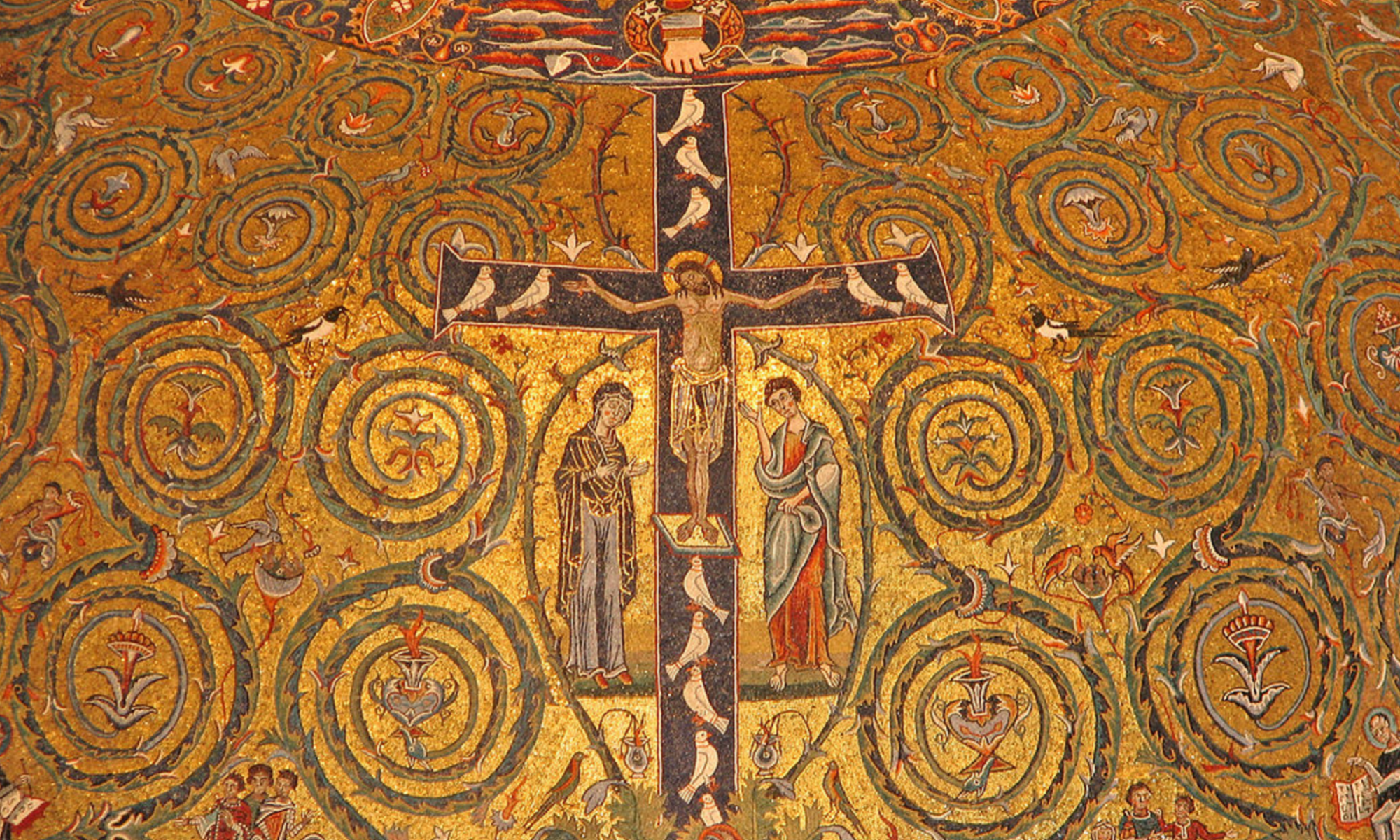
Francis had encountered the voice of Jesus calling to him from the cross in the hillside church of San Damiano. Jesus had beckoned: Rebuild my Church, which as you see is falling into ruin. Francis began the rebuilding effort quite literally, gathering or begging for stones to repair the dilapidated building. He also helped himself to a large bolt of his father’s expensive silk, selling it and attempting to give the proceeds to the stunned priest of San Damiano for help in the repair efforts. The priest prudently refused, not wanting to become one of Pietro’s enemies.

Pietro was a greedy man, but his rage had little to do with wealth. It sprang up from the shame and embarrassment that he felt as Francis rejected the rigid role assigned to him.

The famous friar of Assisi was actually named “John” at baptism – a name given by his mother Pica during the long months of Pietro’s absence in France. Upon returning, Pietro met his son and renamed him “Francis” (basically, “Frenchy”) in honor of the affluent country he loved visiting. In what he saw as great benevolence, Pietro planned to pass on his significant wealth to his son Francis, who would make him proud in carrying on the lucrative family business.

Instead, Francis went about begging, mingling with lepers, and sharing his father’s wealth with the poor. Disgusted and embarrassed, Pietro had him beaten and locked in the cellar, hoping he would fall in line. He didn’t. The next time Pietro was away, Francis’ mother released him, and Francis was right back to rebuilding the church of San Damiano – only now he hid himself in a cave to avoid the revenge of his father. That is when his father went to the bishop demanding justice.

The trial was public. Many witnesses heard Francis declare, “From now on I will say freely: ‘Our Father who art in heaven,’ and not ‘My father Pietro di Bernardone.’ Look, not only do I return his money; I give him back all my clothes. I will go to the Lord naked!”

He stripped himself there and then of his father’s robes, revealing the penitential hairshirt he had been wearing underneath.

And here is where I want to pause the story of Francis’ conversion.

Too often, the Saints are seen as these superhuman beings who quickly and easily rise to heights that are too lofty for the rest of us. The more steps I take on the road of conversion, the more I realize that the Saints were very normal and sinful human beings like you and me who walked a long and often painful path of conversion.

Most of the people who write the lives of Saints are themselves less than fully converted – so they tend to glamorize or oversimplify the journey of conversion. Sure, we would all love it if our conversion could be one simple and dramatic moment of decision and then living happily ever after. But that is rarely if ever how conversion works! Rather, there are many moments of weakness, faltering, stumbling, and struggling. There are many moments of new discovery and new growth. Consider the life of Peter in the Gospels and the Acts of the Apostles. From early on he loves the Lord and has faith in Him. But he continues to struggle before, during, and after the dying and rising of Jesus. His maturing in the love of Jesus is gradual, but significant.

Let’s just suppose that Francis was still – at this moment in his conversion – rather immature and in need of much more conversion. That is actually what the evidence suggests! First, there is Francis’ behavior. He is fearfully hiding in a cave. Plus, his father makes a fair point – it was not okay for Francis to presume that he could just start selling his father’s possessions without permission. There is still no small amount of the entitled party boy in him.

But there is another wonderful detail. For some time, Pietro has been lashing out at Francis with curses. Francis’ solution is to call upon “a lowly, rather simple man” to help him by taking the place of his father. Whenever Pietro would curse Francis, the poor man would speak words of blessing over Francis.

Underlying these details are the fear and shame and insecurity that Francis still felt. Like all human beings, he needed fatherly blessing, and ached for it. He needed to become secure in his identity, to know who he was. That is the greatest gift that fathers in the flesh can give to their children. They can lead them to be secure in the identity that God the Father confers on them – our heavenly Father who alone can fully bless us in the way our hearts desire.

Francis’ greatest example here is not so much his outward poverty as his inward poverty of heart, including his willingness to beg for help. Rather than shaming himself for being emotionally “needy,” he humbly reaches out for words of blessing from a fellow outcast. Through the repeated reminders of another flesh-and-blood human being, Francis’ words to the bishop and the crowd begin taking on flesh.

It sounds nice to say that God is my heavenly Father and that he meets all my needs. But it can be little comfort when my old wounds of shame and insecurity whisper in the shadows that I am not enough, that I am all alone, or that nobody really loves me.

There is a reason why Francis and his followers lived in community as brothers. There is a reason why Jesus taught us to pray to God as Our Father. We cannot connect with the Father without simultaneously connecting with each other as fellow members of the Body of Christ. Only God the Father can fill the void we feel deep in our hearts. But only within healthy community, vulnerably stating needs and receiving care, can we be opened up to receive the Fatherly blessing we need and ache for.

As we become blessed by the Father, then the slow and steady change can begin to happen. Secure in the Father’s love, we can mature in Christ.

Francis’ biographer (Thomas of Celano) delights in the scene of Francis’ nakedness before the bishop and the people: Oh how free is the heart of a man for whom Christ is already enough! True enough, as long as we also remember that Francis was still in the process of claiming that truth and internalizing it – and never without help from others.

Each of us, one way or another, gets pushed into roles. Each of us struggles to discover our true identity, and to be secure in love. In our insecurity we stay stuck in our sins. We need fellow pilgrims on the journey – those who don’t shame us or fix us, but declare us to be beloved children of God. We absolutely need that repeated reminder so that we can stay secure in the Father’s love and keep walking the difficult road of conversion. Maturity will keep coming – usually quite slowly. Like little children who are growing, we need others to notice our growth, to name it, to celebrate it, and to cheer us on. The Saints in heaven certainly do so, but hopefully also some of our fellow Saints-in-the-making.

Who are the “lowly, rather simple” people in your life who remind you of your identity as a beloved child of God?

Certainty ≠ Truth

Certainty can be one of the greatest obstacles to Truth.

That claim may shock many Christians, who feel like they are clutching tenaciously to what little certainty remains in our tumultuous times. But certainty and Truth are not the same thing. When we demand or cling to certainty, our quest for Truth gets abandoned, and the Truth gets lost or distorted.

Have you ever had a moment of reckoning – a moment in which your tightly-held certainty was shattered upon the rock of reality?

My older sister never tires of reminding me of my own six-year-old clinging to certainty. My favorite show at the time was The Price is Right – only I insisted quite emphatically that it was called “Win a Car.” No amount of argumentation on her part could sway me. I had often viewed the latter half of the show at my grandparents’ house after kindergarten. I watched contestant after contestant win a car – or be foiled in the attempt.

And then came my reckoning. I passed by the television one summer morning, saw the flashing lights, and heard the familiar voice of Rod Roddy: “Here it comes! Television’s most exciting hour of fantastic prizes! The fabulous, sixty-minute PRICE IS RIGHT!”

Rod called down the first four contestants, and informed them that they were the first contestants on The Price is Right. And those same words appeared on the screen, tiny at first, but swelling until they filled the screen. I stood agape, stunned at my error. I had been so certain – so very certain.

Reality changes us – if we allow it to. Hopefully reality changes us not just once, but day after day. With childlike wonder, we discover new depths of the mystery. The more we know, the more we desire to know. Authentic growth in wisdom actually yields more wonder and more desire, not less. Those who are wise recognize how little they know and understand.

Such was the wisdom of Socrates in the face of his accusers. When he didn’t know something, he at least knew that he didn’t know. He was not puffed up with false certitude. Such was the wisdom of Thomas Aquinas, who stated that “an article of faith is a glimpse of divine Truth tending towards that Truth” (ST II-II, q. 1, a. 6, sc). Catching a glimpse of Truth is different than possessing it with certainty. Those who catch a glimpse of something they truly care about feel an ache to seek more.

In describing faith, Thomas reminds us that our faith does not point to the proposition, but to the reality itself (ST II-II, q. 1, a. 2, ad 2). And perhaps most shocking of all, Thomas asserts that our knowledge of God is a knowledge what he is not, but that what he is remains utterly unknown to us (SCG c. 3, 49, 9).

Thomas Aquinas is not a relativist, and neither am I. But he is even more a mystic than a theologian. He intuitively understands that God is infinite. The closer we get to him, the more painfully we realize the infinite gap between him and us – a gap bridged not by intellectual comprehension or certainty, but only in a communion of love in the new and eternal covenant.

Jesus Christ presents himself as the Way, the Truth, and the Life. He invites us to enter into a relationship with him and to follow him as disciples. Through faith, we become fellow members of his Body. We begin an ongoing journey of conversion, in which we become changed more and more into him. He invites us into communion with him and his Father. He prays that all that is his will be ours. He invites us as his bride into a one-flesh union with him. We are invited to grow into that union throughout our life.

Our demand for certainty comes from our insecure hearts. To feel insecure is one of the most difficult human experiences. The solution to not the “certainty” of Christian fundamentalism, but the intimacy of communion, and the security that is received in that relationship.

The Truth is not relative, but it IS relational. I love studying ancient and medieval philosophy, and find enormous wisdom there. That great legacy of Truth-seeking did not happen in a vacuum. It happened within the context of community. It is only within secure relationships, and in respectful dialogue with fellow humans, that we can pursue the Truth – never as isolated individuals, but as fellow children of God.

There are two opposite errors here: relativism and fundamentalism. Each in its own way refuses to surrender to reality. Relativism dogmatically asserts that there is no Truth. Those who cling to relativism ultimately refuse to allow reality to change them. They also ultimately refuse to give themselves over in a loving communion with the living God who holds all the answers to our ultimate questions.

But fundamentalism, too, is an enemy of Truth. It pretends to offer total certainty about “the truth” in a way that kills curiosity and wonder – the gifts of God that truly draw us into his Truth. There is a vulnerability and a playful engagement in the curiosity of a child. The “certainty” of fundamentalism exchanges a vulnerable relationship with the living God for an illusory sense of control.

The obsession with certainty has been particularly strong in the modern era (the last few centuries). It shows up in both Catholic and Protestant circles in some form of fundamentalism. We see this clinging to certainty it in the “once saved always saved” approach of some Protestants. We see it in an exaggerated emphasis on the inerrancy of Scripture or the infallibility of the pope. I believe in both of those doctrines as far as they go – but I find that most Christians seriously misunderstand or misrepresent them! Insofar as they point us to divine Truth, both are at the service of the living and enduring Word of God, who is a person inviting us into covenantal relationship with himself and his Father.

Through faith, we share in the dying and rising of Jesus. We are securely loved as God’s children, and are able to grow into maturity in Christ. With childlike wonder and curiosity, we can humbly acknowledge and keep surrendering to a Truth that is always larger than us. In the words of C.S. Lewis, “The further up and the further in you go, the bigger everything gets. The inside is larger than the outside.” May we never allow the temptation of certainty to hinder us from the great invitation of the eternal Bridegroom: “Come further up! Come further in!”