A Mood Change

What is life like when we change our mood from “imperative” or “subjunctive” and learn to live in the indicative?

If that question makes no sense to you, don’t worry – I’ll explain along the way.

I love language. I love learning new languages. I love the experience of connection with someone else’s insights, beautifully expressed – all the more so when the words bridge a gap of time and culture. In another life, I could have been a philologist, like Tolkien or Lewis.

I even love grammar. I’m grateful to my high school teachers, who placed such great emphasis upon it. It served me well later in life when I was wrestling with Latin or Greek or German. With my own writing, being grounded in grammar is not unlike the months of training that Daniel underwent with Mr. Miyagi in Karate Kid. Good grammar doesn’t make good writing, but it lays a sturdy foundation, without which creative expression will stagger and stumble.

During my many years of study, I had nine semesters of Latin and five of Greek. I answered hundreds of questions about declension and case, gender and number, tense and mood. My Latin Composition class in 1998 was at times a torture. Dr. Petruccione relentlessly and manically drove us through Bradley’s Arnold, always sporting a bowtie. Twice every week, we submitted our elaborate sentences, translated from English into Latin. If you missed one time, you dropped a letter grade. If you missed a single class, you dropped a letter grade. Late every Friday afternoon, I would wistfully watch my friends go to goof off, while I plodded off to class. The professor could tell that my mind was wandering, but could never catch me!

“And what mood is that, Mister Sakowski?” At the sound of my name, my distracted brain jolted to attention, frantically poring over the last 10 seconds. Somehow, I always come up with the answer. “Subjunctive!” He screwed up his face with a look of “I’ll get you next time!!” But he never did. What can I say? My body pays attention even when it’s not paying attention. I guess hypervigilance has its advantages.

What kind of overachieving college student enrolls in a challenging elective class on late Friday afternoons? The same kind, I suppose, as the high school student who spends four weeks of her high school summer vacation learning Latin, along with seven of her peers. In 1999 and 2000, home for the summer, I taught Latin upon the request of students at my alma mater. We had a blast.

Most of the students were highly competitive overachievers, but one struggled significantly. Honestly, he only passed because I found creative ways to give him points on his tests. It wasn’t hard, because he made up for his lack of Latin prowess with a wicked sense of humor. One section asked them to parse different words. I had to give him bonus points as I howled at his answers:

  Person?  Magister   [“Teacher” – the name the students called me]

  Tense? Very

  Voice? Sometimes mumbles

  Mood? Depends on the day…

As some of you know, verbs can have different “moods” – indicative, imperative, subjunctive, etc. The indicative mood describes or asks about matters of truth (what actually is, was, or will be the case). The imperative mood gives commands. The subjunctive mood expresses the “woulds” and “coulds” and “shoulds.”

When it comes to discipleship and morality, moods also matter! I’ve come to appreciate living in the indicative mood, rather than the imperative or the subjunctive. Eagerly pursuing the good is much more possible when we can tell the truth with kindness, when we can name particularly what actually is without judging it or pressuring it to be a different way. I wrote recently about this calm noticing and accepting of what is as a prerequisite for virtue.

I remember my early years as a pastor. I was overwhelmed and putting all kinds of pressure on myself. I had just returned from Rome, where I had been researching and learning in seven different languages in the writing of my doctoral thesis. Now I was shared as a pastor of two previously separate parishes, and ministering to the Latino community in the region. I had 5-6 Masses each weekend and felt impossibly pulled in three directions. I lived daily with a fear of failure and a felt trapped in powerlessness. No matter how many “shoulds” I checked of my list, it was never good enough – not for many of the people I was trying to serve and not for my harsh inner critic.

Those first several years, I wrote out my Spanish homilies. One memory that is clearer amidst the blur is my struggle to find effective ways in Spanish to translate “should.” That should say something about the content of my preaching at the time – both to others and to myself!

It was only a matter of time before present pressures and past unhealed wounds converged in an unbearable torrent. When I finally reached out for help, I found myself swept away on a journey of transformation that continues nine years later.

I definitely experienced a “mood change” along the way. I’ve been learning and re-learning the joy of living and relating in the indicative mood – accepting what is and engaging it with curiosity and kindness. Then deciding what to do.

Advice is overrated. It is exceedingly rare for me to tell people what to do. I’ve learned to be with, to notice, to point things out, or to pursue by asking curious questions – all in the indicative mood. When I show up that way, the others can tell that there is no judgment, no pressuring them to be a different way than they are now. They feel my genuine curiosity, wanting to get to know them, and delighting in them as they are now.

To those driven by moral imperatives or living in a “should” fortress, this approach seems madness. In their view, you have to get people to do the right thing, or you’re not being a good Christian. Can you feel the fear there?

How  can we discern what is truly good if we don’t slow down, be with, and perceive what truly is? And how can we see what truly is when shame and fear are in the driver’s seat? They literally and figuratively narrow our field of vision.

I’ve learned to pay attention to what shame is up to. Where there’s contempt, there’s shame. When I notice self-contempt or other-contempt coming up, I get curious. I acknowledge the shame (if I don’t, the shame will power up even more!). But I ask if it’s ok to look at what actually is, setting aside judgment for the moment. Can I just be with you in what’s coming up now?

One would think that all the shaming and pressuring to do what you “should” would be a place of greater truth-telling, but it actually isn’t. When shame is talking, we utter strong-sounding and vague statements like “totally messed up” or “wacko” or “off the rails.” We speak in language of always or never, all or nothing, good guys and bad guys, us versus them. If we calm down and slow down, we can look more honestly at what is really happening – often surprised in the discoveries we make! Pretending like certain emotions aren’t there (or wishing they weren’t there) is not truth telling. Pretending like we can live reaction-less lives is not truth-telling. It’s dehumanizing.

Calming down and slowing down, wondering about what really is (even if it seems unglamourous or “bad”), also allows room for desire to breathe and grow.

Desire can take us places that shame never will. Some of you have seen Monsters, Inc. – the Pixar film about monsters fueling their power plant by capturing the fear of children. Then they make a revolutionary discovery – that laughter is far more powerful than fear. Similarly, desire for goodness is far more powerful than any amount of fear-mongering or “shoulding.” When Christians feel threatened, it seems like only fear and shame will get results. It is much messier to get down in the dirt and look up at what’s really going on. But that’s exactly what humility does.

When we humbly, calmly, curiously, kindly, and truthfully look at what is, we begin to see a much more truthful narrative. We start to see the ways in which deeper desire has been shamed, silenced, belittled, dismissed, or hemmed in. I find that shame is the loudest when desire feels vulnerable and exposed. Rather than allow desire (yet again) to be abandoned, betrayed, dismissed, or disappointed, shame will take over the controls. Setting down shame feels risky! But only then can desire be untethered to seek and find the good, and in finding it to desire it all the more.

What mood are you in today? Do you put pressure on yourself to be a certain way. Is your life one of “I should…” / “I just have to…”/ “I really need to…”? What would it cost you to dial down that pressure for a while, to be with a safe person, and to look at what is? You just might discover your deeper desires, and how your good Father is inviting you to soar.

“Watch!”

Advent is a season of watchfulness. Near the end of Mark’s Gospel, Jesus admonishes his disciples with a simple and strong commandment, “What I say to you, I say to all: watch!” (Mark 13:37).

What does Jesus mean by “watch”?

His one-word command (grēgoreîte) is a dramatic conclusion of extensive apocalyptic prophecies about the destruction of the Temple, the darkening of the sun and moon, the falling of the stars from heaven, and the coming of the Son of Man. You know not the day nor the hour, so watch.

Jesus is not fearmongering – even though many Christians today imagine the apocalypse that way. The coming of the Son of Man is not something we dread, but something we eagerly await, and daily pray for: “Thy Kingdom Come!” “Come, Lord Jesus!”

To be sure, overindulgence, carousing, or spiritual lethargy will hinder us from being watchful and ready at the coming of Jesus. But so will fear! There is an important difference between vigilance and hypervigilance. The former is a sober-minded awareness that is willing and ready to receive and respond. The latter is a fear-based reactivity, a trauma response doing what trauma responses do – ensuring survival at all costs. Jesus is not inviting us to mere survival, but into abundant life.

This fall, I appreciated a prayerful reading of Erik Varden’s The Shattering of Loneliness. Near the end of the book, he suggests a twofold meaning of the word “aware” – 1) to notice; and 2) to take care of or protect. He suggests that the best of the monastic traditions, including the desert fathers, embraced both dimensions of watchfulness. If we exclusively focus on one or the other, we will fail to fulfill Jesus’ command.

I find that, amidst the ruins of Christendom, many of the remnant Christians are so hyper-focused on “taking care of” that they no longer know how to notice with curiosity and kindness. It’s not hard to find hypervigilant and overprotective Christian parents, Christian families, or entire Christian communities. Fear dominates their consciousness and imagination as they try to control their lives and their environments, feeling immensely threatened by “those people.” These attitudes cause grave harm.

When fear predominates, it becomes impossible to live in trust, receptivity, and mutual relationships. I’ve worked with many adults who survived these home and church environments. Beneath all their tendencies of people-pleasing, anxiety, resentment, and control, there is a vast well of grief over never really being noticed, loved, and delighted in for who they are. They had to reshape their identity into cookie-cutter roles in order for the family to feel well-managed and in control.

When fear is intense, our field of vision literally narrows. There is little space for childlike curiosity to notice and discover and grow. I wrote long ago about the difference between Smoke Alarms and Watchtowers. More recently, I explained how virtue is impossible when emotions are eliminated or subjugated.

Christians have understandably felt threatened in the last few centuries. It’s tempting to get stuck in a collective trauma response, bound up in fear, and fail to remember that the victory is already won! Yes, Jesus spends all of Mark 13 offering apocalyptic prophecy. But these teachings immediately precede his entry into Jerusalem and his willing engagement of his Passion. As a victor very much in charge, Jesus overthrows the powers of darkness and brings his Kingdom definitively and victoriously into the midst of a world that is indeed passing away. It is our calm noticing of his presence and activity that will allow us an eager response and a joyful readiness to enter the heavenly wedding feast.

One extreme of “watch,” then, is a fear-based hypervigilance, which is not hard to find in our church communities. In our culture today, you can increasingly find the opposite extreme – an individualistic “mindfulness” that sometimes gets stuck in navel-gazing, or an untethered empathy that leaves no space for truth-telling.

As we see in Jesus, “the kindness of God that leads to repentance” (Romans 2:4) allows compassion and truth-telling to go together. He describes himself and our heavenly Father as “moved with compassion” (Luke 10:33; 15:20), using the Greek word splangna (“guts”). Compassion is an embodied response. We allow ourselves to feel what the other is feeling – especially when it is painful. Rather than backing away, bypassing, or fixing, we stand with as witnesses. Such “being with” is not at all incompatible with telling uncomfortable truths. Once the toxic shaming of “shoulds” is set aside, there is a time and a place for naming honestly and kindly the harm that is being caused by destructive behaviors. Jesus frequently speaks uncomfortable truths with kindness.

What about mindful noticing? During all these years of healing and recovery in my own life, I’ve come to appreciate being aware, here and now, in the present moment. I’ve come to appreciate noticing what is happening, without launching into contempt or judgment. I discover much more truth that way! Much of my former “discipline” was more about self-shaming, drivenness, and perfectionism. From a place of insecurity and fear, I was desperately striving to be good enough to be lovable. That is not virtue.

Of course, overindulgence is not virtue either. As I read Erik Varden’s words this fall, I felt a gentle invitation from the Lord to take the next step from a calm noticing into a healthy “taking care of.” I can be mindful of what is really happening here and now, and then freely engage in a “yes” or “no.” My desires are still unruly and disordered, in need of guidance and direction. They do not need shaming or fixing or subjugation, but they do need to be brought over to the Kingdom of God. So long as my desires belong only to this fallen world, they will indeed pull me downward, in a way that steadily ruins me. As I learn to receive them, accept them, and allow Jesus to love me there, I discover that I can be free in Christ; I can say “no” and be okay.

Jesus is the Word made flesh. He humbles himself to share in the clay of our humanity so that we can be exalted to share in his divinity. Mindfulness has enormous value, but is not an end in itself. It opens us to the transcendence that Jesus brings. It opens us to the fullness of Truth. He is the Way, the Truth, and the Life. Jesus entered this world precisely so that we can be wedded to him and thereby transcend this world – because this world and all the things in it are passing away.

Without the Incarnation, there is no Hope. There is no “taking care of” possible in a world that is under the dominion of its seducer, Satan. Jesus undoes that betrayal, not by eliminating its consequences, but by forging a path through suffering and death into eternal life. Genuine mindfulness allows us to see and follow that path, without being dismayed or distracted by the immensity of suffering that we would prefer to ignore, and definitely without being seduced by the allurements of this world.

Genuine mindfulness allows us to follow the path (not just “me”). The command of Jesus to “watch” is plural (grēgoreîte). He is not inviting an isolated and individualistic mindfulness, but a shared path of noticing and responding. We were never meant to exist as isolated individuals. It is not good for man to be alone.

Pope John Paul II articulated this balance in his Law of Gift: “Man cannot fully find himself except through a sincere gift of himself.” But we cannot give ourselves without much diligent labor of human integration. We must first become more of a whole person, self-aware and self-possessed – thereby allowing us to make a free, wholehearted, and fruitful gift of ourselves. Each person is a unique and unrepeatable mystery, worthy indeed of being loved and cherished in that uniqueness. But that unique giftedness is for the sake of bringing life and healing and goodness to the rest of the Body of Christ. It’s a gift to be given away.

We desperately need healthy Christian community – community which allows us (in the words of Curt Thompson) to be seen, soothed, safe, and secure. It is through a shared and communal “noticing” that each of us can discover more fully who we really are. It is also in that shared and communal noticing that each of us can emerge in lives of discipleship and truly “take care of,” truly become the steward of our story. It is then that self-awareness and self-possession can become self-gift. It is then that we can be one with Jesus in laying down our lives that others may live.

Come, Lord Jesus!

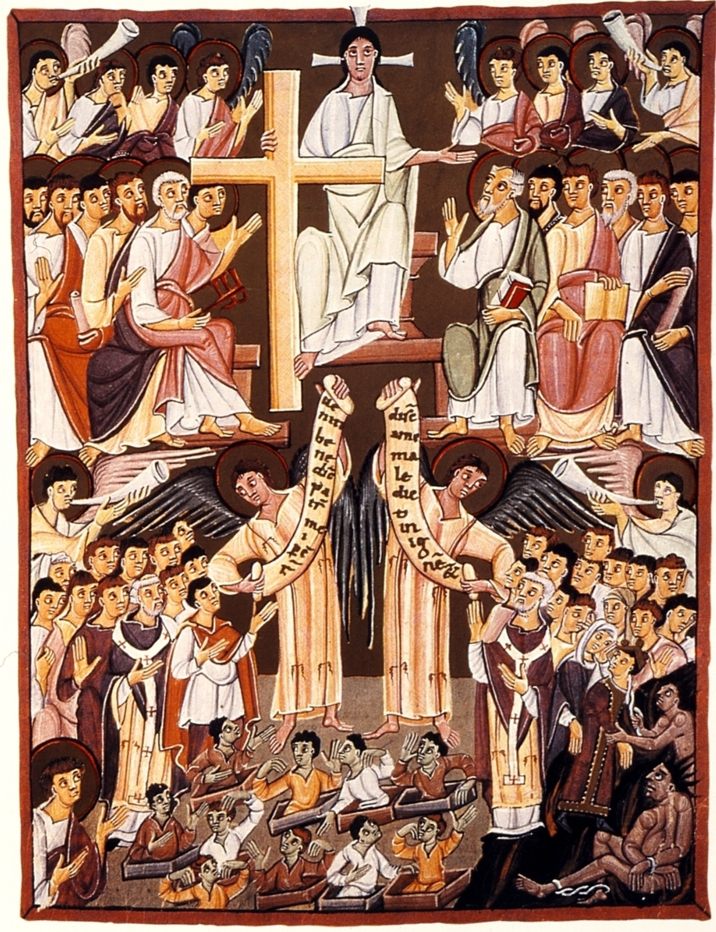
Dies Irae

For Catholics, November is a month of remembrance. We become mindful of many things we would prefer to forget – death and judgment, heaven and hell.

“Memory” in the Jewish, Catholic, and Orthodox traditions is not mainly a matter of looking backwards, but of becoming more mindfully present. Through holy rituals, we “remember” saving events such as the Passover in Egypt, the birth of Jesus, or his death and resurrection – in a way allows us here today to participate and become true sharers in those saving events. They become here and now for us. We also “remember” what is yet to come, the fullness of life in the Kingdom of God. We glimpse the goodness of the Lord in a foretaste and anticipation of more to come.

November begins with the twin celebrations of All Saints’ Day and All Souls’ Day – reminding us that the love of Jesus connects all the members of the human family, even those beyond the grave. In the very flesh and blood of the risen Body of Christ, we are truly united to those who have gone before us. We are never alone. Our deepest longings are never in vain. We are reminded not to get stuck in this fallen world that is quickly passing away.

All around us (at least here in the Northern Hemisphere) nature enters its annual cycle of death and decay. So swiftly does the dazzling and majestic fruitfulness of fall plunge into darkness and decay – particularly for those of us in the upper Midwest!

There is a marvelous medieval hymn traditionally sung during this month of remembering death and the Final Judgment: the Dies Irae. Amidst decades of what Bishop Robert Barron has often described as “Beige Catholicism,” this hymn has been all but forgotten. What is more, those few who remember it tend to be drawn to it for all the wrong reasons: fear-mongering, shaming, or scrupulosity. It doesn’t help that there are bad translations that reflect the shame of the translator more than the actual text. Indeed, the English translation provided in the video linked above describes “universal dread” and a “severe” Judge with “searching eyes.” None of those words are there in the original Latin poetry!

The Dies Irae has captivated human imagination for centuries. In 2014, Thomas Allen of the CBC (Canadian Broadcast Company) offered a playful and fascinating exposition on the influence of this hymn upon musical history.

Yes, the hymn is haunting and disruptive – especially to privileged Americans who would prefer to live comfortable lives and somehow stay young and powerful forever. But it is ultimately an invitation to trust Jesus and step into real Hope.

The world we live in, insofar as it was created by God, is good and beautiful. He entrusted it to us humans as the stewards. We failed in our stewardship. The world we live in, through the devil’s envy, malice, and seduction, is now enemy-occupied territory. Jesus describes the devil as “the ruler of this world” (John 12:31). This world and all the things in it are passing away (1 John 2:17).

The first verse of the Dies Irae reminds us that the “Day of Wrath” will dissolve this world in ashes. However, it goes on to describe the victory of Jesus on the Cross, and the invitation to humble ourselves before him as we receive the redemption that he freely gives. Neither our own merits nor any power of this world will save us on that day. We place our trust in Jesus alone.

“That Day” is also described as lacrimosa dies illa (“That Day of weeping”). We can see why this hymn has been buried in the West during my half century of human existence. We live in a culture that has forgotten how to grieve. And we definitely live in a culture that struggles to engage in real repair when harm has happened. “That Day” of Jesus’ coming will bring both. It is not merely a Day of Judgment; it is a Day that brings full Justice and definitive resurrection and renewal – which is only possible with the fulness of Love and Truth that Jesus will bring. Jesus will definitively heal our shame, if we will allow it.

I’ve developed a keen radar for shame. For several years now, I’ve been contending with my own shame (as well as the shame of others who harmed me in my life – shame that doesn’t belong to me). I’ve learned, at least some of the time, to stand calmly in the face of shame – not to run away, nor to power up, nor to freeze, but to draw closer with curiosity and kindness.

I’ve been learning from Jesus in the Gospels. He frequently pursues those who are feeling shame – when he calls Matthew the tax collector (Matthew 9:9), when he tells the woman caught in adultery “I don’t condemn you” (John 10:11), when he awakens the thirst of the Samaritan woman at the well (John 2), and in his various encounters with Peter. When Peter denies Jesus (as predicted), Jesus turns to look at Peter (Luke 22:61) – not with accusation, but with love and truth. Peter goes out and weeps bitterly. He sees an almost unbearable gaze of kindness – far more painful and more helpful than any accusation or name calling. Peter suffers again after the resurrection, when Jesus awaits him on the seashore, having already lit a charcoal fire (John 21:9-19). He reminds Peter of his threefold denial, not to add to Peter’s shame, but to bring that shame into the light and transform it.

These encounters with the merciful and truth-telling love of Jesus help me imagine what Judgment Day will be like. When I hear the chanting in the Dies Irae describing the “Day of Wrath” or “That Day of Weeping,” I imagine him gazing with love at each of these women and men in the Gospel, seeing right through them, accepting them, choosing them, and inviting them to total conversion. The kindness of Jesus always puts love and truth-telling together. Kindness heals shame, through a gentle yet utterly necessary unveiling of the full truth. That is what “apocalypse” literally means – “uncovering” or “unveiling.”

Shame is a master of disguises. It shows up in outbursts of rage, in ghosting other people, in “cancel culture,” in witty-but-cruel name calling, in self-loathing, or in self-destructive behaviors. Where there’s contempt, there’s probably shame. Where there’s vagueness, there’s probably shame. Where there’s all-or-nothing language, there’s probably shame. I’ve learned to detect the lurking presence of shame, and to draw closer to it, while respecting the sacredness of others’ freedom. This kind and curious pursuit is not what people expect!  I love those moments when it becomes possible to tell the fuller truth with kindness – not to paper over, not to humiliate or condemn, but to be with each other in love and respect while acknowledging all the particulars.

This definitive repairing through the kindness and justice of God is exactly what the Dies Irae is about. Jesus will assemble the nations. Death will stand in astonishment as all the tombs are opened, and all our bodies raised (John 5:25-29). The victory wrought by Jesus on the Cross – overthrowing the cruel empire of sin and death – will be fully unveiled. So will all of our thoughts, words, actions, and omissions. The stories of each and all will be told in their full and unedited versions. In the words of the Dies Irae, “The written book shall be brought forth, in which all is contained, from which the world shall be judged.” No doubt, “My face will blush with guilt” – just like Peter or Matthew or the Samaritan woman. In my fear and shame, I may dread that “the day” will be like a blazing oven that burns up everything (Malachi 3:19) But if my trust is in the victory of Jesus, I will experience “the sun of justice with its healing rays” (Malachi 3:20). There is no other way.

We can conclude with the beautiful words of Pope Benedict XVI in his 2007 encyclical letter on Hope. He describes this encounter with the fire of Jesus’ love, whether on the Day of Judgment, or as a purgatorial experience following my own death. He comments on the apostle Paul’s reflections in 1 Corinthains 3, which describe some of us being saved, but “as through fire.” As Benedict explains, “the fire which both burns and saves is Christ himself, the Judge and Savior. The encounter with him is the decisive act of judgment. Before his gaze all falsehood melts away. This encounter with Him, as it burns us, transforms and frees us, allowing us to become truly ourselves. All that we build during our lives can prove to be mere straw … and it collapses. Yet in the pain of this encounter, when the impurity and sickness of our lives become evident to us, there lies salvation. His gaze, the touch of His heart heals us through an undeniably painful transformation ‘as through fire’. But it is a blessed pain, in which the holy power of his love sears through us like a flame, enabling us to become totally ourselves and thus totally of God” (Spe Salvi n. 47).

Without the Day of Judgment, we cannot share fully in God’s holiness, nor be fully and authentically human. Only the truth-telling and merciful love of Jesus can bring full flourishing and righteousness. Therefore, we pray ancient Christian prayer: “Come, Lord Jesus!”

There is a River

I am from the river.

When I was one, my family moved back to Wisconsin and purchased a little house along the Wisconsin River.

I could see the river from my bedroom window, pulled open on sweaty summer nights, or through the ice that clung to the curtains in January. The river beckoned, beautiful and dangerous: frozen yet fragile in the winter, rising and rushing in the spring, serene in the summer, reflecting bright bursts of color in the fall.

I spent thousands of hours, endlessly exploring in our backyard, between the deck and the dock I had helped my stepdad build. There, near the river, I would catch toads or turtles or grasshoppers. I would dig up worms for fishing, or get grass stains in my pants as I touched and tasted the flowers (the violets were by far the best!). More than once I wistfully watched as a ball plunged into the waters and floated away, eluding the reach of branch or cane pole.

As Heraclitus once suggested, you cannot step into the same river twice. Visiting home elicits a mixture of emotions. It’s the same basic house and yard, but remodeled, refurnished, and rearranged a few times over. The town has the same streets and many of the same buildings, yet feels noticeably different. For many decades, it was a booming paper mill town. Then they witnessed the loss of hundreds of jobs in the early 2000’s, followed by a total shutdown in 2020. What a change from my childhood and teen years, when Consolidated Papers was a Fortune 500 company and invested $400 million to build the state’s largest paper machine.

This fall, I am facilitating a few dozen listening sessions throughout my diocese, inviting our 156 parishes to pivot from maintenance to mission. For many parishes that are struggling, the invitation is felt as an immediate threat. Are we going to close?? What are we going to lose?

The Lord has often surprised me in this process, especially when I feel overwhelmed, fear failure, or put pressure on myself. It happened again a few weeks ago.

My friend showed me a brand new book by Robert Enright, Forgiving as Unity with Christ. I quickly realized – “O, this is going to be one of those books.” It’s going to take me at least six months to meander through the journaling and meditation prompts, which have already tapped deep places in my heart.

So there I was, working on wounds of resentment and unforgiveness (which include my avoidance of feelings of anger). The exercise invited me to remember a time when I received unconditional love from another human, and to enter vividly into that moment. Memories of 1999 cascaded into my imagination. At that time, I received remarkable compassion and kindness from a few friends, especially Peter. It was healing to recall the lovely ways that they attuned to me, drew near to me, held space for my raw pain, and showed empathy.

My gratitude and consolation were interrupted by the memory of how awful it was to lose Peter that November. He was only five months ordained when he unexpectedly and inexplicably died in his sleep.

Out of nowhere I found myself recalling Robert Frost’s poem “Nothing Gold Can Stay.” It opened some of my deepest wells of grief, and I sobbed, not for the first time, and probably not for the last. I was not only feeling that sudden loss of a friend, who indeed glittered like gold. I was connecting with the universal human experience expressed in Frost’s poem. In this post-Eden world, the most amazing and beautiful moments never linger. It is agonizing. We were not meant for endings.

How painful it is to be like the poets or prophets – to have huge imagination and perceive beauty and goodness where many do not. It’s thrilling and delightful. You are eager to share the goodness with others. It’s awful because, often and even inevitably, the delight evaporates. Or it gets crushed, ripped away, or (perhaps worst of all) dismissed or spurned by others, who could have delighted in it. I think here of Jesus weeping over Jerusalem (Matthew 23:37). He imagines and desires so much more goodness for them – but they don’t want it. Or, if they want it, they are unwilling to repent and receive it.

As I continued to pray, I realized the connection between my own intense feelings in the moment and what Jesus is inviting all of us into in the Rebuild My Church Initiative in my diocese. I often feel unsettled and fearful in the face of future unknowns. I keep catching myself trying to manage or control the process, fearing failure. The Lord keeps reminding me that the people of the diocese doesn’t need a project manager; they need my heart. My own experiences are a microcosm of what I’m inviting everyone else into. I have all my familiar survival strategies that feel so much more appealing than trusting and following the voice of the Good Shepherd into more abundant life.

When people first hear about “reimagining the structure of their parishes” or “pivoting from maintenance to mission,” their reaction is often one of fear, suspicion, and self-preservation. I am listening to them in their fears, while inviting consideration that we need not live our lives out of fear.

But the Good Shepherd has been prompting more in my heart. It’s not only the unknowns or the potential losses of the future that are unsettling; it’s what has already changed and changed again, but remains ungrieved. When hurts are unhealed and losses are ungrieved, our human tendency is to fight to hold on to what is already lost, perhaps even finding a scapegoat to blame for the struggles.

Case in point – the loss of Christendom. Fifty years ago, Fulton Sheen prophetically proclaimed, “We are living at the end of Christendom – not the end of Christianity.” Yet so many Christians and churches want to fight culture wars and save Christendom. Rather than weeping over the ruins and rejoicing that new growth is sprouting up, we are fantasizing that we can still stop the collapse – not unlike the Japanese soldiers on Pacific islands who had not yet heard that the war was over.

I’ve been inviting the participants at these listening sessions to reflect upon changes and losses in their families, communities, and churches that have already happened, but are hard to accept. If we don’t mourn those, we will be less capable of heeding the voice of the Good Shepherd, being surprised with resurrected life, and following him into green pastures and new experiences of more abundant life.

In addition to Robert Frost’s poem, my prayer prompted a recall of the 1990’s movie A River Runs Through It. I remembered my curious discovery in Mexico twenty-five years ago. I spotted the movie in a storefront, only the title in Spanish was Nada Es Para Siempre (“Nothing Lasts Forever”). You can’t step into the same river twice. Nothing gold can stay.

Interestingly, in Spain, the same movie bears the Spanish title of El Rio de la Vida (“The River of Life”). There is a river that gladdens the City of God (Psalm 46), running through the heavenly city of Jerusalem. That river brings healing and life and new fruitfulness (Revelation 22).

Whenever I imagine receiving from those saving streams, I sometimes sob. I feel the parched places in my heart soak in the superabundant goodness. It is wonderfully consoling and intensely painful at the same time. My desires awaken, allowing me to drink in divine life. Then, in receiving more, I ache for still more – and know that I still have to wait, mostly because of God’s kindness allowing me to go at my own pace.

In these listening sessions, the hardest questions for people to reflect on have been questions about Hope. Many of our parish communities, not to mention many of our priests, feel listless or lost! They watch their numbers diminish and fear for their very existence, feeling powerless to change. A few of them, I find, have lost all imagination for more. The felt fear is so intense, and the grip on self-preservation so tight, that there is no longer an imagination for what abundance could look like. It feels too painful and too risky to dream of a feast when you are unsure whether you will eat today or where your next meal will come from. Survival mode and scarcity tend to cling to each other.

When I am tempted to feel frustrated or judgy about this narrow-mindedness, the Lord gently reminds me of how patient and kind he has been with me in the very same attitudes. It is truly sad when I or others don’t desire the goodness or abundance that is right in front of us. Or, more accurately, we bury that desire beneath a hardened façade.

It is very much like the story told in the Pixar film Encanto. As with the Madrigal family there, it can be terrifying when the cracks of our façade begin to show, and the “identity” we had falsely propped gets exposed and collapses. But it’s always an opportunity to access the living God anew and remember who we really are. We get to go to the Cross and drink from the life-given stream that flow from the pierced heart of Jesus. He is the Good Shepherd who promises to lead us into more abundant life.

Yes, there is a river that flows through the Heavenly City. That river, too, is beautiful and dangerous. I ache for it and avoid it. That river runs through my divided heart, much like the river that divides my home town.

I am from the river.

Emotions and Moral Virtue

What is virtue?

When I ask that question among Christians, the conversation typically turns to shoulds and have to’s. Virtuous people do the things they are supposed to do. The job of parents and Church leaders is to make sure we do the things we are supposed to do. What is most needed in this view is moral clarity about the rules. The world is full of unvirtuous people because parents and the Church haven’t been teaching clearly enough. If only we have more clear and distinct ideas about morality, all will be well (can you hear the influence of Descartes here?).

When I ask similar questions about emotions as they relate to virtue, at best emotions are named as “neutral.” More often, they’re viewed as a threat or obstacle. We can’t trust our emotions. Morality requires us to subjugate and control them.

“Love is a choice, not a feeling,” I’ll hear Christians say. Or they will even misquote Thomas Aquinas (1225-1274) as teaching that “love is willing the good of another.”

Thomas does say something like that (Summa Theologiae I-II q. 26, a. 4). But he’s actually talking in that passage about love as a desire or an emotion, not yet love as a theological virtue.  He says that when we experience love as a desire, we want good for someone – whether ourselves or another. That desire for good may be rightly ordered or disordered. It is quite possible to want good things for others while trying to manage or control them (just look at the helicopter or Zamboni parents of my generation!).

Thomas actually sees these core human appetites as fundamentally good, and needing the direction and guidance of faith and reason. We desire pleasure and goodness; we are zealous for difficult goods. Often enough, that desire for pleasure is disordered, with a willingness to use or consume or manipulate. Often enough, our anger becomes a weapon used to harm ourselves or others.

I was blown away during my silent retreat last month. I spent much of the time praying with Matthew’s Gospel. In the Sermon on the Mount, Jesus teaches about anger and lust (Matthew 5:21-30). Occasionally, I glanced at the original Greek as well as the Latin Vulgate translation that was familiar to Thomas Aquinas. In the Vulgate, Jesus speaks of one who is angry (irascitur) or one who views another with lustful desire (ad concupiscendum). It was one of those “aha!” moments for me – this is where Thomas Aquinas gets his seemingly technical names for the “irascible appetite” and the “concupiscible appetite.” All humans have these two core appetites: a passionate zeal for righteousness and an eager desire for pleasure and delight. Fundamentally, these two inner drives of the human heart are VERY GOOD, even though, as Jesus teaches, they are in need of integration and re-ordering toward the Kingdom of God.

Thomas Aquinas uses the word “passions” to describe what we would call emotions. The word “passion” literally means something that happens to us. We passively experience it. The word “emotion” suggests an interior movement in our body as a reaction to what we are experiencing. Every emotion, in his view, is an expression of one or both of these core human appetites. True, these desires and emotions are often disordered because of the Fall – but so is our will!

Oh, how interesting it would be if Aristotle or Thomas Aquinas were alive today. They curiously and keenly observed human nature, without the benefit of contemporary neurological research. Today, I am convinced, they would be fascinated by our insights into the brain’s limbic system and prefrontal cortex. Thomas observed that humans have a “common sense” – a part of our brain that blends all of our sensory input into one unified impression. This is how neuroscientists today understand the thalamus (with the exception of the sense of smell). Thomas observed how humans can behave like hunted deer, who have an embodied memory causing them to flee at the sight of a human form. This is how neuroscientists today understand the amygdala. It’s our brain’s security system. Before any sensory input reaches our rational brain, it runs through the amygdala, which sometimes launches us into a fight, flight, or freeze response. These reactions happen automatically, within ¼ of a second. They are pre-rational.

I recall a decade ago, driving home from a Friday night football game. I suddenly sensed a large spider rappelling down an inch in front of my face. Somehow, I found my car pulled over to the curb and myself seated in the passenger seat in less than three seconds. Only then did my rational brain register the situation, with no small amount of astonishment at what I had just achieved. Imagine if it had been a bat! 

I find that so very many Christians (myself included) attempt to grow in “virtue” by no longer having emotional reactions. That approach is dishonoring of the inherent goodness of our bodies. It’s also impossible! First comes the reaction of our limbic brain. Only a few seconds later does it register in our prefrontal cortex – unless our reaction is so intense that we stay stuck in a trauma response. With time and training, our reactions can be received and redirected. But they still happen. Developmentally, this type of training takes years. It’s what is “supposed to” happen in childhood.

Virtue is not a matter of eliminating emotion, nor of subjugating or controlling it. The virtuous person habitually, calmly, and skillfully gives rational guidance and direction to emotions. That is where the prefrontal cortex comes in – the highest and most developed part of our brain. It allows us a calm noticing, which in turn allows what today is called “affect regulation.” Our emotions settle down when they feel the acceptance and calm rational presence of the prefrontal cortex. They are then willing to accept direction – just like a child who truly trusts her caregivers.

Classically, this is exactly what moral virtue is – giving calm rational guidance to our emotions so that they can be ordered toward the good. Our emotions will not authentically accept rational guidance if they are not first received with curiosity and kindness.

Here is where emotionally intelligent parenting comes in. Rather than shaming children for feeling how they feel, mature parents are able to receive the big emotions of their children. They show a curiosity and compassion for what is happening in the bodies and hearts of their children. They help them make sense of it all. Every time that happens, neural pathways are formed and reinforced.

At least 70% of the information in our nervous system flows from the bottom up – as sensory input coming from our body to our brain. When that information is received without judgment, then calm and consistent direction can be given.

Many of us literally lack the neural circuitry for virtue to happen. Sure, we can suppress or subjugate our emotional reactions. We can flog them with “shoulds.” We can exile them or lock them up. But that is not virtue. That is external compliance (perhaps even 90-95% of the time). It leaves us feeling unfree, or even living a double life.

Many people come to priests asking, “Why do I keep doing that???” I gently invite them to notice the tone of voice in their question. We can ask the same question with intense self-contempt or with childlike curiosity (or somewhere in between). Only when there is curiosity and kindness does virtue begin to be possible.

What does this mean? I would suggest that most of us Christians today are not yet in the realm of moral virtue. We have a lot of pre-moral work to do, kindly accepting and patiently integrating our emotions – all the things we needed to happen earlier in life, but did not (and probably have not for multiple generations in most of our families). When you are in survival mode, there is less space for curiosity and kindness.

That is why, when people ask me, “Where did you grow up?” I am barely joking when I respond, “Oh, I’m still growing up!” I am still coming to accept that daily reactions will happen inside of me – frequently and sometimes rather intensely. I am coming to appreciate that it is precisely my capacity to be impacted by others, to receive them vulnerably, and to be moved by their uniqueness and their beauty, that allows me to love them with honor and delight.

May we all become again like little children, allowing ourselves to be moved anew by goodness and beauty in the world around us, and especially in other humans. May we all receive the patient nurture and care that we always needed. Then it becomes possible to become truly mature and wholehearted in virtuous living.

Descartes’ Demand for Clarity

“I think, therefore I am.”

This is another quote we all heard as children. René Descartes (1597-1650), like Francis Bacon, represents a new era in the West, one which winds up exalting mathematical precision and technological dominance over receptivity, relationships, and human integration.

Many a college philosophy class begins by reading Descartes’ Meditations on First Philosophy. “First philosophy” was, at the time, another term for metaphysics – not in the contemporary sense of pursuing occult knowledge, but in the classical and medieval sense of pondering existence itself; what does “to be” really mean?

Like Bacon before him, Descartes spurns the previous approaches. Rather than taking existence as a given and then reflecting more deeply upon it, he begins philosophy with doubt. He insists upon clear and distinct ideas – the kind brought by mathematics. He opens his musings as a solitary “I.” Can I really trust my five senses? How can I be certain I am not deceived? I seem to perceive the warm fireplace before me or the soft chair beneath me, but those perceptions are not clear and distinct like the truth that 2+2=4.

After doubting that the universe around me, other beings, or God exist, I realize that there is one thing I cannot doubt – that I doubt.  If I doubt, that means there is an “I” who is doubting. Therefore, I exist.  From there, I can reason to clear and distinct ideas about God and the world around me. So goes the reasoning of Descartes.

In his demand for clear and distinct ideas, Descartes prioritizes quantitative analysis over our awareness of what he calls “secondary” qualities – which include the perceptions of our five senses, but also things like goodness and beauty and love.

In the spirit of Francis Bacon one generation before, Descartes seeks power. He expresses his hope that this technical and tactical shift of knowledge will allow humans to become “like masters and possessors of nature.” Perhaps, he suggested in his Discourse on Method, it will even free us from illness and aging.

Can you see the connection with our contemporary culture and our obsession with looking forever youthful, or our exaltation of doing and performing over being and relating? Today, the transhumanist movement seductively offers us the dream of Descartes: we can seize the power to transcend our very mortality by means of technological modifications to our humanity. Terrifying.

I began studying philosophy thirty years ago, and am grateful for many wise professors, not so much for the information they communicated as the shared pursuit of wisdom in a respectful and playful environment. For most of them, philosophy was a way of being, not a collection of ideas.

In 1998, just as I was beginning my graduate courses in philosophy, John Paul II published his encyclical letter Fides et Ratio (“Faith and Reason”). He called for a renewal of philosophy as a shared quest for wisdom and meaning. Human beings, he said, are philosophers (“lovers of wisdom”) by our very nature. We are curious. We desire to seek and to find, only to discover that there is still more to discover.

Genuine pursuit of wisdom, John Paul says, begins not with doubt but with childlike wonder. Nor is it an isolated “I” who thinks, but a “we.” The quest for wisdom is always a communal experience. Socrates did not seclude himself in a dark room; he walked the streets of Athens with other wisdom seekers and engaged in meaningful dialogue. Their pursuit of wisdom was a shared effort, trusting in the complementary gifts offered by community, in which the whole is always greater than the sum of its parts.

I remember feeling frustrated reading the Dialogues of Plato (which always feature his mentor Socrates dialoguing with others on a particular theme). Just when I thought I was getting the point, Socrates would disprove it, and begin exploring a new line of inquiry. Over time, he and his students would gain some real insights, but the conversation would result more questions than answers. I found that frustrating. In my own way, I was much like Descartes, harboring a felt need for clear and distinct ideas. I didn’t like the uncomfortable feeling of not knowing, the patient waiting for wisdom to emerge.

I even felt a clenching inside when I read John Paul II’s insistence on “the primacy of the inquiry” – that it is more important to keep seeking wisdom that to feel like you have arrived. At the time, I was keenly interested in apologetics. I felt a certain satisfaction in having clear and distinct answers to those who would dare attack my Catholic faith. I was only beginning to realize the reality that God is always greater, that he is always infinitely beyond my limited insight. Life provided plenty of painful opportunities to keep learning humility.

In the last decade, I’ve become much more trauma-informed. I still see the 1500’s and 1600’s through the lens of revolutionary philosophical ideas, many of which caused harm. But now I appreciate how much Europe was experiencing a collective trauma response. It was an era that boiled with contempt and violence – from the polemical divisions of Protestants and Catholics to the ongoing wars with the Turks to the resurgence of slavery and human exploitation in newly discovered lands. When we feel threatened, we gravitate to black-and-white thinking. Then, like Bacon and Descartes, we demand clear and distinct ideas. We are not okay with abiding in a messy in-between. Like Bacon and Descartes, we seize strategies that allow us to feel in control. We refuse to tolerate any experience of powerlessness. In those centuries, many Europeans (by no means all) felt entitled to power and privilege at expense of slaves or indigenous peoples. These days, many Americans (by no means all) feel entitled to live in “the greatest nation on earth,” with little regard for the status of immigrants or impoverished regions of the earth that serve our interests. Deep down, we know that our comfortable and privileged lives come at a cost to others, but we choose to ignore the signs.

Sadly, there are many Christians who style themselves as “conservative” or “traditional” without realizing how very modern their political and philosophical views are. Such is the rotten fruit of fear-mongering and the seduction of worldly power. It becomes black-and-white and “us versus them.” Too many times, such attitudes have allowed the rise of dictators.

When we find ourselves demanding certainty and clarity, we might become curious and ask why it must be so. There are so many different kinds of certainty: the clarity offered by mathematics, yes, but also the certainty of feeling loved and cherished, the security of belonging to a stable community in which everyone matters, or the shared delight in amazing art or music. Perhaps you have experienced what the poet T.S. Eliot describes: “…music heard so deeply / that it is not heard at all, / but you are the music / while the music lasts.”

The human experience is so amazing when we open ourselves to it – all the more so when we learn to trust each other and open ourselves to the mysteries of life with childlike wonder. It can be tempting to grasp at power and control during times of duress. Then it becomes easy to loathe “those people” and view them with suspicion and contempt. The cost of that kind of “freedom” is perpetual hypervigilance. No, thank you.

I refuse to succumb to that seduction. Jesus is the great “I AM.” Therefore, our restless and racing thoughts can be at peace. He holds us all securely in the Father’s love. He delights in every human being, image bearers that we are. He is grieved by all our contempt for each other, but not worried. He is the unconquerable Lamb, once slain, and forever risen. The peace of Christ is not a clear and distinct idea. It’s the fruit of an abiding relationship.

en_USEnglish
en_USEnglish