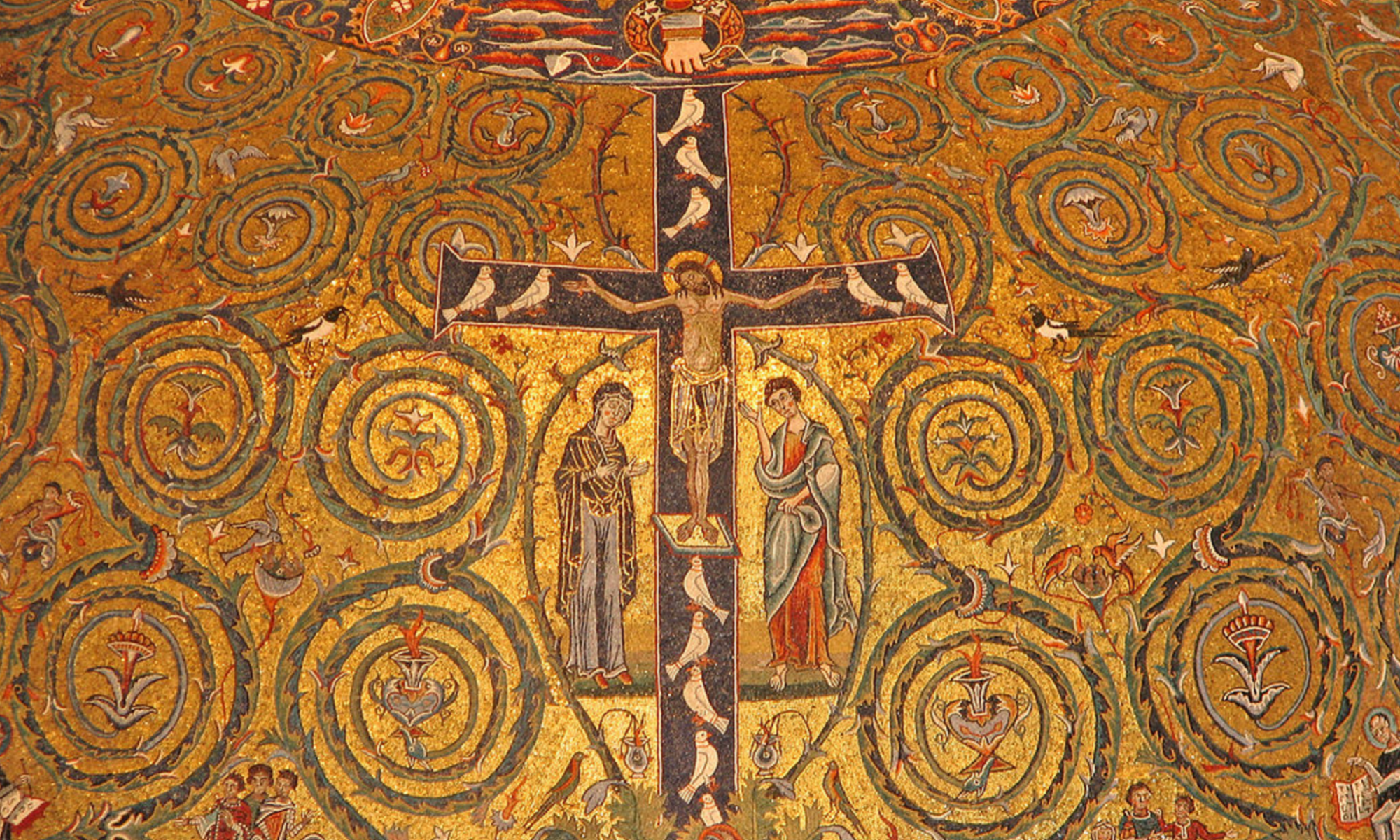

Standing in the Gap

Holy Week invites us into Hope.

Hope sounds lovely, until you actually get into the hoping. There is an often painful gap between what is and what is yet to be!

Jesus literally stands in the gap. He is the one mediator between the human race and God, who eagerly desires all men and women to experience his fullness (1 Timothy 2:4-5). Jesus burns with desire to celebrate the heavenly Passover and so share God’s abundance with his beloved children (Luke 22:15). He suffers intensely in his longing – because God’s chosen children so often do not desire what he desires for them, causing him to weep over our hardness of heart (Matthew 23:37).

Jesus stands in the gap between heaven and earth, He stands especially with the poor, the outcast, the abused, and the abandoned. In his Passion, he willingly plunges into the depths of human misery, uniting himself with all the agony that any of us have ever experienced.

My understanding of the Passion shifted significantly over the last decade as I began experiencing the healing love of Jesus. I used to focus more on how much Jesus suffered physically, how hard he tried, or how much he sacrificed. Looking at the Cross would sometimes cause me to feel that I needed to be better or do more. Without realizing it, I was restlessly striving to be “good enough” so that I could be worthy of love.

Jesus reminded me how his Passion is much more about union. He brings his love and truth into all the darkest and most chaotic moments of human existence. He willingly unites himself with the particular sufferings of each member of the human race. He brings the perfect communion of his eternal Love into each and every one of those places. We are no longer alone in our misery. Love wins.

Little by little, he’s shown me how he was always there in my most agonizing moments – not only my worst sins but also all the moments in which I ever felt terrified, ashamed, powerless, alone, abandoned, neglected, or unprotected. Some of those moments were quite early in my life. And then they’ve been reinforced again and again in no shortage of agonizing situations. It’s a very familiar story to me to feel misunderstood, abandoned, and left alone and unprotected in the face of a massive threat. In those moments, it feels not only like I’ll be alone and unprotected in the face of overwhelming chaos, but that my very lovability is on the line as I walk on the edge of that knife. Impossible pressure. Exhausting to try so hard. But so familiar to me.

On any given day, present-day struggles can still elicit embodied memories of all the times I have felt that way. In comes the seduction of the evil one for me to seize control of my life and manage things for myself. That may come in the form of a restless pressure to produce or accomplish. When that gets unbearable and exhausting, then I am prone to escaping and avoiding and self-soothing. And if I begin to feel violently tossed around in that spin cycle, I am even more prone to isolate and not want to be seen and known by others (how could they love me now?). Unchecked, that isolation and fragmentation become a living hell.

I’ve learned from neuroscience that these initial reactions happen automatically and instantly (in a fraction of a second). I’d so much rather not have the reaction in the first place. But that’s not how the brain and nervous system work. God hardwired us so that our bodies can remember, adapt, anticipate, and react for survival – before the rational brain even gets involved.

What has changed in me, little by little, is a growing gentle awareness of reactions as they start happening, and a growing invitation from Jesus to be one with him in his Passion – even when I can’t just shake it off. On retreat this summer, he showed me what it was like for him when every one of the apostles forsook him and fled (Matthew 26:56). He showed me the union between him and me in every moment of abandonment in my life. He didn’t stop these moments from happening, but he was always there, loving me and choosing me. If he and I are one in the Passion, all will be well, and all manner of thing will be well (even if it feels awful in the tension of the present).

The good fruit of this invitation is most obvious to me when he invites me to stand at the Cross of others. In those moments, I get to weep with those who weep, and to witness what it’s really like for them. I get to stand with them in the gap. I know this has been a great gift to many abuse survivors, who often feel like they are unwelcomed and unwanted in our churches. The community and/or the clergy often don’t want to be burdened with the full truth, the messy symptoms, or the painful tension of what it is like for some of the suffering members of Christ. There are times in witnessing the suffering of others that I simply feel the ache of the love of Jesus on behalf of that beloved child of God. Sometimes there are no words, but only tears or groans. They know the difference between someone standing at the foot of their Cross and someone forsaking them and fleeing.

Jesus invites us as beloved disciples to stand with him at the Cross on Good Friday (and to stand with others who are painfully united with him as members of the suffering Body of Christ). He invites us to stand in the gap of Holy Saturday – trusting in his promise of goodness and resurrection and perhaps having no idea how all will be well.

Few do. In the words of the poet T.S. Eliot, “Human kind cannot bear very much reality.” We prefer to flee from the tension of Hope.

Early in my healing journey, I thought that healing would make the pain and tension go away. Had I known that I would suffer even more, I may have fled! Healing is not always the elimination of tension or pain.  It’s an ongoing encounter with God’s love and truth. It shatters our loneliness and brings you and me ever more deeply into love and communion. If we look at the Saints, we see that this lived communion actually brings more suffering, even as it brings more joy and peace.

One suffering I never anticipated was seeing with ever greater clarity what is diseased and unwell in Christ’s Church. The more I heal, the more clearly I see unnamed abuses, an unwillingness to let go of power structures (not just among clergy but also in parish communities), an unwillingness to be with others in big and intense emotions, a preference to spiritualize or intellectualize, and a contempt or marginalization of people who don’t fit the culture of our comfortable club.

I know very few Christians who are really great at standing at the foot of another’s Cross. Sometimes I’ve felt judgment or contempt on this point, but more and more I realize how much it makes sense. This is where the Church was during Holy Week, when Jesus willingly entered his Passion. All of his chosen priests forsook him and fled – just as I often have. One, apparently, came back on Good Friday to stand with the three Mary’s at the foot of the Cross. Mary Magdalene and a few of the faithful women came to the tomb Easter morning (amidst agonizing tension and loss), while the chosen leaders of the Church cowered in the upper room, and most others were nowhere to be found.

I have huge Hope and imagination for what the Church could be like, as I and others begin to embrace the invitation to stand in the gap. This gives me a sense of what Martin Luther King, Jr. must have felt when he gave his “I have a dream” speech. It’s exciting to see Hope surging in the hearts of some. But it’s agonizing and paralyzing when others exhibit hostility, passive resistance, or apathy when invited to the wedding feast.

Meanwhile, you and I are invited to stand in the gap – just as Moses stood between the stubborn and hard-hearted Israelites and the God who was leading them into so much more. No amount of rational arguments or meticulous strategic planning will change people’s hearts. You can’t coerce someone to give up their precious self-preservation and survival tactics. I was so struck on retreat this summer at how Jesus lovingly chose the disciples and told them repeatedly how much they were worth in his Father’s eyes (Matthew 6:28-30; 10:31), even as he told the truth to them about their fear and their turning away from him. He knew that they wouldn’t be ready until they were ready, and that some of them would never want it.

Mother Mary is the ultimate model of Hope. At each moment of her story, she stands in the gap, waiting for God’s promises to unfold. She sees with clarity the flaws and resistance of the apostles, and stands patiently in their midst, trusting and waiting for the divine goodness she knows will ultimately emerge. And it does.

Jesus invites you and me as beloved disciples to join her and the Saints of every age, to stand in that gap, to abide patiently in the tension of already-but-not-yet, to taste and see how good God is while waiting together for so much more.

Idols and Isaiah

As Advent comes to a close and we welcome the Messiah, I offer some reflections from the prophet Isaiah. He’s been a close companion of mine these past four months.

Isaiah invites Israel to repent of its idolatry, and return to the living God (see Isaiah 44). On the one hand, he names idol worship as empty and fruitless, ultimately leading both idol-crafter and idolater to be put to shame. Yet his lengthy descriptions of the crafting and worship of idols have a certain warmth and tenderness to them. There is a felt beauty and hopefulness in the process that leads, ultimately, to so much emptiness, enslavement, and misery.

Idols are not always ugly. They’re often appealing and alluring. They bring beauty and soothing and comfort. They promise security and protection. There is a certain satisfaction in idols because they are the work of our own hands. We can see them and touch them. They offer a transactional relationship. We know what we are dealing with.

And idols ruin us. They leave us miserably alone and exhausted, languishing in increasing fruitlessness. The work of our hands can never save us. Idols ultimately enslave and torment us.

I have some obvious idols in my life – addictive pleasure that leave me unhealthy, exhausted, depleted, and ashamed. But much more frequently, I feel the pressure to produce or perform, the relentless “I have to, or else…” I can be pulled back-and-forth between those two poles in an endless tug-of-war – only to feel more powerless and ashamed.

As I prepared this summer for the public launch of the Rebuild My Church Initiative in our diocese, I was amped up with anxiety and fear and pressure, which sometimes became paralyzing. In truth, the challenging situations our churches are facing (as well as the amazing opportunities that are in front of us) are beyond any merely human stratagem. The deeper invitation is for me and for all of us to be renewed in our secure relationship with the Father and with each other. Mission is a way of being.

If I’ve learned anything in my personal recovery journey, it’s that most of us have far more shame and fear and insecurity than we care to recognize. Shame and fear, when unnoticed and untended, become a hotbed for the weeds of idolatry to take root and take over.

During many moments of overwhelm this past spring and summer, I felt a gentle invitation from Jesus to keep embracing the interior integration he is inviting me to. Any “successful” institutional renewal only flow from my interior renewal.

So, at the end of the summer, I began journaling and reflecting on forgiveness, slowly making my way through Robert Enright’s new book on that topic. I shared back in October how that reflection unexpectedly brought me to Robert Frost’s poem “Nothing Gold Can Stay.”

The Lord had more to show me that day. I suddenly remembered the words of Isaiah – “All flesh is grass.” And I found my way to Isaiah 40.

“A voice says, ‘Cry out!’ And I said, ‘What shall I cry out?’”

“All flesh is grass, and all its beauty is like the flower of the field … The grass withers, the flower fades, but the word of our God will stand for ever” (Isaiah 40:6-8)

And I kept reading. Chapter after chapter, the words pierced my heart. I felt encouraged and emboldened by the invitation to be a herald, about to cry out to thousands during the fall listening sessions. It’s easy for me to see the ways that our Catholic parishes are clinging to a familiar institutional culture that offers a false security and comfort while choking off new life. The Lord was showing me the same struggle in my own day-to-day discipleship. How can I invite institutions to repent of their idols if I don’t look at my own?

The Lord also spoke promises and assurances (Isaiah 41:8-10). They seeped into a deeper layer in my heart than ever before:

  Friend

  I have chosen you

  I am with you

  I am your God

  I will strengthen you

  I will help you

  I will uphold you with my victorious right hand

For many days, I kept returning to these words in prayer. Meanwhile, I was finishing reading a book about families raising securely attached kids. I was stunned when the author discussed the prospect of grooming and sexual abuse of one’s own children. After many valuable practical instructions on crucial conversations, she calmly and matter-of-factly named the truth that parents cannot stop bad things from happening. Security comes not from the prevention of tragedy, but from knowing that there is an abundance of secure love and connection before, during, and after any bad things that happen.

Here God was answering some painful cries of my heart in the preceding months. Occasionally, I write my own psalms of lament to God (not easy to do, but worth it!). More than once I have written, “How can I trust you?” – along with a list of complaints to God of the ways he did not stop bad things from happening in my life. Where’s the “protection” in that?

Can you see the appeal of idols here? They twist the promises of God in Isaiah 41:

  The LORD – “I am your God”

     Idols –  “Craft your own god”

  The LORD – “I will strengthen you”

     Idols – “You can be strong on your own”

  The LORD – I will help you”

     Idols – “you won’t need to depend”

  The LORD – “I will uphold you”

     Idols – “You can uphold yourself”

  The LORD – “my victorious right hand”

     Idols – “Bad things happen in this world. You need to protect yourself!”

Idols seduce us by appealing to our fear and shame, and distracting us away from our deeper longings of Faith, Hope, and Love. Idols promise protection against those desires getting betrayed, crushed, rejected, abandoned, or disappointed.

Desire is a dangerous thing. It feels dangerous to us. But it is first dangerous to the devil and his kingdom of darkness. He is a liar and a murderer from the beginning, envying what God placed in us and the lofty destiny he has for us. So he assaults and disrupts our secure relationships with God and with each other. He invites us to turn away from our desires, and instead to live controlled, curated, and comfortable lives. He seduces us individually, but especially loves it when entire church institutions can begin living this way. That way, even when some individuals (like the prophet Isaiah) have abundant desire and lively imagination for more, there is an inertia in place to resist institutional change. Prophets tend to be persecuted.

In a fallen world, in which bad things happen (and all flesh is grass that will wither), it is not an easy thing to abide in Faith, Hope, and Love. Holding desire and imagination for abundance means weeping over what is no longer and waiting for the not-yet. It means trusting in the promises of a God who is truly good.

God actually does NOT promise us that no bad thing will ever happen to us. As human beings, we find ourselves in the middle of a story in which terrible tragedy has already struck. Things are not as they should be, and more bad things will happen. Through the prophet Isaiah, the LORD promises to be our friend, to be with us, to be our God, to help us, and to uphold us as He works out the victory that is already assured.

The birth of Jesus at Christmas brings the assurance of Emmanuel, God-with-us. He enters our world, enemy-occupied territory, on a stealth rescue mission. Precious few people realized that the God-man was in their midst – certainly not the rich or the powerful of this world. They only felt threatened and attempted to murder him. Baby Jesus barely escapes.

I love imagining that flight into Egypt. Baby Jesus, even in his frail humanity, felt calm and secure, not because Joseph and Mary were preventing bad things from happening, but because they were connecting again and again to God, to each other, and to him. They had no idea how this all was going to be okay, except that they were being assured by God’s promises.

Jesus brings true salvation and security. Genuine security is not found in managing or controlling. It’s not found in five-year strategic planning or by setting measurable goals and objectives (even when there is a time and place for those). Genuine security doesn’t even mean that you and I won’t experience fear or failure. We will, and often.

The true security that Jesus brings is the one-flesh union of the heavenly wedding feast, already anticipated on the Holy Night that we are about to celebrate. The gap between heaven and earth is now bridged. Humanity and divinity are now one, in the tiny body of the babe of Bethlehem. What God has joined together, no human being can separate.

Come, let us adore Him.

With-ness and Witness

Advice is overrated.

When we are suffering or struggling or stumbling, we don’t need fixing or figuring out nearly as much as we need witnesses and companions. We need fellow human beings who are with us and for us, and who are willing to stay connected to us even when the answers aren’t obvious.

Consider the Crucifixion of Jesus. Although most of his closest companions fled and abandoned him, a few faithful witnesses remained at his side: “Standing by the Cross of Jesus were his mother and his mother’s sister, Mary the wife of Clopas, and Mary Magdalene” (John 19:25).

For almost any of us, what an agonizing and overwhelming sense of powerlessness this scene would evoke! We could not bear to watch the one we love in utter torment. We would very quickly feel like we had to fix it or make something happen. But they stood. They witnessed. They remained in a state of with-ness. They loved.

I’ve been a priest for nearly 21 years, and have found myself in the face of all sorts of human misery. As a pastor of two churches, I was one of the first to hear the shock of a cancer diagnosis, whether from the patient or from his loved ones. I preached at funerals following suicide, tending to the survivors who were stricken with guilt and shame. I had a front-row seat to family drama when it came time to seize the car keys or relocate a declining parent into memory care. I saw all the various ways people deal (or don’t deal) with the dying of a loved one. I certainly saw death – or at least the before and the after of death, since the moment itself is veiled. I met with the depressed, the suicidal, the anxious, or the scrupulous. I heard thousands of Confessions, often of people feeling shame as they found themselves returning to the same sins over and over. I met many people who were desperately striving to fix their spouses or their children (even when the “children” were older than I was). I encountered far too many burnt-out caregivers who found themselves stuck in rage or depression after months or years of trying to do it all by themselves.

How was I “with” those people? How did I witness?  I’d like to say it was with the heart of Mother Mary as she stood at the foot of the Cross, but that hasn’t always been the case.

I can think of many times, in younger years, in which I felt like I had to fix it. I had to help them feel better, or change their attitude, or help them believe the truth. I had a preconceived outcome and saw it as my job to convince them of it. I compared their situation to those of other people who had it worse. I got them to laugh. I said pious things. I bypassed their deeper heartache.

To be fair to myself, I know many people who remember with gratitude the care I provided ten or twenty years ago. I was still myself, even though less mature. I have always been curious about people and caring about their suffering. I was not always in touch with my own sadness, shame, fear, or anger. I used to minimize my pain, ignore entire sectors of my heart, and avoid looking at the full truth of my story. That kept me from a deeper “with-ness” with others.

As I look back, I actually went quite often with people into difficult or intense situations – for as long as I can remember. It’s part of my story. From a tender young age, I learned to contain my own emotions and be strong for others. If others felt shame or panic or rage, I just had to take it. So I got really good at taking it. But “taking it” is different from “being with.” I take it because I have to. I learn how to be selectively present, and feel resentful if it gets overwhelming or extreme. And as the resentment or stuck-ness sets in, I become highly susceptible to addictive behaviors once the “have to” goes away.

Jesus willingly and freely entered his Passion. He chose it. He didn’t do it because he had to or because he should. Yes, he agonized in the garden (how could he not?). But he surrendered to his Father’s will in full freedom.

No one took Jesus’ life – not the Pharisees, not the soldiers, and not his Father. Every Good Friday, we hear the story in John’s Gospel. He is very much the one in charge. At any moment he could stop it. But he doesn’t. He chooses a solidarity with our suffering, a “with-ness” that defies normal comprehension. He plunges into the depths of our human misery – all the harm others have ever done to us, all the ways we ourselves have harmed, and all the damaging effects. He freely says “yes,” willingly connecting himself to all of it.

The three Marys willingly stayed connected to him. They stood at the foot of the Cross, not because they “had to” or felt stuck, but because they wanted to be witnesses and wanted to be with.

I still have a lot of growing up to do, but I am learning to be with and be a witness. In the face of powerlessness or heartache, I still sometimes notice in my bodily sensations an urge towards cracking a joke or generalizing or spiritualizing. Those are moments in which I can be curious about why I am pulling away. More often, I choose instead to remain with. Now that I have explored far more places of heartache in my own heart, I find myself able and willing to go into deeper and darker places with others, without losing myself. That exploration often takes us beyond the presenting symptoms (addictive behaviors, relational struggles, anxiety, etc.) and down to the roots. I keep discovering that the majority of our families, though beautiful, carry far more brokenness and dysfunction than we wish to talk about.

The same holds true for our church families. So many have left our churches over the last few generations – too often because we in the Church harmed them or neglected what they really needed. Among those who remain, you will find a significant number of anxious and not-yet-converted Marthas (cf. Luke 10:38-42), or of judgy and controlling older brothers or sisters who don’t want to see that they are every bit as lost as their “fallen away” or “prodigal” siblings (cf. Luke 15:11-32).

What do hurting people experience when they come to our churches? Do they encounter loving witnesses who are ready to stand with them at the foot of their cross? If so, they will feel a sense of safety and belonging; they will discover a secure home in which they can begin to heal and mature.

Too often, both people and priests alike behave like those who don’t yet recognize our total and radical need for the Divine Physician. When we humbly and truthfully acknowledge that need, when we get serious about walking a path of ongoing healing, we will discover in ourselves a much greater capacity for with-ness and witness.

Triggers and True Kindness

These days, merely uttering the word “triggered” is likely to trigger someone.

There are many who mock today’s tendency to give a “trigger alert.” I notice intense reactions of contempt among some of my fellow Christians. I have a hard time imagining Jesus showing the same scorn. He compassionately sought out those who were weak or wounded. He met them with tender love. He did not expect them to pull themselves together before he would allow them to belong or to follow him.

At the same time, Jesus did not preface his teachings with a “trigger alert.” In his parables and conversations, you can see him intentionally eliciting a reaction from his listeners. He skillfully provokes in order to uncover what needs healing, to awaken desire, to proclaim Good News, and to invite them into a covenantal relationship in which they can grow and bear fruit.

To be triggered is to experience a bigger reaction to a situation than one might normally expect. Amidst a sudden influx of images or bodily sensations, a trigger might elicit a flash of anger, a surge of sexual arousal, a pang of dread, a paralyzing anxiety, or a dissociative numbness.

And it happens so very quickly. Hence the term “trigger.” Much like a speeding bullet, our nervous system and limbic brain have the capacity to be launched into a life-or-death response.

The reaction happens first. Rational thinking may or may not follow, depending on the intensity of the reaction. The activation or the shutdown of our body begins in a fraction of a second. We are already mobilizing, fleeing, freezing, or going numb by the time our rational brain gets the memo a few seconds later – that is, if the memo even arrives. Survival is the priority when it comes to our body’s trauma responses.

Eight centuries ago, Thomas Aquinas noticed and reflected on these reactions that are common to all mammals. Deer who have memory of being hunted experience a swift reaction in the presence of humans. Our bodies and brains have a capacity to remember, to form associations, and to expect what will happen next. Without having access to the findings of neuroscience, Thomas was already observing the principle that “neurons that fire together wire together.”

In situations of threat, getting triggered is a marvelous asset. The speed and intensity of our reaction are the very thing that helps us get back to safety. In day-to-day relationships, triggers can be frustrating, as we go on hurting ourselves and the ones we love by any number of reactive behaviors: raising our voice, interrupting, berating, glaring, getting small, fawning, avoiding, withdrawing, isolating, going numb, turning to an addiction, etc.

Most of us wish we didn’t have these reactions. We wish they would just go away. Or we feel resentful at those who so insensitively trigger us. Yet every trigger is an opportunity to experience authentic connection, healing, and repair.

I began exploring my own triggers seven years ago, in my early months of healing and recovery. I remember that summer well, slowly reading Seven Desires by Mark and Debbie Laaser. They gave names to my behaviors and experiences. I didn’t always like it. It was painful to see how often I had been putting expectations on others and on myself, rather than acknowledging and feeling my deep and unmet needs. It was also liberating to tell the fuller truth. It opened up more and more curiosity.

Mark described triggers as an opportunity to be curious about my unmet needs, to become responsible for them, and to communicate about them – rather than expecting or demanding or resenting. Daily curiosity allowed me to notice and share with friends my various overreactions. Little by little, I grew in an awareness of what I was really feeling and needing. I noticed how present-day reactions were connected to my story.

Debbie described her preference to imagine triggers as “anointings” – meaning that we can welcome the anointing balm of the Holy Spirit any and every time we feel a strong reaction. That was such a lovely invitation, and one that I also started practicing.

There began in me a “thawing out” process. After decades of minimizing my feelings and needs, I began paying attention, allowing time and space and care. There’s a real challenge there – thawing out hurts!! Over time, I discovered new layers in my story – long years of loneliness and heartache that I had never fully felt. With the strong and tender presence of the Virgin Mary, my daily prayer became a time in which I could bring my daily triggers, allow myself to feel more of them, and welcome the anointing of the Holy Spirit. It was so painful and so consoling.

These experiences unfolded over months and eventually years. Scriptures began coming to life for me. My body is a temple of the Holy Spirit (1 Corinthians 6:19). That means I can allow myself to feel intense sensations in my gut, chest, or throat. I can welcome the Holy Spirit there. He can anoint me there. The very name “Christian” implies being a “christ” – being anointed as Jesus was anointed. Jesus promised that very anointing in the Beatitudes when he said “Blessed are those who mourn, for they will be paracleted.” (Matthew 5:4). I use the word “paracleted” in order to highlight the anointing of the Paraclete that soothes and encourages us whenever we are willing to experience our intense heartache and receive needed care.

Case in point: Just minutes ago, I received an unexpected and totally unwelcome interruption. It abruptly brought up all kinds of intense memories for me. So what did I do? I felt resentment and anger at the text message. I devoured an unhealthy snack, feeling shame as I ate it, along with the predictable and not-nearly-enough soothing sensation. Then I noticed myself just wanting to push through and move on. Then I felt the invitation to practice what I am preaching here. I took 5 minutes to lie down, allowing myself to feel more of it. I wept and shook and gasped for air. I realized how young I was feeling (like a 1-year old?). I realized how powerless and unprotected I had been feeling, and how familiar that was to my nervous system. I allowed time to receive comfort. I feel much more peace now.

Part of me feels frustrated at this “fragility” or that I still need so much. But if I tell the truth, what today required a 5-minute break would have set me in a rut for days or weeks in the past – and without me even being aware that I was triggered. The healing steps that I have already taken now give me a window of opportunity (usually) to notice and be aware, and to decide how to respond to the trigger. It’s a slow process that requires the faith of a child.

In healthy human development, as infants or toddlers or children, we have thousands and thousands of moments like the one I just had. Initially, that care comes from others; over time, we grow in our own capacity to notice what’s happening, to be resilient and resourceful, and to respond with good care and reasonable behavior.

As I get to know thousands of people’s stories, I am discovering an unpleasant reality. Most Americans I know did not experience myriads of moments of that kind of care as a child. We were more likely to be ignored, dismissed, judged, threatened, humiliated, attacked, or used. Many of us learned at a very young age either to keep our needs and feelings to ourselves, or that we will only get care if we perform or achieve, if we are dramatic or manipulative, or if we are giving something in exchange for it. We can expect as adults that it will take many thousands of moments of getting triggered, noticing our reaction with kindness, taking time to receive, and reconnecting. The alternative is to continue through life with unhealed wounds and unmet needs – which ultimately means remaining wounded people who wound people.

What about other people’s triggers? If we look at Jesus, we see grace and truth. Kindness seeks to heal ruptures, restore communion, and grow together in love. That requires a skillful combination of empathy and truth-telling. Jesus shows a marvelous awareness of what each person needs at a given moment. He neither backs away nor barges in. He loves them first, and then playfully engages their defenses, inviting them into more love and more truth.

To be oblivious or uncaring about what is obviously triggering to someone else is unkind or even cruel. But to expect others to tiptoe around my own triggers is egoistic and even abusive. I should know! I spent much of my life tiptoeing around others’ triggers. I’m learning that I don’t have to keep doing that. It helps neither me nor them. Their triggers and their needs are their responsibility, even if I genuinely care about them.

We all need people who care about what we need and feel, and who help us make sense out of life. Jesus needed that – and he experienced that! Not from most people, but from some.

Will we become again like little children? Will we admit and acknowledge the depths of our need, and be aware that those around us have their own stories and their own needs? Will we be responsible for our own needs and not expect others to do acrobatics around our tripwires?

May the true kindness of Jesus be an open invitation to each of us, in our own human growth, and in our relationships with one another.

Admiration ≠ Love

Admiration feels amazing – for a while. It is never enough. It never satisfies our insatiable thirst for love. Admiration is not love.

Consider how many celebrities bask in the admiration of their fans, while secretly struggling with loneliness or depression. Consider the trend to chase after “likes” on social media – often eliciting envy in the onlookers, thrilling for a while, but inevitably leaving the recipient feeling empty and disappointed. Consider the mental health crisis in our schools and universities – including (and especially) among the “high performing” students.

I recall a conversation about university life. One institution was monitoring their students who were at the highest risk of flunking out. A consistent profile was emerging. It was not what many would think – not the party crowd who are getting distracted from their studies. No, by far the larger at-risk group was made up of students who had “performed” at a high level in high school, had presented an “ideal” college application, and were now in desperate trouble.

I was certainly one of those high-pressure students as I entered the university, though it took me another two decades or so to have my perfectionism fall apart. In part, that was because I had some genuine experiences of being loved for who I was (experiences that are increasingly scarce for young people today!). In part, it was because of my intense determination and my many talents. Whenever I seemed stuck, I fought and found ways to keep “succeeding.” I got myself back to a place of being admired by others. And it kept getting lonelier.

It was exhausting being admired, not to mention terrifying. There was no room for rest. Being admired meant that I couldn’t fail. I had to keep succeeding. It meant I couldn’t have any messy emotions or be in need. Shame was always lurking in the shadows – warning me that others would want nothing to do to me if I didn’t keep it up.

What I really needed was love – to be loved for who I really am. Being loved for who I am is so different than being appreciated for all that I do or being celebrated because of how amazing I am at this or that role.

It was incredibly hard to be loved for who I was because I had buried that identity so deeply that I didn’t even know it myself! During most of my childhood, I felt like I was under surveillance. I had to behave a certain way and be a certain way – or else. I discovered over time that I could be a “good” child by not having emotions or needs. I could even receive praise or more privileges if I was highly responsible, dependable, disciplined, and successful. I grew into that role and stayed in it for a few decades. The admiration was a drug that, like other drugs, kept me anticipating the next dopamine release – but ultimately left me feeling hollow. Others were loving me in a role, but they weren’t actually loving me – because I was keeping the real me hidden.

The last seven years have been an arduous but rewarding journey of recovering and reclaiming who I really am – who God created me to be. That journey has introduced me to unexpected companions and new friends. Even in environments with a high level of safety and care, I still find it awkward or scary when others really see me, and all I can do is receive their love – or squirm away from it. My defenses still spring up – though with slowly increasing freedom to notice what’s happening and allow the defenses to settle back down. It still feels easier to be in a “one up” or “one down” position – admired by another or admiring another; clearly “stronger” or “further along” than another or clearly in the position of an admiring (and subtly fawning) disciple.

I am convinced that the deepest wound we can experience is not being loved for who we are. Facing abuse is hard. I’ve done it with my own experiences of abuse, and I’ve very often been there with others. But in every case I have found the deeper wound and the longer road of healing to be around the ache to being loved for who we are. Once we have a chance to work through the fear or hurt or rage at being mistreated or used, we begin to access the deeper heartache of longing for love but not really receiving it. Lack of love is the deepest wound, resulting in the biggest ache.

The more I have healed, the more I see how omnipresent this wound is! Our churches hold up “good” Christian families to be – ahemadmired by the community. And their children or adult sons and daughters often struggle with feeling alone and unloved. Until their parents begin facing their own heartache and receiving what they really desire and need, they will struggle in providing it for their children. I say all this without the least bit of shaming or finger-pointing, but to tell the truth with kindness.

I believe that most of our families have transmitted heartache from generation to generation. How could we not? On a collective level, we have endured massive traumas over the last 150 years: the radical reordering of society and family life wrought by the Industrial Revolution, the struggles of immigration, two global pandemics, the Great Depression, and savage wars that have killed more people than the rest of the human centuries put together. How many of our families have actually faced that heartache and received the needed healing? Until we do, we are bound to keep transmitting the pain – leaving it to the next generation to figure out. Meanwhile, the saddest result is that most children are left entering adulthood feeling insecure and unloved.

I am aware that many readers may be feeling shame about how they have treated others. Notice that – but please don’t let it distract you from receiving what you need. We cannot give others what we have not received ourselves.

Do you tend to seek admiration rather than love? Do you truly feel loved for who you are? Are you playing a role rather than abiding securely in your authentic identity? Would you like to change that? If so, may the Holy Spirit inspire you and illumine the next step or two along the path.

Self-Denial vs. Deprivation

“It is just as much a sin to deprive the body without discernment of what it really needs as it is to indulge in gluttony.”

These were wise words of Francis of Assisi to his band of brothers in the 1220’s. This is the Francis of Assisi who embraced radical poverty, including fasting and prayer vigils that most today would consider austere. He often meditated on the sufferings of Christ, and desired to be one with Jesus on the Cross. But Francis was known above all else for his radiant joy – a heart bursting with praise and gratitude. He surrounded himself with beauty and delight, but never grasped at it. He freely gave it all back to God.

The daily invitation of Jesus was imprinted in Francis’ heart: to deny ourselves, take up our cross each day, and follow him (Luke 9:23). How, then, can we make sense of his caution about not depriving ourselves of what we really need?

Francis of Assisi, with his marvelous grasp of the human heart, understood intuitively what contemporary research proves consistently: there is a connection between unmet human needs and unwanted behavior. Whenever we human beings are chronically deprived of play, rest, connection, community, understanding, safety, nurture, or meaningful purpose in life, it is only a matter of time before we start acting out with entitled behaviors.

Deprivation feeds entitlement. Entitlement then seizes. Our grasping attitude may not be that far from that of Sméogol in Lord of the Rings: “We wants it, we needs it! Must have the precious! They stole it from us!” If you are not a Tolkien fan, then I imagine you can resonate with the words of the apostle Paul, “The good I desire I do not do, but I do the evil I do not want” (Romans 7:19).

The immediate instinct in these cases is to assume that it is a problem of laziness or lack of discipline – often with no small amount of self-contempt and shame. We then punish ourselves by deprivation, telling ourselves we are doing penance and following Jesus. But in many cases, these penances embraced without discernment also begin to cut us off from what we truly need – from the things our hearts (and limbic brains) were looking for in the first place.

As a priest, I’ve worked with hundreds of people over the years who struggle repeatedly with the same patterns of behavior. Any time I have curiously explored, I have always found a significant deprivation of one or more authentic needs. Deprivation is not the primary reason why people get stuck in unwanted behaviors, but it is almost always there as a driving force!

I’ve learned much from contemporary Christian authors like Mark Laaser or Jay Stringer. Mark (now deceased) helped thousands to find freedom from their addiction to pornography or worse, not to mention helping to restore many marriages. Jay conducted research with 3,800 men and women struggling with unwanted sexual behaviors. His book (entitled Unwanted) explores the causes and contributing factors that need to be addressed if a struggling individual desires to live differently. Both make a convincing case for the importance of paying attention to our human needs, whatever our unwanted behaviors might be. Mark and his wife Debbie (in the book Seven Desires) describe how every human needs to be heard and understood, affirmed, blessed, safe, touched in a meaningful way, chosen, and included. Jay discusses the importance of delight, rest, play, creativity, meaning, and purpose. If we have a serious lack in any of these areas, we are likely to find ourselves unfree in our decision making.

Today’s authors give more precise language to these needs, they are by no means the first to notice them! I think of the Rule of Saint Benedict (he lived from 480-547). Most of us today would find their monastic lifestyle quite penitential. But it is moderate compared with the desert monks that Benedict had learned from. His Rule seeks balance and adaptability. He frequently acknowledges the importance of a wise abbot offering accommodations to monks regarding their prayer or eating or sleep, based on what is truly best for them and the community.

And then there is the quotation from Francis. Here is the fuller story from his companion and biographer, Thomas of Celano:

“One night while all were sleeping, one of his followers cried out, ‘Brothers! I’m dying! I’m dying of hunger!’ At once [Francis] got up and hurried to treat the sick lamb with the right medicine. He ordered them to set the table … Francis started eating first. Then he invited the brothers to do the same, for charity’s sake, so their brother would not be embarrassed.”

Francis concludes with the important lesson: it is just as much a sin to deprive the body without discernment of what it really needs as it is to indulge in gluttony. And then he reminds them of the supreme rule of charity (Christ-like love of God and neighbor). Our freedom in receiving and giving love is the ultimate test in discerning the wisdom of any self-denial.

Finally, let us not forget the example of Jesus himself. His human needs mattered. As a human being, he definitely received understanding, safety, nurture, delight, care, connection, rest, and play – not all the time or from everyone, but in ways that left a lasting impact. Throughout his childhood, he received from Mary and Joseph, not to mention his heavenly Father. He spent less than 10% of his life giving in public ministry – and even then he received care from friends like Lazarus or Mary or Martha. Even in Holy Week, Jesus rested in Bethany with those friends – receiving hospitality and love. Even in the Garden of Gethsemane, as he entered his Passion, Jesus reached out to his other friends (Peter, James, and John), asking them for connection and care.

Sometimes we don’t get what we need. Sometimes God even asks us to sacrifice things that we truly need – but usually he doesn’t. Over time, as deprivation of authentic human needs intensifies, our freedom tends to diminish, and with it our ability to receive and give freely in love. Our “sacrifice” will become joyless; our resentment will increase – and with it a Gollum-like grasping of entitled behaviors.

Discernment is the key. Jesus tells us to test a tree by its fruits. If self-denial is leading to growth in freedom, growth in faith, growth in hope, and growth in love, then we know it is being led by the Holy Spirit.

Yes, our greatest calling is to make a total gift of self and become the grain of wheat that dies so as to bear abundant fruit. That self-gift is only possible if (like Jesus) we humbly allow ourselves to receive, again and again, all that we need. Francis of Assisi and many other Saints understood. Their humble acknowledgement of their depth of human need allowed them to receive. Their receptivity opened them to the amazing joy of self-gift. May we learn from their example!