Triggers and True Kindness

These days, merely uttering the word “triggered” is likely to trigger someone.

There are many who mock today’s tendency to give a “trigger alert.” I notice intense reactions of contempt among some of my fellow Christians. I have a hard time imagining Jesus showing the same scorn. He compassionately sought out those who were weak or wounded. He met them with tender love. He did not expect them to pull themselves together before he would allow them to belong or to follow him.

At the same time, Jesus did not preface his teachings with a “trigger alert.” In his parables and conversations, you can see him intentionally eliciting a reaction from his listeners. He skillfully provokes in order to uncover what needs healing, to awaken desire, to proclaim Good News, and to invite them into a covenantal relationship in which they can grow and bear fruit.

To be triggered is to experience a bigger reaction to a situation than one might normally expect. Amidst a sudden influx of images or bodily sensations, a trigger might elicit a flash of anger, a surge of sexual arousal, a pang of dread, a paralyzing anxiety, or a dissociative numbness.

And it happens so very quickly. Hence the term “trigger.” Much like a speeding bullet, our nervous system and limbic brain have the capacity to be launched into a life-or-death response.

The reaction happens first. Rational thinking may or may not follow, depending on the intensity of the reaction. The activation or the shutdown of our body begins in a fraction of a second. We are already mobilizing, fleeing, freezing, or going numb by the time our rational brain gets the memo a few seconds later – that is, if the memo even arrives. Survival is the priority when it comes to our body’s trauma responses.

Eight centuries ago, Thomas Aquinas noticed and reflected on these reactions that are common to all mammals. Deer who have memory of being hunted experience a swift reaction in the presence of humans. Our bodies and brains have a capacity to remember, to form associations, and to expect what will happen next. Without having access to the findings of neuroscience, Thomas was already observing the principle that “neurons that fire together wire together.”

In situations of threat, getting triggered is a marvelous asset. The speed and intensity of our reaction are the very thing that helps us get back to safety. In day-to-day relationships, triggers can be frustrating, as we go on hurting ourselves and the ones we love by any number of reactive behaviors: raising our voice, interrupting, berating, glaring, getting small, fawning, avoiding, withdrawing, isolating, going numb, turning to an addiction, etc.

Most of us wish we didn’t have these reactions. We wish they would just go away. Or we feel resentful at those who so insensitively trigger us. Yet every trigger is an opportunity to experience authentic connection, healing, and repair.

I began exploring my own triggers seven years ago, in my early months of healing and recovery. I remember that summer well, slowly reading Seven Desires by Mark and Debbie Laaser. They gave names to my behaviors and experiences. I didn’t always like it. It was painful to see how often I had been putting expectations on others and on myself, rather than acknowledging and feeling my deep and unmet needs. It was also liberating to tell the fuller truth. It opened up more and more curiosity.

Mark described triggers as an opportunity to be curious about my unmet needs, to become responsible for them, and to communicate about them – rather than expecting or demanding or resenting. Daily curiosity allowed me to notice and share with friends my various overreactions. Little by little, I grew in an awareness of what I was really feeling and needing. I noticed how present-day reactions were connected to my story.

Debbie described her preference to imagine triggers as “anointings” – meaning that we can welcome the anointing balm of the Holy Spirit any and every time we feel a strong reaction. That was such a lovely invitation, and one that I also started practicing.

There began in me a “thawing out” process. After decades of minimizing my feelings and needs, I began paying attention, allowing time and space and care. There’s a real challenge there – thawing out hurts!! Over time, I discovered new layers in my story – long years of loneliness and heartache that I had never fully felt. With the strong and tender presence of the Virgin Mary, my daily prayer became a time in which I could bring my daily triggers, allow myself to feel more of them, and welcome the anointing of the Holy Spirit. It was so painful and so consoling.

These experiences unfolded over months and eventually years. Scriptures began coming to life for me. My body is a temple of the Holy Spirit (1 Corinthians 6:19). That means I can allow myself to feel intense sensations in my gut, chest, or throat. I can welcome the Holy Spirit there. He can anoint me there. The very name “Christian” implies being a “christ” – being anointed as Jesus was anointed. Jesus promised that very anointing in the Beatitudes when he said “Blessed are those who mourn, for they will be paracleted.” (Matthew 5:4). I use the word “paracleted” in order to highlight the anointing of the Paraclete that soothes and encourages us whenever we are willing to experience our intense heartache and receive needed care.

Case in point: Just minutes ago, I received an unexpected and totally unwelcome interruption. It abruptly brought up all kinds of intense memories for me. So what did I do? I felt resentment and anger at the text message. I devoured an unhealthy snack, feeling shame as I ate it, along with the predictable and not-nearly-enough soothing sensation. Then I noticed myself just wanting to push through and move on. Then I felt the invitation to practice what I am preaching here. I took 5 minutes to lie down, allowing myself to feel more of it. I wept and shook and gasped for air. I realized how young I was feeling (like a 1-year old?). I realized how powerless and unprotected I had been feeling, and how familiar that was to my nervous system. I allowed time to receive comfort. I feel much more peace now.

Part of me feels frustrated at this “fragility” or that I still need so much. But if I tell the truth, what today required a 5-minute break would have set me in a rut for days or weeks in the past – and without me even being aware that I was triggered. The healing steps that I have already taken now give me a window of opportunity (usually) to notice and be aware, and to decide how to respond to the trigger. It’s a slow process that requires the faith of a child.

In healthy human development, as infants or toddlers or children, we have thousands and thousands of moments like the one I just had. Initially, that care comes from others; over time, we grow in our own capacity to notice what’s happening, to be resilient and resourceful, and to respond with good care and reasonable behavior.

As I get to know thousands of people’s stories, I am discovering an unpleasant reality. Most Americans I know did not experience myriads of moments of that kind of care as a child. We were more likely to be ignored, dismissed, judged, threatened, humiliated, attacked, or used. Many of us learned at a very young age either to keep our needs and feelings to ourselves, or that we will only get care if we perform or achieve, if we are dramatic or manipulative, or if we are giving something in exchange for it. We can expect as adults that it will take many thousands of moments of getting triggered, noticing our reaction with kindness, taking time to receive, and reconnecting. The alternative is to continue through life with unhealed wounds and unmet needs – which ultimately means remaining wounded people who wound people.

What about other people’s triggers? If we look at Jesus, we see grace and truth. Kindness seeks to heal ruptures, restore communion, and grow together in love. That requires a skillful combination of empathy and truth-telling. Jesus shows a marvelous awareness of what each person needs at a given moment. He neither backs away nor barges in. He loves them first, and then playfully engages their defenses, inviting them into more love and more truth.

To be oblivious or uncaring about what is obviously triggering to someone else is unkind or even cruel. But to expect others to tiptoe around my own triggers is egoistic and even abusive. I should know! I spent much of my life tiptoeing around others’ triggers. I’m learning that I don’t have to keep doing that. It helps neither me nor them. Their triggers and their needs are their responsibility, even if I genuinely care about them.

We all need people who care about what we need and feel, and who help us make sense out of life. Jesus needed that – and he experienced that! Not from most people, but from some.

Will we become again like little children? Will we admit and acknowledge the depths of our need, and be aware that those around us have their own stories and their own needs? Will we be responsible for our own needs and not expect others to do acrobatics around our tripwires?

May the true kindness of Jesus be an open invitation to each of us, in our own human growth, and in our relationships with one another.

Welcoming Emmanuel

God is with us. God is greater.

With these two simple statements, I invite each of us to be open and receptive to the good news of salvation that Jesus brings, and will keep bringing in ever greater measure. It’s a simple invitation, yet not an easy one!

That is because there is tension in those statements – a tension familiar to Joseph and Mary, and to true believers in every age. God was with them. He showed up in their lives, multiple times – usually in unexpected ways, even though they were looking for him. To announce the coming of Emmanuel, God sends his angel. Each of them welcomes the good news with trust and joyful obedience. But God leaves far more questions unanswered! Mary ponders all these things in her heart. She seeks to understand, without (like Zechariah) insisting on grasping it all. Joseph promptly obeys the message of each dream. He believes God is with him, and recognizes that God is infinitely greater. He obeys with trust, not having any sense of the how or the when of the fulfillment of those good promises. God was with them. God was greater. They allowed that tension to linger and play itself out. They received and kept receiving, in a way that kept expanding with each new unveiling of the mystery.

God has shown up many times in my own life – often in surprising and unexpected ways. Again and again, he reminds me that he is truly with me. When I welcome his presence, I am aware – sometimes painfully – that he is so much greater. I am consumed with a longing that is both joyful and sad – joyful because I am truly drinking in his comforting presence, sad because I sense his grandeur and my own limited capacity to receive. The gap feels insurmountable, even when he reassures me of his goodness.


I can see, over the years, how much he has stretched me, increasing my desire and so increasing my capacity to receive and give. Sometimes I joyfully cooperate and welcome the expansion and growth.  Other times, I resist.

I notice two frequent temptations. One is to “arrive” – to have it all together and all figured out. In response to this temptation, there is the cliché telling us that it’s more about the journey than the destination. That’s not entirely true. The destination matters. It’s just that the journey is so darn long – and has to be – because God is infinitely greater! In his longing to share his fullness with each and all of us, he will offer every opportunity to stretch our hearts and increase our capacity for union with him. My ache to arrive is not bad in and of itself. The Magi felt it in their search for Emmanuel. Joseph and Mary felt it in their search for shelter.

There are moments that indeed feel like “arrival” – Emmanuel moments in which God definitively shows up with a further unveiling. These moments bring immense and intense joy – as we see in the story of the Magi and the renewed movement of the star (Matthew 2:10).  Many of us are then tempted, like Peter, to build our tents and stay there at the moment, as though we’ve now arrived. If we are wise like the Magi or Joseph or Mary, we will humbly recognize that there is still far more to be unveiled, all in due time.

My second temptation is to sabotage the expansive growth God is offering. I sometimes (even often) prefer to stay small and return to my familiar little cell – even when I see signs that those surroundings are increasingly rotting and toxic. Jesus has broken open the bars of that cell and shattered my chains. I am free to step out into expansive Hope. Yet, like so many survivors of a prison camp, the bigness and freedom now available feels unfamiliar and scary. Following the star to an unknown destination includes leaving familiar contexts behind – and I resist. In those moments, I am not so much avoiding pain as avoiding the immensity of the desire and of the increasing goodness that I am entering.

Thanks be to God, my fumbling and stumbling has not for a moment stopped Jesus from remaining Emmanuel – fully present and active. He keeps surprising me and keeps alluring me to grow into the fullness of his Kingdom.

There is a third way, one that invites a holy remembrance of past blessings and an eager anticipation of unknown blessings yet to come. This is the way exemplified by Mary and Joseph. It is the way ultimately embraced every true mystic or saint. It is also what we enter into communally in liturgical seasons and observances, indeed in every Mass. We connect with each other and with God. We confess our unfaithfulness and seek reconciliation. We remember the ways God has been with us. We profess our Hope and pray eagerly for his coming. Healed and nourished, we are sent out eagerly on mission into the world with renewed Faith, Hope, and Love.

I have also learned the importance of having my own personal ways of remembering and anticipating. In my meeting spaces, my workplaces, or my places of prayer, I allow myself to have outward reminders of the ways God has truly showed up on my journey. My friends at the John Paul II Healing Center would call these the “Emmanuel Moments” in my life. My friends at the Allender Center would call my outward reminders “Ebenezers.” Emmanuel is Hebrew for “God is with us.” Ebenezer is Hebrew for “a stone of help” – as in the memorial stones sometimes erected in Old Testament stories to remind people of the ways God has showed up. I can return to these moments – not to cling to them or to stay there, but to be reminded of the twofold truth: God is with us, and God is greater.

Ignatius of Loyola (1491-1556) led thousands of believers through his Spiritual Exercises – indeed, many millions if you count five centuries of retreatants. One of his greatest points of emphasis is “repetition” – returning to experiences of divine consolation in order to soak in more of the blessing and grow into fruitfulness. Here we see a strong conviction in the truth of both statements: God is with us; God is always greater.

“Consolation” is ultimately from the Greek New Testament word that means “paracleting” – that is to say, the undeniable presence and activity of the Holy Spirit. When we know that the Spirit of God has shown up and begun working in us, there is an invitation to keep returning, keep discerning, and keep receiving. In times of desolation, remembering God’s goodness offers us endurance and Hope – resisting the temptation to become discouraged and get small. In times of consolation, returning to those moments allows us to receive even more, resisting the temptation to settle or “arrive” without further growth.

These days, this invitation is especially crucial. So many are feeling afraid or discouraged by the seeming strength of evil. And the toxic currents of our smart phone / social media culture are tirelessly stealing away our rest and sweeping us along, enticing us to keep moving and keep distracting ourselves. Now, more than ever, there is the invitation to allow God to be with us. We can remember the ways he has already shown up, be open to the surprising ways that he is showing up even now, and expect him to increase and expand his blessings upon us in the days ahead. May we all be open to the good news and the salvation that Jesus brings, and will keep bringing, until he becomes all in all.

Admiration ≠ Love

Admiration feels amazing – for a while. It is never enough. It never satisfies our insatiable thirst for love. Admiration is not love.

Consider how many celebrities bask in the admiration of their fans, while secretly struggling with loneliness or depression. Consider the trend to chase after “likes” on social media – often eliciting envy in the onlookers, thrilling for a while, but inevitably leaving the recipient feeling empty and disappointed. Consider the mental health crisis in our schools and universities – including (and especially) among the “high performing” students.

I recall a conversation about university life. One institution was monitoring their students who were at the highest risk of flunking out. A consistent profile was emerging. It was not what many would think – not the party crowd who are getting distracted from their studies. No, by far the larger at-risk group was made up of students who had “performed” at a high level in high school, had presented an “ideal” college application, and were now in desperate trouble.

I was certainly one of those high-pressure students as I entered the university, though it took me another two decades or so to have my perfectionism fall apart. In part, that was because I had some genuine experiences of being loved for who I was (experiences that are increasingly scarce for young people today!). In part, it was because of my intense determination and my many talents. Whenever I seemed stuck, I fought and found ways to keep “succeeding.” I got myself back to a place of being admired by others. And it kept getting lonelier.

It was exhausting being admired, not to mention terrifying. There was no room for rest. Being admired meant that I couldn’t fail. I had to keep succeeding. It meant I couldn’t have any messy emotions or be in need. Shame was always lurking in the shadows – warning me that others would want nothing to do to me if I didn’t keep it up.

What I really needed was love – to be loved for who I really am. Being loved for who I am is so different than being appreciated for all that I do or being celebrated because of how amazing I am at this or that role.

It was incredibly hard to be loved for who I was because I had buried that identity so deeply that I didn’t even know it myself! During most of my childhood, I felt like I was under surveillance. I had to behave a certain way and be a certain way – or else. I discovered over time that I could be a “good” child by not having emotions or needs. I could even receive praise or more privileges if I was highly responsible, dependable, disciplined, and successful. I grew into that role and stayed in it for a few decades. The admiration was a drug that, like other drugs, kept me anticipating the next dopamine release – but ultimately left me feeling hollow. Others were loving me in a role, but they weren’t actually loving me – because I was keeping the real me hidden.

The last seven years have been an arduous but rewarding journey of recovering and reclaiming who I really am – who God created me to be. That journey has introduced me to unexpected companions and new friends. Even in environments with a high level of safety and care, I still find it awkward or scary when others really see me, and all I can do is receive their love – or squirm away from it. My defenses still spring up – though with slowly increasing freedom to notice what’s happening and allow the defenses to settle back down. It still feels easier to be in a “one up” or “one down” position – admired by another or admiring another; clearly “stronger” or “further along” than another or clearly in the position of an admiring (and subtly fawning) disciple.

I am convinced that the deepest wound we can experience is not being loved for who we are. Facing abuse is hard. I’ve done it with my own experiences of abuse, and I’ve very often been there with others. But in every case I have found the deeper wound and the longer road of healing to be around the ache to being loved for who we are. Once we have a chance to work through the fear or hurt or rage at being mistreated or used, we begin to access the deeper heartache of longing for love but not really receiving it. Lack of love is the deepest wound, resulting in the biggest ache.

The more I have healed, the more I see how omnipresent this wound is! Our churches hold up “good” Christian families to be – ahemadmired by the community. And their children or adult sons and daughters often struggle with feeling alone and unloved. Until their parents begin facing their own heartache and receiving what they really desire and need, they will struggle in providing it for their children. I say all this without the least bit of shaming or finger-pointing, but to tell the truth with kindness.

I believe that most of our families have transmitted heartache from generation to generation. How could we not? On a collective level, we have endured massive traumas over the last 150 years: the radical reordering of society and family life wrought by the Industrial Revolution, the struggles of immigration, two global pandemics, the Great Depression, and savage wars that have killed more people than the rest of the human centuries put together. How many of our families have actually faced that heartache and received the needed healing? Until we do, we are bound to keep transmitting the pain – leaving it to the next generation to figure out. Meanwhile, the saddest result is that most children are left entering adulthood feeling insecure and unloved.

I am aware that many readers may be feeling shame about how they have treated others. Notice that – but please don’t let it distract you from receiving what you need. We cannot give others what we have not received ourselves.

Do you tend to seek admiration rather than love? Do you truly feel loved for who you are? Are you playing a role rather than abiding securely in your authentic identity? Would you like to change that? If so, may the Holy Spirit inspire you and illumine the next step or two along the path.

Check out my new blog!

Hello faithful readers. Can you believe this blog has been going for nearly five years now? Thank you to each and all of your for your support and encouragement – and especially for the courage you have shown on your own journey of healing and conversion. Rest assured, I have not run out of content yet, and plan to continue posting in Abiding in Love and Truth.

Meanwhile, I just launched a new blog entitled Brave Shepherds. It goes hand in hand with my new assignment as Director of the Rebuild My Church Initiative in my diocese.

Brave Shepherds is a blog for priests and for those who desire to support us priests in our task of growing as human beings, as disciples of Jesus, and in our self-offering as priests.

Would you consider sharing my new blog with any priests that you think might be interested?

If you or anyone you know would like to subscribe and receive emails about new blog posts you can learn how to do so HERE.

Thank you all very much!

Francis of Assisi and Fatherly Blessing

There is a famous moment in the life of Francis of Assisi, in which he dramatically renounces his earthly father and claims God as his heavenly Father. Francis gives back to his father not only the money he was demanding, but the very clothes off his back.

His furious father, the wealthy cloth merchant Pietro di Bernardone, had pressured the local bishop to call Francis to trial. Pietro demanded that his son pay back what he owed.

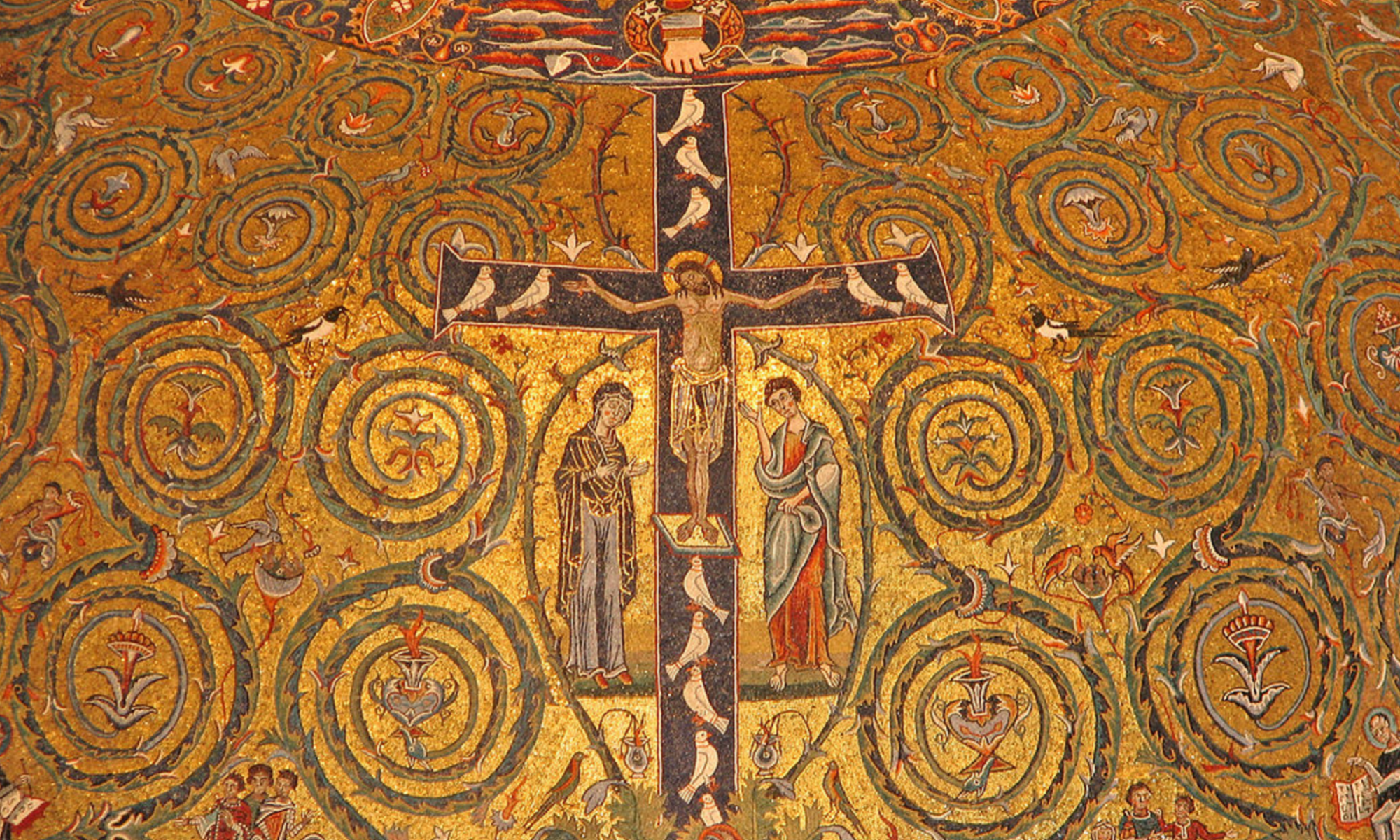
Francis had encountered the voice of Jesus calling to him from the cross in the hillside church of San Damiano. Jesus had beckoned: Rebuild my Church, which as you see is falling into ruin. Francis began the rebuilding effort quite literally, gathering or begging for stones to repair the dilapidated building. He also helped himself to a large bolt of his father’s expensive silk, selling it and attempting to give the proceeds to the stunned priest of San Damiano for help in the repair efforts. The priest prudently refused, not wanting to become one of Pietro’s enemies.

Pietro was a greedy man, but his rage had little to do with wealth. It sprang up from the shame and embarrassment that he felt as Francis rejected the rigid role assigned to him.

The famous friar of Assisi was actually named “John” at baptism – a name given by his mother Pica during the long months of Pietro’s absence in France. Upon returning, Pietro met his son and renamed him “Francis” (basically, “Frenchy”) in honor of the affluent country he loved visiting. In what he saw as great benevolence, Pietro planned to pass on his significant wealth to his son Francis, who would make him proud in carrying on the lucrative family business.

Instead, Francis went about begging, mingling with lepers, and sharing his father’s wealth with the poor. Disgusted and embarrassed, Pietro had him beaten and locked in the cellar, hoping he would fall in line. He didn’t. The next time Pietro was away, Francis’ mother released him, and Francis was right back to rebuilding the church of San Damiano – only now he hid himself in a cave to avoid the revenge of his father. That is when his father went to the bishop demanding justice.

The trial was public. Many witnesses heard Francis declare, “From now on I will say freely: ‘Our Father who art in heaven,’ and not ‘My father Pietro di Bernardone.’ Look, not only do I return his money; I give him back all my clothes. I will go to the Lord naked!”

He stripped himself there and then of his father’s robes, revealing the penitential hairshirt he had been wearing underneath.

And here is where I want to pause the story of Francis’ conversion.

Too often, the Saints are seen as these superhuman beings who quickly and easily rise to heights that are too lofty for the rest of us. The more steps I take on the road of conversion, the more I realize that the Saints were very normal and sinful human beings like you and me who walked a long and often painful path of conversion.

Most of the people who write the lives of Saints are themselves less than fully converted – so they tend to glamorize or oversimplify the journey of conversion. Sure, we would all love it if our conversion could be one simple and dramatic moment of decision and then living happily ever after. But that is rarely if ever how conversion works! Rather, there are many moments of weakness, faltering, stumbling, and struggling. There are many moments of new discovery and new growth. Consider the life of Peter in the Gospels and the Acts of the Apostles. From early on he loves the Lord and has faith in Him. But he continues to struggle before, during, and after the dying and rising of Jesus. His maturing in the love of Jesus is gradual, but significant.

Let’s just suppose that Francis was still – at this moment in his conversion – rather immature and in need of much more conversion. That is actually what the evidence suggests! First, there is Francis’ behavior. He is fearfully hiding in a cave. Plus, his father makes a fair point – it was not okay for Francis to presume that he could just start selling his father’s possessions without permission. There is still no small amount of the entitled party boy in him.

But there is another wonderful detail. For some time, Pietro has been lashing out at Francis with curses. Francis’ solution is to call upon “a lowly, rather simple man” to help him by taking the place of his father. Whenever Pietro would curse Francis, the poor man would speak words of blessing over Francis.

Underlying these details are the fear and shame and insecurity that Francis still felt. Like all human beings, he needed fatherly blessing, and ached for it. He needed to become secure in his identity, to know who he was. That is the greatest gift that fathers in the flesh can give to their children. They can lead them to be secure in the identity that God the Father confers on them – our heavenly Father who alone can fully bless us in the way our hearts desire.

Francis’ greatest example here is not so much his outward poverty as his inward poverty of heart, including his willingness to beg for help. Rather than shaming himself for being emotionally “needy,” he humbly reaches out for words of blessing from a fellow outcast. Through the repeated reminders of another flesh-and-blood human being, Francis’ words to the bishop and the crowd begin taking on flesh.

It sounds nice to say that God is my heavenly Father and that he meets all my needs. But it can be little comfort when my old wounds of shame and insecurity whisper in the shadows that I am not enough, that I am all alone, or that nobody really loves me.

There is a reason why Francis and his followers lived in community as brothers. There is a reason why Jesus taught us to pray to God as Our Father. We cannot connect with the Father without simultaneously connecting with each other as fellow members of the Body of Christ. Only God the Father can fill the void we feel deep in our hearts. But only within healthy community, vulnerably stating needs and receiving care, can we be opened up to receive the Fatherly blessing we need and ache for.

As we become blessed by the Father, then the slow and steady change can begin to happen. Secure in the Father’s love, we can mature in Christ.

Francis’ biographer (Thomas of Celano) delights in the scene of Francis’ nakedness before the bishop and the people: Oh how free is the heart of a man for whom Christ is already enough! True enough, as long as we also remember that Francis was still in the process of claiming that truth and internalizing it – and never without help from others.

Each of us, one way or another, gets pushed into roles. Each of us struggles to discover our true identity, and to be secure in love. In our insecurity we stay stuck in our sins. We need fellow pilgrims on the journey – those who don’t shame us or fix us, but declare us to be beloved children of God. We absolutely need that repeated reminder so that we can stay secure in the Father’s love and keep walking the difficult road of conversion. Maturity will keep coming – usually quite slowly. Like little children who are growing, we need others to notice our growth, to name it, to celebrate it, and to cheer us on. The Saints in heaven certainly do so, but hopefully also some of our fellow Saints-in-the-making.

Who are the “lowly, rather simple” people in your life who remind you of your identity as a beloved child of God?

Behold Your Mother!

As Jesus died on the Cross, he uttered his final words. In any great story, the last words of the hero are loaded with significance. The dying and rising of Jesus is the greatest story ever told.

On the Cross, Jesus speaks to his mother Mary and to his beloved disciple (John 19:25-29). He tells her, “Behold your son!” He tells him, “Behold your mother!”

Why does Jesus make a point of introducing this relationship? Why does John, inspired by the Holy Spirit, make a point of recording it for all posterity to read?

Jesus is not a procrastinator who suddenly realizes he has not made arrangements for his mother. He is not worried about who will take care of her. He is inviting you and me into a relationship with his mother. He is introducing her as a mother that we all need!

Each one of us is a beloved disciple of Jesus. Each one of us is invited into the new and eternal covenant, sealed with his blood on the Cross. And each one of us needs a heavenly mother.

At the Last Supper, two chapters earlier (John 17), Jesus prays his priestly prayer to his Father. He delights in the intimate relationship he has with his Father. He prays for the disciples he has chosen. He also prays for you and me –for those who one day will believe and become his beloved disciples (John 17:20). He desires and prays that all that is his will be ours. That includes his intimate relationship with his Father. It also includes having his mother as our mother.

This weekend we celebrate another Mother’s Day. As we show honor and delight to our earthly mothers, or give thanks in their memory, we can also ponder Jesus’ invitation from the Cross. He offers us Mary as an icon of motherhood, but also as a real human being (now sharing in his glory in heaven) who is capable of being intimately present as a heavenly mother to each and all of us in the ways we most need.

As children, we all needed tender nurturing, fierce protection, and wise guidance. These needs are hardwired into us in the biological bond between mother and child.

Those needs may shift in adulthood, but they do not go away. In fact, for the last couple of centuries, it is mothers themselves who have been most deprived of those needs! The very genesis of the Mother’s Day holiday is a feeble acknowledgement that we live in a culture that devalues and degrades women while expecting the impossible of them.

Most mothers that I know feel like they are failing most of the time. They continue to struggle with their own ache for nurture, protection, and mentoring, and are somehow supposed to provide those things to each child – AND be a strong and capable worker, AND have the right body shape and allure, AND engage in prayer and self-care, AND…   You get the point. Holding a commercialized holiday in mid-May does not dispense us from the duty of conducting a thorough inspection of the toxic waters we expect mothers to swim in.

Some think it has always been so. I do not agree. Yes, throughout history, women are subject to exploitation by men seeking privilege and power. But it shows up differently in different times and places. What many consider to be “traditional” gender roles are much more modern than they realize! The burden placed upon women in the West in the modern industrial era is uniquely ugly.

If you study the Saints of the Middle Ages, you will find many tender-hearted men and many fierce women. Literacy was not widespread anywhere prior to the printing press, but there were many literate women who became strong leaders. One of the unintended side effects of the Protestant splintering was the abolition of religious life. No more alternative paths for women. Be a wife and mother.

A second major shift happened with the Industrial Revolution. The division into specialized labor led to massive migration, pulled extended families apart, and pushed men who used to work at home or close to home into factories. The nuclear family replaced extended families as the norm, and women were left alone at home – except at wartime, when they were also supposed to provide the needed labor in the workforce. In all these shifts, women were largely abandoned in their God-given task of mothering – without tribe or village supporting them. It is impossible to mother alone! That conviction seems to be what fueled Anna Marie Jarvis in the original observance of this holiday.

Both the culture and our churches tend to perpetuate false and impossible expectations on women. The “perfect family” idealized over the decades in ads or TV shows or church culture does not actually exist! Some glamorize the “good old days” of the mid-20th Century – ignoring the ugly realities of domestic violence, sexual abuse, and objectification. Meanwhile, the ideal woman is supposed to check an impossible list of boxes regarding appearance and performance, while still finding a way to nurture, protect, and guide her kids.

How can mothers give what they have not themselves received? And how do our institutions and structures back up mothers to ensure they can thrive during the critical years of mothering? For multiple generations now, motherhood has been in survival mode. That cycle means that even the best of mothering experiences will leave the children aching for more when they enter adulthood.

The Catechism of the Catholic Church (n. 2779) warns us that our notions of fatherhood and motherhood are often wordly, distorted, and toxic. They need to be purified by looking to how Jesus has revealed God’s Fatherhood (and Mary’s motherhood) to us. We have much to reflect on!

In the meantime, each of us needs Mary’s mothering. Each of us has an ongoing ache for the tender nurture and fierce protection that she can provide. Each of us can turn to her as the wisest of mothers.

To be continued…