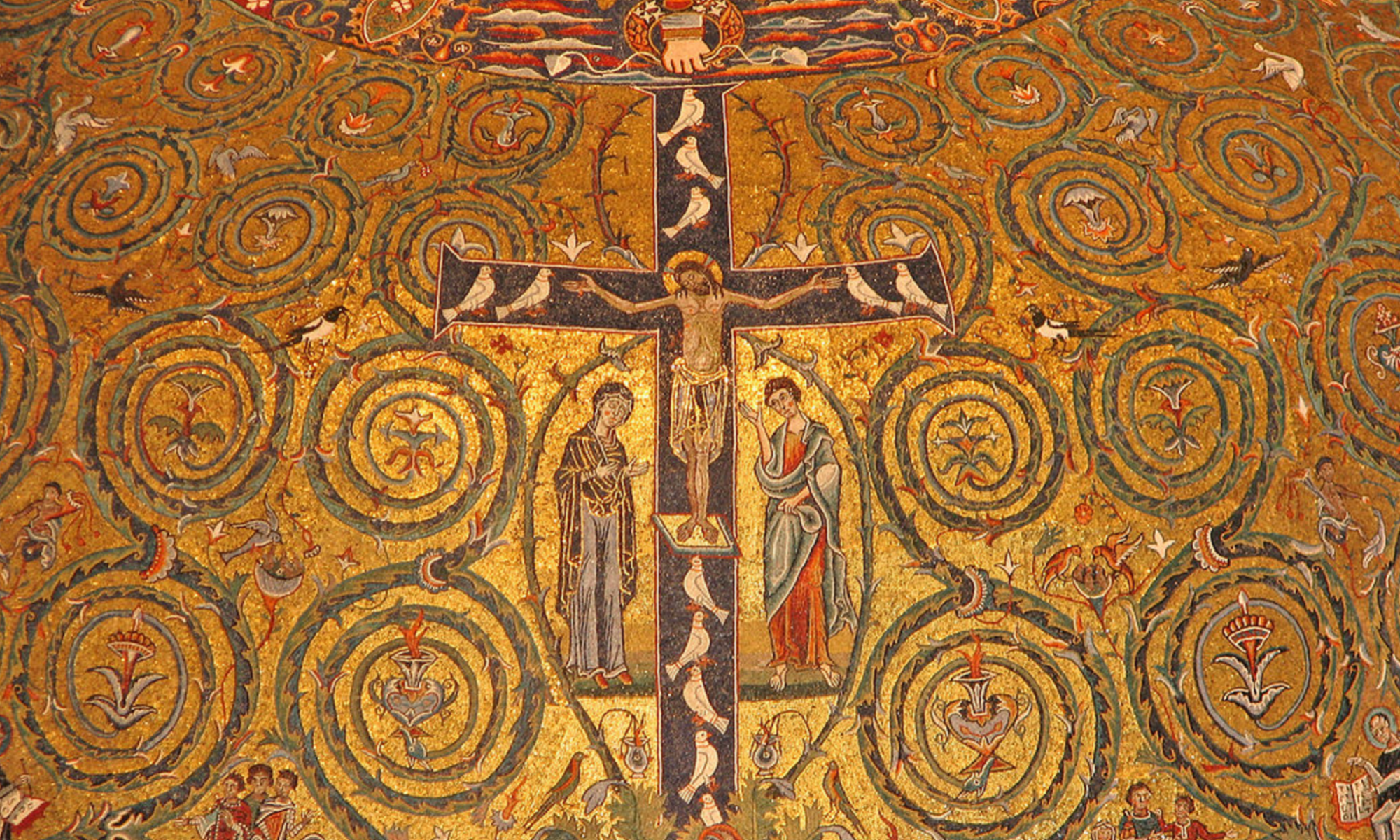
Behold Your Mother!

As Jesus died on the Cross, he uttered his final words. In any great story, the last words of the hero are loaded with significance. The dying and rising of Jesus is the greatest story ever told.

On the Cross, Jesus speaks to his mother Mary and to his beloved disciple (John 19:25-29). He tells her, “Behold your son!” He tells him, “Behold your mother!”

Why does Jesus make a point of introducing this relationship? Why does John, inspired by the Holy Spirit, make a point of recording it for all posterity to read?

Jesus is not a procrastinator who suddenly realizes he has not made arrangements for his mother. He is not worried about who will take care of her. He is inviting you and me into a relationship with his mother. He is introducing her as a mother that we all need!

Each one of us is a beloved disciple of Jesus. Each one of us is invited into the new and eternal covenant, sealed with his blood on the Cross. And each one of us needs a heavenly mother.

At the Last Supper, two chapters earlier (John 17), Jesus prays his priestly prayer to his Father. He delights in the intimate relationship he has with his Father. He prays for the disciples he has chosen. He also prays for you and me –for those who one day will believe and become his beloved disciples (John 17:20). He desires and prays that all that is his will be ours. That includes his intimate relationship with his Father. It also includes having his mother as our mother.

This weekend we celebrate another Mother’s Day. As we show honor and delight to our earthly mothers, or give thanks in their memory, we can also ponder Jesus’ invitation from the Cross. He offers us Mary as an icon of motherhood, but also as a real human being (now sharing in his glory in heaven) who is capable of being intimately present as a heavenly mother to each and all of us in the ways we most need.

As children, we all needed tender nurturing, fierce protection, and wise guidance. These needs are hardwired into us in the biological bond between mother and child.

Those needs may shift in adulthood, but they do not go away. In fact, for the last couple of centuries, it is mothers themselves who have been most deprived of those needs! The very genesis of the Mother’s Day holiday is a feeble acknowledgement that we live in a culture that devalues and degrades women while expecting the impossible of them.

Most mothers that I know feel like they are failing most of the time. They continue to struggle with their own ache for nurture, protection, and mentoring, and are somehow supposed to provide those things to each child – AND be a strong and capable worker, AND have the right body shape and allure, AND engage in prayer and self-care, AND…   You get the point. Holding a commercialized holiday in mid-May does not dispense us from the duty of conducting a thorough inspection of the toxic waters we expect mothers to swim in.

Some think it has always been so. I do not agree. Yes, throughout history, women are subject to exploitation by men seeking privilege and power. But it shows up differently in different times and places. What many consider to be “traditional” gender roles are much more modern than they realize! The burden placed upon women in the West in the modern industrial era is uniquely ugly.

If you study the Saints of the Middle Ages, you will find many tender-hearted men and many fierce women. Literacy was not widespread anywhere prior to the printing press, but there were many literate women who became strong leaders. One of the unintended side effects of the Protestant splintering was the abolition of religious life. No more alternative paths for women. Be a wife and mother.

A second major shift happened with the Industrial Revolution. The division into specialized labor led to massive migration, pulled extended families apart, and pushed men who used to work at home or close to home into factories. The nuclear family replaced extended families as the norm, and women were left alone at home – except at wartime, when they were also supposed to provide the needed labor in the workforce. In all these shifts, women were largely abandoned in their God-given task of mothering – without tribe or village supporting them. It is impossible to mother alone! That conviction seems to be what fueled Anna Marie Jarvis in the original observance of this holiday.

Both the culture and our churches tend to perpetuate false and impossible expectations on women. The “perfect family” idealized over the decades in ads or TV shows or church culture does not actually exist! Some glamorize the “good old days” of the mid-20th Century – ignoring the ugly realities of domestic violence, sexual abuse, and objectification. Meanwhile, the ideal woman is supposed to check an impossible list of boxes regarding appearance and performance, while still finding a way to nurture, protect, and guide her kids.

How can mothers give what they have not themselves received? And how do our institutions and structures back up mothers to ensure they can thrive during the critical years of mothering? For multiple generations now, motherhood has been in survival mode. That cycle means that even the best of mothering experiences will leave the children aching for more when they enter adulthood.

The Catechism of the Catholic Church (n. 2779) warns us that our notions of fatherhood and motherhood are often wordly, distorted, and toxic. They need to be purified by looking to how Jesus has revealed God’s Fatherhood (and Mary’s motherhood) to us. We have much to reflect on!

In the meantime, each of us needs Mary’s mothering. Each of us has an ongoing ache for the tender nurture and fierce protection that she can provide. Each of us can turn to her as the wisest of mothers.

To be continued…

Emmaus and the Eucharist

Of all the resurrection stories, perhaps my favorite is the Road to Emmaus (Luke 24:13-35). Two downcast disciples are wandering away from Jerusalem, away from all their hope, when Jesus walks up and joins them. He playfully pretends not to know what is going on. He wants them to acknowledge their loss so that his Holy Spirit can enter their hearts and rekindle their hope. He breaks open the Scriptures for them, helping them to make sense of the Messiah’s story and their own story. Their hearts expand in a yearning to stay connected with him. He breaks bread with them, at which point they recognize his presence. They hasten to Jerusalem and become witnesses of the resurrection.

But there is more. Luke wrote his Gospel for the sake of early Christian communities who were already gathering Sunday after Sunday to listen to the Scriptures and to “do this in memory of me” by celebrating the Eucharist (Luke 22:19). It is not merely a story about a one-time appearance of Jesus to some guy named Cleopas and some other unnamed guy. It is a story about how every Sunday Eucharist is a life-transforming encounter with the risen Jesus. That which happened to those two disciples on a Sunday is intended for each of us.

Our Sunday worship bears a twofold structure: Liturgy of the Word and Liturgy of the Eucharist. We listen receptively to the Scriptures and ponder how they connect with our present-day life. We allow our hearts to be set ablaze as we realize how Jesus’ story gives meaning and purpose to our own story. Then we get fed with his very flesh and blood following a ritual reenactment of the once-for-all offering of Jesus. We remember those saving events in a way that allows us to participate in them here and now.

Bishop Robert Barron, in his insightful and inspiring fashion, has drawn many other connections. We begin each Mass by calling on the Lord for mercy: kyrie eleison. Like Cleopas and his friend, we are downcast. Many of the early Church fathers described the fallen human condition as incurvatus. Like the crippled woman in Luke 13, we are bowed down. We are wounded by sin – by the way others’ sins have harmed us and by our own sins. We remain God’s beloved children, inherently good. But we are bent, weighed down, and turned in on ourselves. Without divine mercy, we are like a younger Peter, fluctuating between an “I’ve got this!” grandiosity and an “I’m so horrible!” discouragement.

So, we begin the Mass by acknowledging our sins and inviting the mercy God freely offers us in Christ. We trust that his victory allows us to stand upright – not through our own merits but by his free gift.

Then we listen to the Scriptures and allow them to be broken open for us. In every Sunday Mass, there is a connection between the First Reading and the Gospel. The Catechism of the Catholic Church cites an adage from the early Church: “The New Testament lies hidden in the Old, and the Old Testament is unveiled in the New” (n. 129). There is also a connection between the stories of Scripture and our own personal story – some of which we know with clarity and some of which is a mystery to us. Without the story of Jesus, our own story will remain fragmented and disorienting.

Those of us who are ordained ministers are commissioned by God to proclaim the Gospel with authority. That does not mean that every homily we preach will be brilliant and breathtaking. It does not even mean that we will preach the truth. It does mean that we are called to stand in as Christ, allowing him to speak in and through us. I think every priest or deacon has had the experience of what we thought to be a rather flat performance becoming the divinely chosen moment for one person’s heart to be permanently changed.

The first half of Mass centers around the ambo – the podium at which the Word is proclaimed. We then shift to the altar, which is also a banquet table. All of Scripture and all of the Mass revolve around the paschal mystery of Jesus. “Paschal” is another word for “Passover.” Jesus shows the disciples at Emmaus how the Passover events in Egypt were a prefiguration of his once-for-all Passover offering – which begins at sundown on Holy Thursday. Jesus freely offers himself as the Paschal Lamb – feeding his disciples at table, praying prostrate in the Garden of Gethsemane, suffering and dying on the Cross, proclaiming the Gospel in the realm of the dead, rising in glory, and now robed in human flesh as our great high priest, interceding for us at the right hand of the Father. He is both the priest who offers and the victim who is offered. The Mass participates in that one eternal sacrifice. But why? So that we can all join together with him at the banquet table, celebrating his nuptial union with his bride. Every Mass is a taste and glimpse of the wedding feast of heaven. The Eucharist, Christ’s own risen flesh and blood, is both our food for the journey and our medicine. It nourishes, heals, and strengthens us.

Mass ends by sending us forth. “Mass” comes from missa (“sent”). Like the disciples on the road to Emmaus, we can go forth truly changed – having passed over from old to new, no longer downcast but erect, eager to live as witnesses of Jesus’ story that has given so much meaning to our own story. Renewed and sustained by this steady gift, we now have the capacity to live in a way that attracts others to be curious about Jesus.

Until Jesus comes again, the Eucharist is the beating heart of the Church. We fulfill Jesus’ command to “keep on doing this in memory of me.” We remember where we have come from and where we are going. We become again and gain what we one day will be.

Self-Denial vs. Deprivation

“It is just as much a sin to deprive the body without discernment of what it really needs as it is to indulge in gluttony.”

These were wise words of Francis of Assisi to his band of brothers in the 1220’s. This is the Francis of Assisi who embraced radical poverty, including fasting and prayer vigils that most today would consider austere. He often meditated on the sufferings of Christ, and desired to be one with Jesus on the Cross. But Francis was known above all else for his radiant joy – a heart bursting with praise and gratitude. He surrounded himself with beauty and delight, but never grasped at it. He freely gave it all back to God.

The daily invitation of Jesus was imprinted in Francis’ heart: to deny ourselves, take up our cross each day, and follow him (Luke 9:23). How, then, can we make sense of his caution about not depriving ourselves of what we really need?

Francis of Assisi, with his marvelous grasp of the human heart, understood intuitively what contemporary research proves consistently: there is a connection between unmet human needs and unwanted behavior. Whenever we human beings are chronically deprived of play, rest, connection, community, understanding, safety, nurture, or meaningful purpose in life, it is only a matter of time before we start acting out with entitled behaviors.

Deprivation feeds entitlement. Entitlement then seizes. Our grasping attitude may not be that far from that of Sméogol in Lord of the Rings: “We wants it, we needs it! Must have the precious! They stole it from us!” If you are not a Tolkien fan, then I imagine you can resonate with the words of the apostle Paul, “The good I desire I do not do, but I do the evil I do not want” (Romans 7:19).

The immediate instinct in these cases is to assume that it is a problem of laziness or lack of discipline – often with no small amount of self-contempt and shame. We then punish ourselves by deprivation, telling ourselves we are doing penance and following Jesus. But in many cases, these penances embraced without discernment also begin to cut us off from what we truly need – from the things our hearts (and limbic brains) were looking for in the first place.

As a priest, I’ve worked with hundreds of people over the years who struggle repeatedly with the same patterns of behavior. Any time I have curiously explored, I have always found a significant deprivation of one or more authentic needs. Deprivation is not the primary reason why people get stuck in unwanted behaviors, but it is almost always there as a driving force!

I’ve learned much from contemporary Christian authors like Mark Laaser or Jay Stringer. Mark (now deceased) helped thousands to find freedom from their addiction to pornography or worse, not to mention helping to restore many marriages. Jay conducted research with 3,800 men and women struggling with unwanted sexual behaviors. His book (entitled Unwanted) explores the causes and contributing factors that need to be addressed if a struggling individual desires to live differently. Both make a convincing case for the importance of paying attention to our human needs, whatever our unwanted behaviors might be. Mark and his wife Debbie (in the book Seven Desires) describe how every human needs to be heard and understood, affirmed, blessed, safe, touched in a meaningful way, chosen, and included. Jay discusses the importance of delight, rest, play, creativity, meaning, and purpose. If we have a serious lack in any of these areas, we are likely to find ourselves unfree in our decision making.

Today’s authors give more precise language to these needs, they are by no means the first to notice them! I think of the Rule of Saint Benedict (he lived from 480-547). Most of us today would find their monastic lifestyle quite penitential. But it is moderate compared with the desert monks that Benedict had learned from. His Rule seeks balance and adaptability. He frequently acknowledges the importance of a wise abbot offering accommodations to monks regarding their prayer or eating or sleep, based on what is truly best for them and the community.

And then there is the quotation from Francis. Here is the fuller story from his companion and biographer, Thomas of Celano:

“One night while all were sleeping, one of his followers cried out, ‘Brothers! I’m dying! I’m dying of hunger!’ At once [Francis] got up and hurried to treat the sick lamb with the right medicine. He ordered them to set the table … Francis started eating first. Then he invited the brothers to do the same, for charity’s sake, so their brother would not be embarrassed.”

Francis concludes with the important lesson: it is just as much a sin to deprive the body without discernment of what it really needs as it is to indulge in gluttony. And then he reminds them of the supreme rule of charity (Christ-like love of God and neighbor). Our freedom in receiving and giving love is the ultimate test in discerning the wisdom of any self-denial.

Finally, let us not forget the example of Jesus himself. His human needs mattered. As a human being, he definitely received understanding, safety, nurture, delight, care, connection, rest, and play – not all the time or from everyone, but in ways that left a lasting impact. Throughout his childhood, he received from Mary and Joseph, not to mention his heavenly Father. He spent less than 10% of his life giving in public ministry – and even then he received care from friends like Lazarus or Mary or Martha. Even in Holy Week, Jesus rested in Bethany with those friends – receiving hospitality and love. Even in the Garden of Gethsemane, as he entered his Passion, Jesus reached out to his other friends (Peter, James, and John), asking them for connection and care.

Sometimes we don’t get what we need. Sometimes God even asks us to sacrifice things that we truly need – but usually he doesn’t. Over time, as deprivation of authentic human needs intensifies, our freedom tends to diminish, and with it our ability to receive and give freely in love. Our “sacrifice” will become joyless; our resentment will increase – and with it a Gollum-like grasping of entitled behaviors.

Discernment is the key. Jesus tells us to test a tree by its fruits. If self-denial is leading to growth in freedom, growth in faith, growth in hope, and growth in love, then we know it is being led by the Holy Spirit.

Yes, our greatest calling is to make a total gift of self and become the grain of wheat that dies so as to bear abundant fruit. That self-gift is only possible if (like Jesus) we humbly allow ourselves to receive, again and again, all that we need. Francis of Assisi and many other Saints understood. Their humble acknowledgement of their depth of human need allowed them to receive. Their receptivity opened them to the amazing joy of self-gift. May we learn from their example!

More Than We Can Handle?

“God doesn’t give us more than we can handle.”

At least that is what many Christians say in the face of trial or loss. But is it actually helpful? And is it true? I believe it is rather unhelpful, and only partially true.

I’ve written before on the importance of learning to sit with sadness – something we tend to avoid! It’s hard enough when it’s our own sorrow. We’d rather plunge into busyness or fixing or numbing rather than face our grief. But it’s especially hard when we are in the presence of other people’s pain. That’s when the advice or clichés come out!

First, we’ll try to fix it – if there seems to be a way of fixing. We’ll be “generous” and offer to help; we’ll make suggestions for books or podcasts; or we’ll compare this person’s pain with our own or that of a friend – anything to help make the pain go away, because we don’t like to feel it, and we definitely don’t like to feel powerless.

In some cases (tragedies or definitive losses), there is nothing we can do. When fixing doesn’t work, we start grabbing for clichés. Surely one of them will be the magic wand that will make this feeling of powerlessness go away! Surely one of them will help this person feel better so that I can feel better.

Are these clichés helpful? No, I would say not. They often have the effect of “blaming the victim” or shaming others for feeling the way they feel. Rather than compassion (“suffering with”), clichés are a way of stepping back from the pain of others and leaving them to suffer alone.

I suppose there is a time and a place for distracting or diverting from pain. Perhaps we are in a survival situation and lack the time, resources, or energy to engage head on. If mere survival is the best we can hope for at the moment, then we can indeed turn to our arsenal of distractions and find ways to minimize the pain.

Even when we are ready to face heartache, we are still human, meaning we are limited. We can’t face it all the time. It can be appropriate to take a break from our grieving, laugh together at a joke or a movie, plunge into a hobby or game, and so forth. A cliché could be helpful as permission to take a short break from the pain.

But if our Christian families and communities are unable or unwilling to accompany people as they face pain and heartache, then where can they go? Jesus does not want his Church to be a place of mere survival, but God’s own hospital in which we experience healing, redemption, restoration, and total transformation. That only happens by facing our heartache, taking up our Cross, following Jesus, dying amidst our powerlessness, watching and waiting, and experiencing the newness of the Resurrection. If we desire to be “helpful” to those in pain, we must first walk this path ourselves – as Jesus did. We can’t give what we ourselves have not experienced.

Is there any truth to this expression, that “God doesn’t give us more than we can handle”? Sort of.  Here is what the apostle Paul says:

“No trial has come to you but what is human. God is faithful and will not let you be tried beyond your strength; but with the trial he will also provide a way out, so that you may be able to bear it” (1 Corinthians 10:13).

As you can see, the cliché is an oversimplification and distortion of what Scripture actually says.

Paul doesn’t attribute our trials directly to God’s agency. God permits or allows us to endure trials, but they are human. They are the result of a misuse of human freedom – by our first parents, by others who have caused harm, and by our own sins. Directly or indirectly, all trials in this life are the result of human sin. God allows these consequences because he has entrusted us with dignity, freedom, and  real authority amidst our stewardship.

God is faithful. He is absolutely committed to accompanying us through every trial. He will never abandon us, and will never leave us without every means of assistance that we truly need to move through the trial.

God provides a way out. There is a true exit to the trial. We tend to hunker down in our panic rooms, avoiding the heartache – and ultimately getting stuck. But Jesus himself, God’s own beloved Son, has plunged into our trials. He has gone there first, and has opened up a path to new life. If we follow him faithfully, if we share in his suffering and death, we will experience a radical newness and expansiveness – and not just “one day” in heaven.

As we see in the saints, there is an amazing foretaste of this newness that comes even in this life. If you study their lives, you will find a stunning diversity of humans, all with two common features: (1) They endured enormous trials; (2) They were incredibly joyful followers of Jesus.

Like them, we will be able to bear our trials: because God is faithful to his promises, because Jesus has blazed a trail for us, because he accompanies us, and because he won’t allow us to be tested beyond our strength. Therefore, we can hope.

Hope is the answer in the face of heartache. Hope refuses to be killed by suffering (or by clichés!). Hope perseveres – not by naïve optimism, not by secular stratagem, but by waiting persistently for our faithful God to fulfill all his promises. This is the hope of mother Mary standing at the foot of the Cross on Good Friday and at the tomb on Holy Saturday – believing God’s promise, staying present, enduring, pondering, and waiting. The joy of resurrection always comes to those who abide in hope.

May we be people of hope, this Lent and always!

Michael the Archangel

Michael is a mighty archangel described in Scripture as commander of God’s heavenly armies. Many of us call upon him daily as a defender and protector. But in what sense does he protect? And what is the battle really about?

Scripture describes Michael casting Satan out of heaven (Revelation 12), battling with Satan over the body of Moses (Jude 9), or battling a spirit described as “the prince of Persia” (Daniel 12).

If angels are spiritual and immortal beings, what does it even mean for them to “fight”? They cannot be wounded or killed – so how can there be any battle, any victory or defeat?

The real battleground is over human freedom, and all that is impacted by our “yes” or “no.” This battle has implications for each one of us individually, but also cosmic ones – because God makes us his stewards.

Each and every human person is created in God’s image and likeness. The devils envy and hate each one of us, and relentlessly seek to ruin us. But God also placed the entire cosmos under human stewardship. God invested us with true authority – an authority the devil has always envied and hated. He seeks to steal it away by seduction and lies. He seems to succeed – both with Adam and Eve and with each of us. They and we give away what is not his to take. And then he thinks he can hold us captive.

Enter Jesus as the new Adam. He ushers in the Kingdom of God, the new creation, new heavens and a new earth. Those who are willing to die with him and rise with him through Faith become members of his Body. Under his headship, every enemy is placed under his feet, until at last even death itself is destroyed (Ephesians 1-2). All this happens by human agency, by the exertion of human freedom – his human freedom, but also yours and mine.  In due time, our human destiny is to become higher than all the angels as we behold God face to face and become like him (1 John 3).

We tend to esteem our own dignity and freedom far less than God does! He never forces us to do anything. For that matter, evil spirits cannot force us to do anything either. Had Adam said “no” and told the devil to leave, the devil would have had to honor Adam’s God-given authority! The same holds true for us, though we need the power of Jesus to reclaim and restore that which we have given away. United with him and in him, we need never fear evil spirits. Indeed, it is they who fear us as we shine with restored glory!

When I say that God honors our freedom, that also means that he allows our freedom to have its consequences. We were the stewards of this current cosmos, and we failed in our stewardship. Though it still bears stunning goodness and beauty, this cosmos is irreparably damaged. The world as we know it is passing away.

[NOTE – I am using the original Greek word kosmos, which can be translated either as “world” or “universe”]

Jesus tells us that he came into this cosmos not to condemn it but to save it (John 3:17).  He will cast out the devil, the ruler of this cosmos (John 12:31). But in what manner? Jesus does not stop us from dying, and he does not stop this universe from coming to its just demise. His kingdom is not of this world – because we the stewards have truly ruined it by giving dominion over to the devil. The devil will have his pound of flesh. But the devil has never understood love or the new life that springs forth from love.

In his dying and rising and ascending, Jesus crushed the head of the serpent. And he ushered in the new creation. Like his risen body (or rather, AS his body) this new creation is both the same and new. We already participate in it! In Christ the head, the battle is done. It is finished. Love wins.  In us the members, the battle is still playing itself out – we need only give over our freedom!

In the early Church, the Letter to Diognetus taught that we Christians are in the world, but not of the world. In one sense, we live and act just like everyone else. But we actually live in an entirely different dimension!  In the 300’s, Gregory of Nyssa observed that “the foundation of the Church is the creation of a new cosmos.” More recently, Pope Benedict XVI explained the Ascension of Jesus as opening up a new dimension of human existence.

That is where Michael comes in. He is the mighty guardian of this new creation. He is God’s answer to the devil. His name is not a name but a menacing question: “WHO IS LIKE GOD??” The devil styles himself a god, but is not. Michael brings God’s Truth and Love to full light and casts out the devil. All that is true and good and beautiful is resurrected in the new creation. All that is disordered, all that tends toward ruin or destruction, all that spirals towards nothingness – that belongs to the devil, who will ultimately be the ruler of nothing.

But back to human freedom. If we want Michael’s protection, we must choose to abide in the new creation, rather than cling to this world, which is quickly passing away. That means becoming willing to die to what is easy or familiar and trust in the newness that is coming. We gain glimpses and tastes of that newness, but are not yet ready for it in all its fullness.

It is truly challenging to abide in the “already but not yet” of Hope. Even now, we possess the Kingdom and already participate in it. But we are not yet ready to see God face to face, and not so completely transformed as to share in the fullness of the ascended glory of Jesus. We call on Saint Michael again and again to defend us in that in-between place, in which we are still vulnerable to the attacks of the evil one. Michael willingly and faithfully defends us. He safeguards the space in which grow. but only we can do the growing!

The more we become who we are, the fewer entry points the devil even has to attempt an assault. God’s light shows us the weak spots where the devil will predictably attack us. We ask Michael’s protection – but we also cooperate with Christ to repair those breaches!

Gregory the Great calls the earthly Church “the Dawn” – surely and certainly ushering in the full light of Day, but still mixed up with the darkness. We eagerly await the full Day, when Christ will always shine, and when Michael’s protection will no longer be needed. In the meantime, we engage our journey of change and growth, until Christ becomes all in all.

A Horn of Salvation

He has raised up for us a horn of salvation, in the house of his servant David (Luke 1:69).

These are the words proclaimed by Zechariah, the father of John the Baptist, after nine long months of silence. Nine months to ponder the promises of God given through the angel Gabriel.

At the very moment of proclaiming that his newborn son will be named “John,” Zechariah was flooded with the Holy Spirit and burst into praise – in words that many of us proclaim each morning in the Liturgy of the Hours. Unfortunately, our English version loses something in translation, saying “He has raised up for us a mighty savior…”

By contrast, the original text speaks of a “horn of salvation.”  Why?

If the name John (“God is gracious”) was significant and willed by God, so much more the holy name of Jesus, at which every creature must bow – those in heaven, those on earth, and even those in the infernal regions (Philippians 2:10-11).

The name “Jesus” in Hebrew is Yeshua – the very same name as “Joshua” in the Old Testament. The name means “savior.” Joshua was a figure of salvation – giving us a foretaste of Jesus, the true savior of the world.

Joshua led the Israelites in the battle of Jericho (see Joshua 5 and 6). But more truthfully, it was God himself, through his mighty messenger, who won the battle. As Joshua approaches Jericho, he sees a fierce warrior, drawn sword in hand, and asks him, “Are you one of us, or one of our enemies?” And the warrior replies, “Neither. I am the commander of the army of the Lord: now I have come” (Joshua 5:13-14).

We could debate whether this messenger was Michael the Archangel, or the Word of God himself (not yet in the flesh, not yet named “Jesus”). Either way, the instructions come directly from the Lord: Joshua and his soldiers are to circle the city for six consecutive days. Then on the seventh day they are to circle the city seven times. Seven priests are then to blow their seven horns, followed by a jubilant shout.

In light of that story, the seventeenth-century theologian Jacques-Bénigne Bossuet interpreted Zechariah’s choice of words: “The word horn is one of magnificence and terror that in Scripture signified at once glory and an incomparable power for defeating our enemies.”

But who are these enemies from which we need to be delivered? Bossuet reminds us, “They are, in the first place, the invisible enemies who hold us captive by our sins.”

The apostle Paul says the same: “Our struggle is not with flesh and blood but with the principalities, with the powers, with the world rulers of this present darkness, with the evil spirits in the heavens” (Ephesians 6:12).

What important reminders for us today! If we spend mere minutes on social media, we will encounter animosity and enmity – one group of humans pitted against another group of humans, their accusations dripping with contempt. The devil is a master strategist, and “divide and conquer” is one of his choice strategies!

But – you might object – some human beings are perpetrating atrocities against other human beings, or threatening to force us to change our beliefs, or else. Doesn’t that make them “enemies”?

Yes and no. Human beings are only ever “enemies” in a secondary sense. They are, first and foremost, created in God’s image and likeness. He wills their and our salvation (1 Timothy 2:4). Jesus commands us, “Love your enemies and pray for those who persecute you” (Matthew 5:44). Paul gets even more specific: “If your enemy is hungry, feed him; if he is thirsty, give him something to drink; for by so doing you will heap burning coals upon his head. Overcome evil by doing good” (Romans 12:19-20).

This is not a command to become objects for others to use or oppress. Rather, it is a command to be on fire with the love of Jesus and to trust God the Father. Jesus was never a powerless victim to others’ manipulations and schemes; yet he truly loved his enemies. Bossuet suggests that this manner of heaping coals upon their head is “to warm up and melt their icy and hardened hearts.” Not all with hardened hearts will welcome this melting. God desires that all be saved, but fully honors our freedom.

Jesus came among us as a true savior from our real enemies. He allowed God’s own breath, the Holy Spirit, to blow through him according to the Father’s will. He knocked down the wall of hostility that had divided us, opening up true reconciliation with the Father and with each other (Ephesians 2:14-16).

For us on earth, the battle is still playing itself out. We are still in the middle of the story. It is so normal for us to feel terrified. It is so tempting for us to look for scapegoats – to depict one human or group of humans as “the enemy.” We need not let the evil spirits play upon our fear and our shame. We need not allow them to seduce us into hatred, division, or contempt. We need not succumb to the lie that secular human efforts will save and deliver us.

Imagine how hard it must have been for Joshua and his soldiers to surrender with trust to God and his promises! Were they really to believe that seven priests blowing on their horns would win the battle, rather than military might or human cunning? But at God’s command, so it happened.

And what a powerful reminder that God does not belong to any sides in our human factions! For him, there is never an “us versus them.” He is fully in charge, and all human beings are called to be restored as his beloved children.

Rather than seeing other human beings as enemies to be fought, rather than looking to secular means of deliverance, will we trust the living God? Will we give our fears over to him, and seek the deliverance that only Jesus can bring?