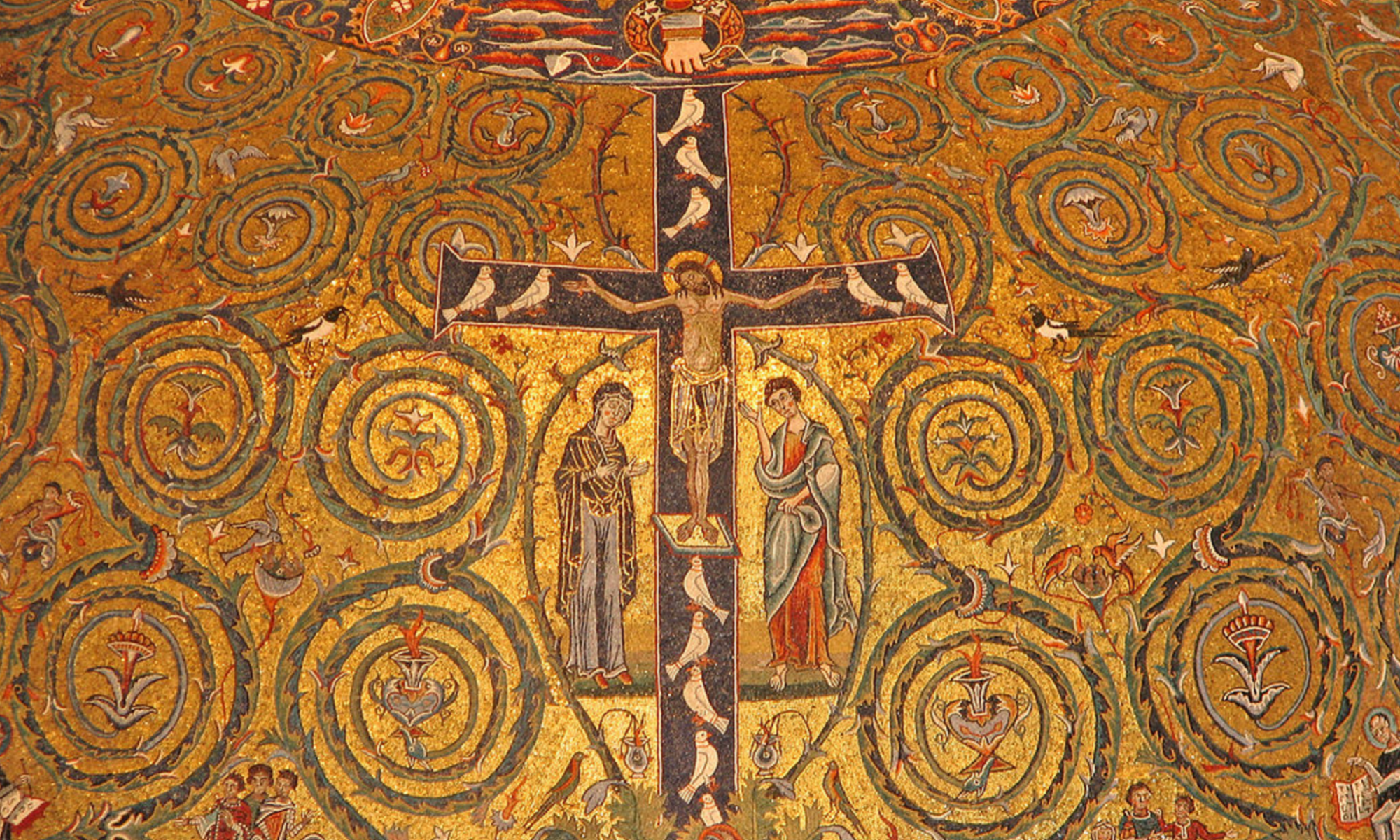
Paschal Triduum

We will soon celebrate the Paschal Triduum. We will enter the holiest three days of the year. We will remember the dramatic story in which Jesus redeemed and renewed us.

“Paschal” is another word for Passover. That connection is lost when we use the common English word “Easter.” On Resurrection Sunday, my Spanish-speaking parishioners will say to me, “¡Feliz Pascua!” which literally means “Happy Passover!”

For us Christians, the Passover observance has been forever changed by Jesus. No longer do we spread the blood of a slaughtered lamb on the doorposts and lintels of our homes. Jesus offers himself as the lamb of God who takes away the sins of the world. He willingly becomes the lamb, once slain, who now lives, never to die again. His dying and rising are one single offering to the Father. They are now, for us, one single celebration.

In terms of calendar time, the Triduum spans three days, beginning the evening of Holy Thursday and concluding the evening of Resurrection Sunday. However, it remains one single event, a seamless moment in time.

Scripture scholars distinguish chronos and kairos, two Greek words for “time.” Chronological time marches along with steady precision, and with utter disregard for our lived human experience. Sometimes time can’t move quickly enough, as on a Friday afternoon when students and employees stare at the sluggish clock. At other times the hours, weeks, or even years seem to be racing past us. By contrast, there are kairos moments within the passage of time. Whether such a moment lasts a few hours or a few months, we remember it as one significant event or era. The Sacred Triduum is THE kairos event of human history.

For many of the disciples, it was largely a trauma event. They abruptly lost their Lord, and found themselves falling away from him. Within moments, they experienced dread, doubt, confusion, betrayal, loss, guilt, and shame. Trauma has its own sense of timelessness. When we feel powerless, it seems like the anguish will never end.

Jesus transforms our human experience. He willingly enters the depths of human drama and human trauma, conquering every single moment with perfect love.

For some of you, “Triduum” is a new word and a new concept. Others among you have been observing it liturgically for decades. Either way, I invite you to gaze and ponder afresh what transpired during those three days. This three-day event is willed by God to become the very heart of every human story.

DAY ONE

Remember that in Jewish tradition, the new day begins at sunset. Therefore, Day One of the Triduum includes Jesus’ suffering, dying and burial. He initiates this new Passover event by sharing a meal with his disciples. They spend much of the meal debating who among them is the greatest. He declares the bread and wine to be his own flesh and blood and commands them to commemorate this offering. He prays to his Father in the garden. He watches his friends abandon him as he faces arrest, trial, torture, mocking, and crucifixion. His physical torment alone is enough to move human hearts to repentance. But his emotional and spiritual suffering were so much more intense. He willingly takes on our own infirmities, freely entering every traumatizing human experience: abandonment, rejection, the violation of his body, shaming comments, and a felt powerlessness. His cry to his Father gives voice to every human heart that ever has or ever will endure such experiences: “My God, my God, why have you abandoned me?” But unlike each of us, Jesus remains faithful and true. He surrenders in trust; he holds out hope; he loves to the end. Day One concludes with his burial and the sealing of the tomb, just in time for the Sabbath.

DAY TWO

Day Two is so easily forgotten by Christians. Jesus’ body remains in the tomb on a Sabbath Day like no other.

Imagine what Holy Saturday was like for the various followers of Jesus. Many had abandoned him or denied him. Imagine the shame they felt! The gospels don’t specify what Peter and the others were up to on this day, but we know that by Sunday most of them were on voluntary lockdown, cowering in the cenacle.

Most of them had their messianic hopes crushed. Despite Jesus’ miracles, parables, and constant proclamation of the Kingdom of God, each follower continued to clutch a more tangible kind of salvation – deliverance from the Romans or restoring the Kingdom of Israel.

Others, like Mary Magdalene, were actively seeking him, like the beloved in the Song of Songs, going out into the night and earnestly searching after the one her heart loves. Desiring and not possessing is an agony like no other – the agony of Hope.

There is also the Hope of Mary, Jesus’ own mother, who had spent thirty years with him, had stood with him at the foot of the Cross, and had always pondered his words and events in her heart. She knew his promises better than anyone.  As at the Annunciation, as at Bethlehem, as during the flight into Egypt, as when seeking and finding Jesus in the Temple, Mary believed that God was ushering in a new and greater human experience. But she couldn’t imagine what it was going to be like. She persevered in Hope. Scripture doesn’t tell us about what it was like when Mary encountered the Risen Jesus, following the agonizing Hope of Day Two. But we can imagine the surprise and the joy.

In Catholic life, each Saturday is a day of devotional remembrance of Mary. We forget that it is her day because Holy Saturday is the day on which she persevered in Hope.

DAY THREE

Jesus rises on the Third Day, during the night preceding the dawn of Resurrection Sunday. No other human being directly witnesses his Resurrection, but the encounters explode, like kernels of corn beginning to pop – at first one by one, and then rapid fire. In every encounter, the Risen Jesus catches them by surprise, and fills their hearts with unimaginable joy. Their narrow and preconceived ideas about the messiah are shattered against the event of his dying and rising. He helps them to understand how everything in the Law and Prophets – indeed everything about our human story – points to this new Passover. This event of his dying and rising (and the agonizing wait in between) is what gives meaning and purpose to your story and mine.

Even still, you and I have a tendency to bypass the Paschal Mystery. Resurrection sounds nice, but what about fully entering with Jesus into suffering, dying, and an agonizing wait at the tomb? Like the characters in the Bible, we prefer perfectionistic rule-following, secular political solutions, or to the old standbys of pleasure, prestige, and power.

This Holy Week, may we allow our minds and hearts to be reawakened to the Faith, Hope, and Love that the Sacred Triduum offers us.

Watching and Waiting

Revised from the original posting on Dec 1, 2018

Advent is a season of watching and waiting, a time of abiding in expectant hope, confident in the coming of the King.

Advent is so much more than preparing for Christmas. The early days of Advent focus especially on the second coming of Jesus. Our watching and waiting for his coming is not static or sterile, sitting here idly until some future day when he eventually comes. Rather, theologians speak of an “already but not yet.” Christ has not yet come in glory, but he is already growing and bearing fruit in the lives of his holy ones.

There is a famous Advent homily in which Bernard of Clairvaux (1090-1153) describes a third coming of Jesus, in between his birth at Bethlehem and his coming in glory. No, he is not talking about “the rapture,” but rather the coming of Jesus into the heart of every true believer. As Jesus promised at the Last Supper, “If anyone loves me, he will keep my word, and my Father will love him and we will come to him” (John 14:23).

This coming into our heart is a dynamic process of nurture and growth. As we abide in expectant hope, our desire for the Lord increases. That desire itself springs from a seed planted by the Lord.  The more we desire his coming, the more our capacity to receive him grows. The greater our capacity, the more we receive. The more we receive, the more deeply we desire. And the cycle of “already but not yet” continues until he comes again.

Think upon the parable of the sower (Matthew 13:1-23). Christ sows his Word. Some seeds fall on the path, others on rocky ground, others among thorns, and others into good soil. Advent is a time to become good soil, totally receptive, growing in faith and hope.

That is the sad irony of December in the modern world. In the midst of Advent, we are constantly exposed to commercialism and consumerism and unneeded busyness. The self-indulgence of “the season” stands in stark contrast with the penitent cry of John the Baptist to “prepare the way of the Lord!” We can easily heap excessive expectations upon ourselves, thinking of all the things that we “have to get done.” Then we find ourselves too busy or stressed out to do any watching or waiting (except perhaps binge watching Netflix).

With God’s help, we can recognize some of the weeds and thorns in our heart, obstacles that need to be uprooted with firm resolve. We also have hard and dry places in our hearts, tough soil that needs the gentle dew of the Holy Spirit to soften and moisten, freeing us to become receptive, like Mary and Joseph.

Our free cooperation matters much. But in the end, God is the one who provides the growth and the fruit. We are called to abide in love. The watching and waiting is the most challenging part! We are so conditioned to expect instant gratification and easy results.  The parable of the sower reminds us to be patient and receptive.

Henri Nouwen wrote often about our powerlessness, and how challenging it is for us to be humble and patient. We depend totally upon God for the growth – much like the farmer in the field. Nouwen offers the image of an impatient gardener periodically digging up the plant to check on its growth. That tactic definitely doesn’t work! We hate to wait. Our restless hearts resist and sabotage the Father’s rest. All the while he gazes upon us with delight, inviting us to trust that we are his beloved children.

The growth will happen on his timeline, as we learn to abide in him. The fruitfulness will come in due time, so long as there is steady growth. By contrast, we will wither and die if we cut ourselves off from the source of all growth.

Healthy Christian community helps so much. True Christian friends will notice what God is doing in us and encourage us. It is good to notice the growth and to praise him for it. That thankfulness and praise stirs up the desire of our heart all the more. There is no risk of pride when our heart is Christ-centered and full of praise.

Psalm 1 offers an image of the tree that is planted beside the flowing waters, putting out its roots to the stream, staying green amidst the drought, whose leaves never fade, prospering and bearing fruit. Contrast that with the ways of the wicked, who cling to fruitless desires. They are like the chaff that gets blown away.

It is easy – especially at this time of the year – to become anxious or overwhelmed and then flee into one of our “panic rooms” – reaching for our phone, grabbing extra food or drink, plunging into pleasures that don’t actually bring peace.

Instead, we can choose to be patient and gentle with ourselves. It is normal to feel unsettled during changes of seasons and when reconnecting with family. Instead of isolating ourselves, we can choose to stay present to our minds and bodies, present to Christ, and present to those around us. We can receive grace and grow in patience. The fruit will come in due time.

Advent has always been a favorite season of mine. It touches the deepest desires of the human heart. May God give each of us the courage to root out the weeds from our hearts. May he cultivate and soften the hard and unreceptive places. And may he help us to abide in expectant hope, watching and waiting patiently as Christ comes to us, gives us growth, and bears much fruit.

Always Ready for a Party

Authentic hospitality is one of the greatest human experiences. There is the literal hospitality of receiving and hosting a guest with a sense of delight and dignity and belonging. More importantly, there is the day-to-day openness to the experience of receiving and being received, the surprising delight that can arise in encounters that cause us to feel more authentically human and more authentically Christian. You just never know when a small foretaste of the heavenly wedding feast might unexpectedly manifest itself! But we easily miss the moment if we are not abiding in love and truth.

I’m currently in the midst of a 3-month sabbatical, and gratefully receiving the hospitality of Benedictine monks. The importance of hospitality is actually written into the Rule of Saint Benedict, that brief but adaptable treasure trove of wisdom that still inspires people of all faiths even 1,500 years after he wrote it. Benedict instructs his monks, “All guests who present themselves are to be welcomed as Christ, for he himself will say: I was a stranger and you welcomed me.”

Some of my happiest memories of childhood are moments of hospitality. I was recently asked to reflect on experiences of wholeness in my story – when I most deeply felt a sense of delight, belonging, and justice. It was a challenging exercise at first! My story includes much deprivation and going it alone. But with prayer for illumination, my memories turned to my grandparents’ home, their joy and excitement at seeing me every time I arrived, the warm embrace, the twinkle in their eyes, the offering of food or drink or toys they knew that I enjoyed, the total sense of belonging and safety. Or I thought of Christmas gatherings with extended family – the laughter, the acceptance of everyone present, and the material and emotional abundance, the ache for the moment to last forever.

During my college seminary years, I met a few friends from the South, and came to appreciate their constant readiness to show hospitality to guests. It felt dignified and important to me, and became something I’ve valued over the years. Whether my years in communal living or my years in a rectory, I’ve relished the opportunities to show hospitality to guests. Planned gatherings are fun enough, but the best moments have been the unexpected parties. I’ve learned to ensure that I have a few things on hand to be up for the occasion. As I sometimes quip, I like my living space to be ready to go “From Zero to Party in 10 Minutes.” People have appreciated the gesture more than once.

Truthfully, though, I am still very much learning the height and breadth and depth of human hospitality. There are various versions of it, not all of them equally great. There have been times where my hospitality was more about projecting an image or feeling the pressure to perform, rather than simply “being with” the guests. There have been times where it was more about subtly grasping at my own unmet needs than about serving those I was hosting. And there is my frequent tendency to get disengaged, to check out of the present moment or withdraw emotionally into my own space of isolation – and then my connection with others is diminished or lost.

Speaking more universally, when it comes to hospitality of the heart, being open and receptive to unexpected “Jesus moments” with others, I cannot truthfully say that my heart is always ready. It’s one thing to think ahead and have a few items stocked up in the pantry. It is so much more challenging to abide in love and live wholeheartedly in the present moment.

Jesus was a human being who knew how to experience hospitality – how to receive it and how to give it. There is a great vulnerability in authentic hospitality, a tender willingness to enter into intimacy. We cannot give well if we have not learned how to receive. We don’t often ponder this point, but Jesus was quite willing to receive hospitality –from the very beginning.

God though he was, Jesus began his human existence in humility and obscurity, depending vulnerably on the tender care of his mother and foster father, taking in the delight and awe showed by so many guests at his birth: the shepherds, the magi, and the angels. He spent thirty of his thirty-three years learning how to receive. Even in his public ministry, he still allowed himself to be vulnerable and receive. I think of the woman with the alabaster jar in Luke 7 – weeping, kissing his feet, and anointing him with costly perfume. Jesus does not squirm or resist, as many of us probably would. I think of Jesus’ apparently frequent visits to Bethany, cultivating a deep friendship with Lazarus, Mary, and Martha – including a willing reception of their hospitality. He even goes there during Holy Week, shortly after his entrance into Jerusalem on Palm Sunday. Even on Holy Thursday, as he enters his “Hour” of suffering, Jesus reaches out to Peter, James, and John – asking them whether they would be with him in his sorrow. And of course, there is his belonging to and receiving from his heavenly Father, as Jesus regularly withdraws – not in isolation or disengagement – but into vulnerable and intimate relationship.

Drawing from that sense of joy and belonging and abundance, Jesus showed hospitality so beautifully. One of the strongest “accusations” against him was that he welcomed sinners and dined with them! Jesus attuned to people’s hearts, noticing the desire and the movement of the Holy Spirit there (or the hardness of heart and resistance!). When there was movement, he stopped and lingered and invited them into relationship. They felt seen by him. They felt understood by him. They felt welcomed and delighted in by him. They were loved as they were, and they also realized that he was committed to their well-being and wasn’t going to fudge or fake things in the relationship. I think here of the woman at the well, the woman caught in adultery, Zacchaeus, Matthew, and Peter (at so many moments!).

I have always cherished hospitality, and intuitively understood how central it is in the human experience. I have not always appreciated the invitation to vulnerability that is there, the call to give others access to my well-guarded heart, the call to be present and engaged, to be open to unexpected surprises, to notice what God is doing in the hearts of others, to appreciate their uniqueness and to accompany them step by step in becoming who they are (versus who I want them to be!). To the extent that I abide and stay open to hospitality, I truly get to “taste and see the goodness of the Lord” – even now amidst this sojourn through a valley of tears. Such moments never last, but they are truly good – a promise and foretaste of the Day in which the joyful feasting we experience together will never end, but only become ever more delightful and more real.

Healing and the Holy Spirit

Have you ever heard testimonies from fellow Christians about powerful healing experiences and secretly doubted or judged them? Or have you perhaps felt threatened by or resentful of the joy and freedom they seem to possess? I admit that I have!

For every person who has a powerful healing story there are dozens of others who have been reaching out for years and (it seems) experiencing no answer. Whether we have a physical ailment, anxiety and depression, a repeated sinful habit, an addiction, or relationship struggles, we can find ourselves suffering painfully for many years.

Reaching out and not being attuned to, not being heard, or not being cared for is one of the most painful human experiences. It can feel far safer to close ourselves off, to believe that healing doesn’t really happen, or to claim that it happened “back then” with Jesus but no longer happens today.

It doesn’t help that plenty of us Christians are prone to exaggerate or embellish, to draw attention to ourselves, or to avoid facing our brokenness by hiding behind a healing story. Even when real healing has happened, it can be tempting to tell a glamorous healing story that turns a blind eye to our ongoing struggles and avoids facing the toilsome work still ahead.

Isn’t it fascinating that sometimes God works powerful graces so swiftly and suddenly, and other times he seems to keep us waiting for SO long?

Lurking in the background here is perhaps the greatest theological mystery, namely, the interplay between God’s omnipotence and our human freedom. He is the all-powerful God AND he always honors the freedom he has given us. This means that the Holy Spirit works with amazing swiftness, but always in a way that respects and honors our human dignity, our desires, our receptivity, our readiness, and our freedom to choose.

Ambrose of Milan comments on this swiftness of the Holy Spirit, reflecting on Luke’s Gospel account of the birth of Jesus. The angel Gabriel comes to Mary and declares her to be full of grace. He invites her to say “yes” and become the mother of Jesus. She freely and wholeheartedly surrenders. Immediately God’s eternal Word becomes flesh in her womb, as the Holy Spirit rushes upon her in a new and special way. The result? She sets out in haste to the hill country. In the words of Ambrose, “Filled with God, where would she hasten but to the heights? The Holy Spirit does not proceed by slow, laborious efforts.”

The Holy Spirit acts with utmost swiftness. Whether impregnating the Virgin Mary, forgiving the sins of the Apostles on Easter Sunday, exorcising demons, healing the sick, or raising the dead, the Holy Spirit needs no time.

It is we who often need time. And God honors us in that need!

I know for myself that my “yes” to God’s invitation, my surrender to him, seems to come with strings attached. I have experienced many grace-filled moments in which I have given everything to him. Yet I keep discovering that I have secretly crossed my fingers behind my back. Somehow I have maintained a contingency plan, withholding some small parcel for myself just in case he doesn’t come through for me. It reminds me so much of the scene in Lord of the Rings in which Bilbo Baggins is called upon to surrender the highly corrupting Ring of Power, passing it to his nephew Frodo. Bilbo agrees and then gets up to leave the house – only to be confronted by the wizard Gandalf with the words, “You have still got the ring in your pocket.”

Like Bilbo, I can so often respond, “Well, so I have.”

And God waits – not with disdain or disappointment, but with eternal kindness and patience. He desires me to desire him. As a loving Father, he patiently watches me grow, without jumping in or coercing.

Receptivity in freedom is not a “one and done.” Even for Jesus and Mary, who were so utterly receptive to the Father’s will, so totally open to being led by the Holy Spirit, receiving was an ongoing reality. Mary was already “full of grace” (Luke 1:28) when she said yes to God – receiving ever greater blessings. She pondered God’s mysteries in her heart as she kept growing in her wisdom and understanding (Luke 2:19, 51). Luke twice tells us that Jesus himself grew in wisdom and in grace (Luke 2:40, 52).

To be truly human is to grow our whole life long. Our human existence is dynamic, not static. We are freely invited by God to become who we are. We are created in God’s own image and likeness, and called to receive love freely and give love freely as we grow in communion with God and each other. We are intended to love and be loved with ever greater depth and fullness and fruitfulness.

Desire and receptivity are key concepts here. We all have holy desires, sown in us by God the Father, who is always drawing us to himself (John 6:44) – often in undetected ways, but always in a manner that honors our freedom to say yes or no.

As we well know, our good and holy desires often get twisted and tangled up. Augustine of Hippo beautifully described the experience in his Confessions. In our unloveliness we plunge ourselves into the lovely things God has created – things which cannot even exist without him. We run far from him even though he is never far from us. And ever he pursues us, ever he invites us to open up and receive.

Desire stretches our hearts. The more we receive and truly experience the living God, the more we thirst for him. Thirst for God is quite possibly the most painful human experience of all – and the one that keeps enticing us to stretch out our hearts in receptivity. The more we willingly thirst, the more we can receive him, and the more the Holy Spirit is then unleashed to rush upon us, to flood us, to possess us, and to lead us in haste to give freely and sacrificially to others.

God alone knows all the reasons why healing does or doesn’t happen in any particular case. In some cases, we may never know in this lifetime. Often, however, what feels like a delay to us is actually a deep honoring of our desires, our receptivity, and our freedom. I believe that the single hardest human thing for many of us is to open up and receive. It is so hard to do what the Virgin Mary did in her fiat – to receive love vulnerably, freely, and wholeheartedly, setting down all our well-crafted defenses, permitting God and others to be and to stay intimately close.

Quite often, we find ourselves in a bind. One part of us deeply aches for connectedness and communion. We ache more than anything else for someone to draw near, to see us, to hear us, to be intimately close to us. And then when a good and trustworthy person actually does that, we freak out and sabotage! I am astounded at the lightning speed with which my defenses engage in situations like this.

The great spiritual question is the question Jesus asked at the pool of Bethesda to the man who had been crippled for 38 years: “Do you desire to be well?” Of course we do! All of us desire to be well, to love and to be loved. God created us for these things and planted these desires in us. But many of us are also chained by our pride and self-reliance, our hiding and self-protection. We need Jesus to break those chains by the power of the Holy Spirit. He will eagerly do so, and with even greater swiftness that our defensive reactions – if and when we deeply desire it. Some of us need many years to grow in those desires and reach a point where the strength of our desire is greater than the strength of our defenses. The Holy Spirit will never force himself – but thankfully he only needs a tiny crack to enter. Faith the size of a mustard seed is enough.

Many of us may need a long time and much breaking up of the hard soil before we are receptively willing to permit the Holy Spirit to act upon us and possess us. Likewise, after powerful moments of healing, the real work is only just beginning. Whether the healing received is physical, emotional, or spiritual (with spiritual healing always being the most important and most amazing), we are then invited in freedom to grow and mature and bear fruit. Only Jesus, through the anointing of the Holy Spirit, can liberate us. He breaks our chains, rolls away the stone that is blocking our self-created tomb, calls out forth, unbinds us and pulls off the masks that have obscured our vision. Once these obstacles are removed, his desire is for us to keep growing in our desires, to keep receiving and giving, and to bear fruit. He wants us to be true sharers in his love, his freedom, and his dignity. We are not robots of puppets. We are no longer slaves but are led by the Holy Spirit to live in the glorious freedom of the sons and daughters of God.

Conversations about faith and good works so easily get sidetracked if we don’t look at them in terms of Love. From start to finish, it is all God’s work – starting with the very desires themselves that he sows in us, continuing with the period of preparation (as long as it takes) for receiving the gift, rushing ahead in powerful moments of healing and grace, sprouting forth with new life, proceeding with everyday moments of patient and laborious growth, and culiminating with superabundant fruitfulness. From start to finish, God honors our dignity and freedom, inviting us freely to grow and mature and bear fruit in love, as we become who we are.

Lectio Divina Part II: Meditation

We continue our consideration of how to engage effectively in Lectio Divina, including its four chief components: (1) Reading, (2) Meditation, (3) Prayer, and (4) Contemplation.

Last time we considered component #1: purposeful reading as the fuel that consistently feeds the flame of prayer in our heart. Today we turn our attention to meditation.

In our contemporary world, “meditation” has many connotations, not all of them helpful for launching into Lectio Divina.

For instance, many gurus today (even Christian ones) urge us to “clear our mind” and utterly empty our imagination in order to meditate. I cannot help but think of the hilarious scene in Ghostbusters in which Peter Venkman (Bill Murray) urges his companions, “Okay, empty your heads!” – and Ray (Dan Akroyd) can’t help himself. The Stay Puft Marshmallow just pops in there. It is normal and human to have an active imagination, and God will work with that.

The gurus have a good point, though. The finger that points at the moon is not the moon. God is radically beyond our ideas and images of God. They are but shadows of his infinity. Nevertheless, He chooses to use finite images and concepts to feed us – especially at the beginning of our journey of prayer. Did he not send his own Son in the flesh, as the visible image of the invisible God? He wants to appeal to our five senses, our memory, our intellect, our will, and our imagination. As we actively engage these God-given faculties, they become more and more purified in his presence.

I have encountered misguided methods of “centering prayer” that urge the vacating of our minds. Sometimes they appeal to John of the Cross and other great mystics of our Christian tradition. I truly love John of the Cross, and his message is clear: keep on meditating on something as long as it feeds you. Yes, God will eventually “empty your head” for you – but until he does, keep meditating.

Saint Paul explains to the Corinthians that we feed on milk when we are babies, and gradually grow into the nourishment offered by solid food (1 Corinthians 3:1-2). Over time, God leads his holy ones beyond ideas and images into his own inner life. That process can involve a purifying darkness, described by John of the Cross as the “dark night of the soul.” One by one, God kicks away the props we are leaning upon and teaches us to trust in Him alone. That emptying of our mind and heart will come in time – step by step – and only as we are ready. In the meantime, most of us need to meditate on something, fully engaging the mind, heart, and will that God gave us.

There is also a deeper danger of emptying our minds, namely, a lack of discernment of spirits. We read in the First Letter of John: “Beloved, do not trust every spirit but test the spirits to see whether they belong to God” (1 John 4:1). Unfortunately, not all spirits are benevolent spirits. Some of them serve us, but others have rebelled and are actively seeking our ruin. The devil and his minions are cunning, baffling, and powerful. Jesus warns us about leaving our house empty and undefended against malicious spirits (Luke 11:24-26). Eventually, people of prayer learn the gift of discernment and can quickly recognize (and fight) the deceptions of the evil one. In the meantime, a Christ-centered meditation is the safest path for beginners.

We can express similar cautions regarding the practice of mantras, another well-intentioned and sometimes misguided method of meditation. The idea of using a mantra is to help soothe or calm our mind, allowing us to enter a meditative state – i.e., to get into our watchtower. In principle, it’s a marvelous idea. In practice, it can become esoteric, New Agey, or even idolatrous if the mantra invites us to invoke the name of a pagan deity or demon.

By contrast, the classic Christian way to soothe or relax our mind through repetition is to keep repeating a verse of Scripture, a short prayer, or the name of Jesus. Actually, that is exactly the idea behind the Rosary in the West and the Jesus Prayer in the East. Both center on Jesus by repeatedly uttering his holy name. Both can be wonderful ways of calming and soothing us, opening us to God’s presence and activity.

The model of meditation in Scripture itself is found in the Virgin Mary. Twice Saint Luke tells us that she treasured God’s activity in her heart (Luke 2:19, 51). We can do the same, in any number of ways.

First there is the classic means, exercised by so many of the medieval monks. They ruminated. Not having a personal Bible of their own, they fastened in on one verse heard orally and proceeded to ponder it for days on end. Imagine a cow chewing its cud, savoring it. If we find a Scripture verse that truly speaks to our heart, we can keep mulling over it: verbally, mentally, or in our imagination – whatever works for us.

Ignatius of Loyola encourages the use of our imagination in prayer, suggesting that we put ourselves into the scene we are pondering. For years I told people that this means of meditation didn’t work for me. I was mistaken.  More recently, I have found enormous healing of imagination through Lectio Divina. Remember that “imagination” refers not just to visual pictures but to all five of our senses and to our creative capacity in general. Sooner or later, those capacities need to be consecrated entirely to God. Healthy meditation can help accomplish that.

As we meditate, God may speak to us in any variety of ways: images, words, thoughts, emotions, or desires.  I have definitely found him to be full of surprises! In time, we will recognize when our heart has been stirred, and will allow ourselves to enter into a heart-to-heart encounter with the living God. We’ll pick up with that point next time!

Learning to Sit with Sadness

The apostle Paul exhorts us, “Rejoice with those who rejoice, weep with those who weep” (Romans 12:15). Doing so enriches the human experience and makes the love of Christ visibly present.

Unfortunately, heeding Paul’s advice is not so simple as it sounds. Rather than rejoicing, we are sometimes saddened at the successes of others. Rather than weeping, we sometimes avoid accompanying others in their misery. Sure, we’ll send them a sympathy card or drop off some food. We’ll say some pleasant-sounding words like “Everything happens for a reason” or “He’s in a better place.” But one or two or twelve month later, when the anguish is even worse, they find few friends still willing to be with them in their grief.

Sitting with others in their sadness can be one of the most unsettling things to do – especially when we are powerless to do anything about it. It is so much easier to throw a cliché at the unpleasant emotions, as though uttering an incantation that will magically make us all live happily ever after. The truth is that we are unsettled and are trying to protect ourselves from the mess of the other person’s experience.

I have written before on the importance of healthy grieving, and our human tendency to avoid it. Whatever our pain or loss may be, our human misery will be too much to bear if we try to do it alone. God made us for communion with himself and with each other. It is within healthy community that healing happens.

Unfortunately, healthy community can be hard to find. All too often, when it comes to grieving well, we encounter dysfunction in our families and even in our Christian churches. The more challenging emotions like anger or guilt or grief are unwelcome and avoided. They are seen as an evil to be eliminated, rather than a healthy part of the human experience. This extermination of unwelcome emotions can be done in a more abusive way (“Stop crying, or I’ll give you a reason to cry!”) or a more subtle way (“There are other people have it much worse…”). The unspoken message is “you shouldn’t feel that way.” But sometimes we do. It’s just a fact.

If we want to understand what it truly means to be human, we look to Jesus (the New Adam) and to Mary (the New Eve). They model so many virtues for us, including a refusal to shortcut the hardest human experiences like sadness.

“Jesus wept” (John 11:33). It’s the shortest verse of the Bible, and one of the most meaningful: Even though he is the resurrection and the life, even though he knew that he was about to raise Lazarus from the dead after four days in the tomb, Jesus wept. He wept over his dead friend. He wept with those who were weeping. He didn’t avoid or minimize the healthy human experience of grieving.

In the Garden of Gethsemane, Jesus became “sorrowful even to death” (Matthew 26:38). This was not a dismay at his own immanent death. Rather, he was freely taking upon himself the full depths of human suffering and misery – drinking it to the dregs. He felt in his heart every agony, every sorrow, every wound, every tragedy – the greatest of which is sin. He entered into our sadness and freely offered our human condition to his Father, crying out from the Cross the plea of every agonizing human heart: “My God, my God, why have you abandoned me?”

In the Letter to the Hebrews, we learn that Jesus’ empathy with human sorrow led him to the point of loud sobs and tears (Hebrews 5:7). Is that not what is popularly described today as an “ugly cry”? You know, the kind of uncontrollable sobbing that we suppress or avoid or feel deeply embarrassed about? Apparently, Jesus wasn’t worried about sobbing uncontrollably or oozing a little snot. Most of us are much more cautious and self-protective. As the poet T.S. Eliot used to say, “Human kind cannot bear very much reality.”

The problem with painful emotions is that, well, they’re painful. We’d rather avoid the experience of powerlessness in the face of others’ suffering. It’s easier to flee or to fix. We “flee” by avoiding those around us who are suffering in an unbearable way, like the priest and Levite in the Good Samaritan story. Our withdrawing causes their experience of abandonment and isolation to become like that of the suffering servant foretold by the prophet Isaiah: “He was spurned and avoided by men, a man of suffering, knowing pain, like one from whom people turn their face…” (Isaiah 53:3).

“Fixing” is no better than fleeing. Many Christian families and faith communities, in their avoidance of “ugly” emotions, try to make it all better with a pious saying or an invitation into busyness and distraction. Fixing is not grieving, and it doesn’t actually comfort anyone. When Job was in agony, he didn’t need fixing; he needed someone to sit on the dung pile and be sad with him.

On Good Friday, Jesus drank the chalice of human suffering to the full. He refused to numb his pain with the gall offered him. Likewise, his mother Mary stood at the foot of the Cross (John 19:25). She suffered together with him, refusing to avoid or escape.

On Holy Saturday, Jesus descended into hell, and Mary continued watching and waiting in sorrowful hope. Perhaps she had some inkling of the resurrection to come – but surely not of when or how. Hope is hard. We know that God is faithful, but during the darkest moments we have no idea how long the suffering will last, or how our prayers will be answered. We are tempted to take a shortcut and avoid the full experience of Good Friday and Holy Saturday.

The joy of Easter Sunday indeed comes as promised – but often in ways that catch us by surprise. Intense sorrow is no obstacle to intense joy – quite the opposite. It is only when we learn to stop hardening our hearts and protecting ourselves that we become capable, not only of embracing the “ugly” human experiences that we’d rather avoid, but also of experiencing the boundless joy of the resurrection. May Jesus open our hearts and help us to empathize with each other as we watch and wait in hope.