
“Damaged goods” – what an interesting label that is so often tagged to a human being, a precious child of God.
Perhaps they are words whispered behind someone’s back as a cautionary tale (“Stay clear of her – she’s damaged goods!”). Perhaps we hear the whisper within ourselves in our darker moments (“I guess I’m just damaged goods…”). In either case, the ink on that label is dripping with contempt.
The implication is that this person is damaged beyond repair. She is toxic and will never change. Moreover, she is probably contagious. If anyone gets too close for too long, they too will get infected.
These are exactly the kind of humans that Jesus sought and loved: Zaccheus the tax collector, Mary Magdalene who was possessed by seven demons, Simon Peter (“Stay away from me, Lord, I’m full of sin!”), the woman caught in adultery, the Samaritan woman at the well, Nathanael (“I saw you under the fig tree”), or Saul who became Paul.
With people like Peter and Paul, we get enough glimpses into their story to learn that their conversion was a long and messy process. Sure, there were major moments of conversion. But there were many setbacks.
Peter professes Jesus as the Messiah and the Son of the living God, and in the very next instant wants to flee from the Cross (see Matthew 16:13-24). He promises faithfulness to Jesus at the Last Supper, only to deny him three times before the night is over. He joyfully encounters the risen Jesus, but still decides to go back (quite miserably and unsuccessfully) to his former life of fishing (John 21:1-3).
Paul radically changes his life after his encounter with Jesus on the road to Damascus. Yet it’s obvious from his writings that he experienced frequent temptations and sins. He describes to the Romans how he does not do the good he desires, but the evil that he hates (Romans 7:15). He tells the Corinthians about a thorn in his flesh and an angel of Satan. He begs God for deliverance, but is invited to be content with his weakness and powerlessness.
If these descriptions don’t fit the contemporary label of “damaged goods,” what does? Both Peter and Paul have many moments of feeling that way, on the verge of discouragement, laden with burdens of shame and self-contempt.
And the Lord meets them there – again and again, as many times as they need. It’s not a one-time healing and transformation, but a slow and patient process.
That is because each of us, as fallen human beings, have lots of shattered pieces. Just as the Body of Christ is one Body with many parts, so also each human being is a microcosm, the whole Church in miniature. The drama of human history – with the dying and rising of Jesus at its center – also plays out in each individual disciple.
The event we call “The Fall” was a savage attack by a powerful and envious foe. The devil saw how “very good” God made Adam and Eve – not only in their souls, but in their maleness and femaleness, in their capacity for receiving and giving honor and delight and becoming one flesh. The devil envied; he seduced; he enticed us into ruining.
It was a shattering – a shattering of trust in God’s goodness, a shattering of vulnerability with each other, a shattering of confidence in their own inner goodness. They hid from God and protected themselves from each other.
God immediately responds with truth and love. He invites Adam to look more particularly at the truth of where he is and what he has done. Adam dodges and deflects. God is not fooled and doesn’t go anywhere. Indeed, he promises that he will send “the woman” who will be a true enemy of the devil, and that her offspring will crush the head of that ancient serpent. God is faithful to that promise in ways we could never have imagined – sending his own Son in human flesh, and turning the worst of shame and humiliation (which is what Roman Crucifixion was mainly about!) into a total overturning of Satan’s kingdom.
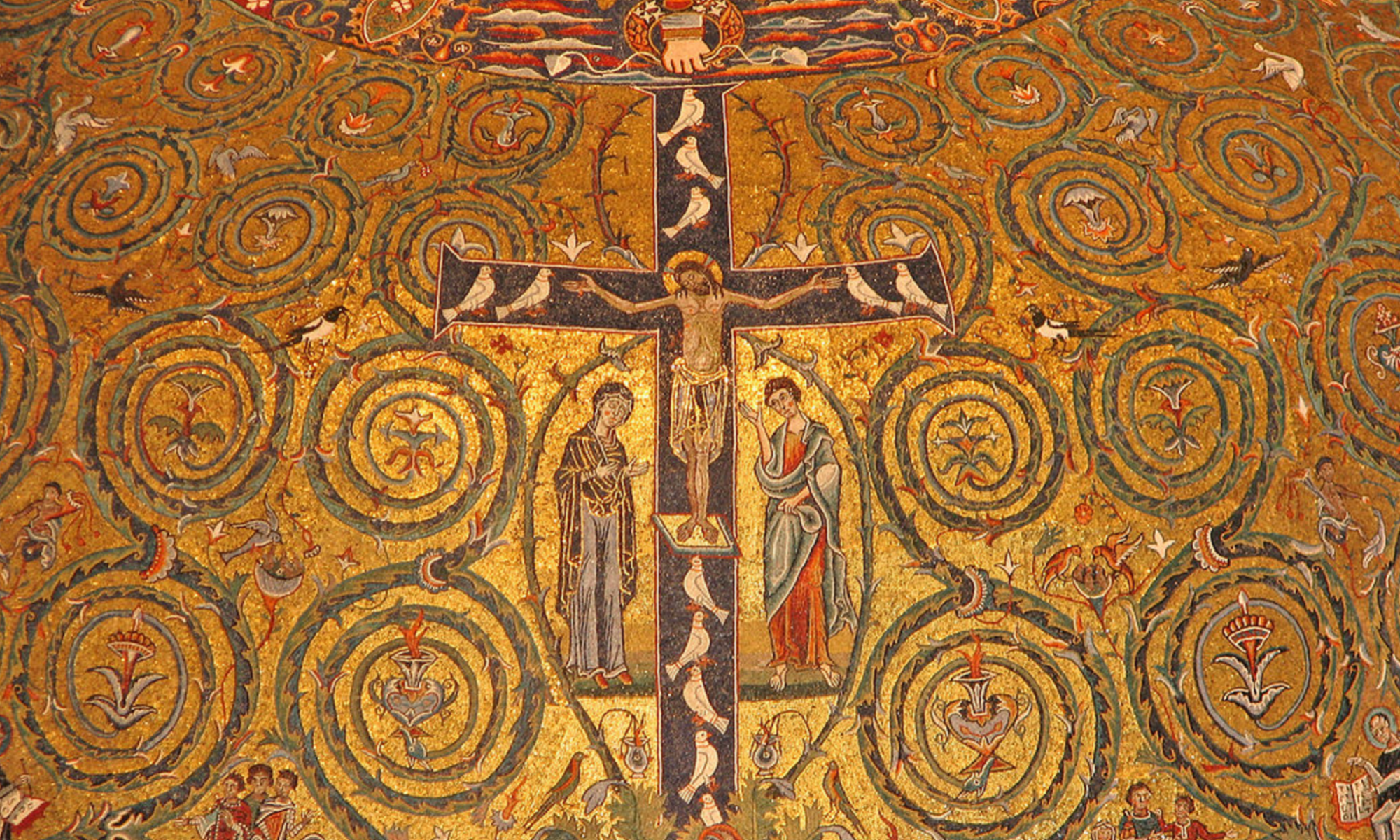
Good Friday. Damaged Goods. What happens when you put those two together?
An oxymoron becomes a paradox.
For those less familiar with literary terms, an “oxymoron” happens when you put two opposite words together and create a new meaning: jumbo shrimp, old news, pretty ugly, even odds, etc. In this case, “damaged” and “goods” are seen as incompatible – the damaged has vitiated the good.
That is exactly the story the devil wanted Adam and Eve to believe about themselves. It is the story Peter and Paul sometimes believed about themselves. Jesus shatters that story. He crushes the head of the serpent.
I would suggest instead that you and I (and every fallen human) are “damaged very goods.”
We are indeed shattered – not only by Adam and Eve’s sin, but by the particular ways that other human beings have harmed us and the particular ways we have harmed ourselves. Each of us has a personal story that is intermingled with the collective human story. When Jesus tells each and every story on the Day of Judgment, we will see with clarity just how much shattering happened for each of us – in the three or four generations preceding our arrival, in our tender years of childhood, in our moments of opening up in desire only to be crushed or betrayed, in our repeated stumbling and struggling, and in our rising again (and again and again).
We are damaged, yes, but we are “very good,” and the Lord never stops pursuing us. Moreover, each and every shard is “very good” – and without all the shattered pieces we cannot truly be ourselves. We desperately wish that we could shortcut the process, discarding or ignoring some of the pieces. We bury away the unpresentable parts and create a caricature of ourselves – perhaps one that looks great on social media or wins praise in our family, in our workplace, or in our churches. But God knows our entire self and will not rest until we are truly and completely made whole. It may take – indeed it will take nothing short of a lifetime.
This is the “long and exacting work” of human integration. The Catechism of the Catholic Church talks about it (nn. 2331-2347). The documents on Catholic seminary formation talk about it. And still, we look for the quick fix. We expect that we should just have it all together by now.
So many of the lives of the Saints need to be rewritten. Too often the story is told by narrators who want a shorter and easier path – one that avoids getting anywhere close to “damaged goods.” But we see in Jesus and Mary and the Saints that they are quite willing to feel powerless and be with others in their mess. They are not repulsed by struggle or weakness or sin. Indeed, they are drawn to human poverty because it is there that God loves us and blesses us – if we are to believe Jesus’ words in the Beatitudes!
The biblical stories do not sweep human sins and struggles under the rug. They do not pretend or compartmentalize. They do not fantasize about quick or easy transformation. They tell the story of very good men and women who shine with God’s goodness AND sin and struggle along the way – along a very, very long way: Abraham and Sarah, Isaac and Rebecca, Jacob and his sons, David, Peter, and Paul.
May we allow our shame to be set to the side – even if for brief moments. May we allow ourselves (ALL the parts of ourselves) to be seen and known, to experience honor and delight, goodness and connection. That process, in my experience, is a great tug of war. Most moments in which the greatest love gazes upon me are exactly the moments I want to hide the most – just like Adam and Eve in the garden, just like Peter in the courtyard. Even if I resist goodness and love a thousand times, that thousand-and-first time in which I let down my defenses allows me to taste and see that the Lord is superabundantly good – and that I am indeed his beloved.

 English